Blinds + Boss Blinds
The round structure. Each Ante is three Blinds: Small, Big, and Boss. Score thresholds escalate; the Boss Blind adds a run-warping modifier; the run is 8 Antes (24 Blinds total) to win.
The Boss Blind catalogue is the run's anti-build layer: 30 named modifiers that selectively punish whatever the player is leaning on.
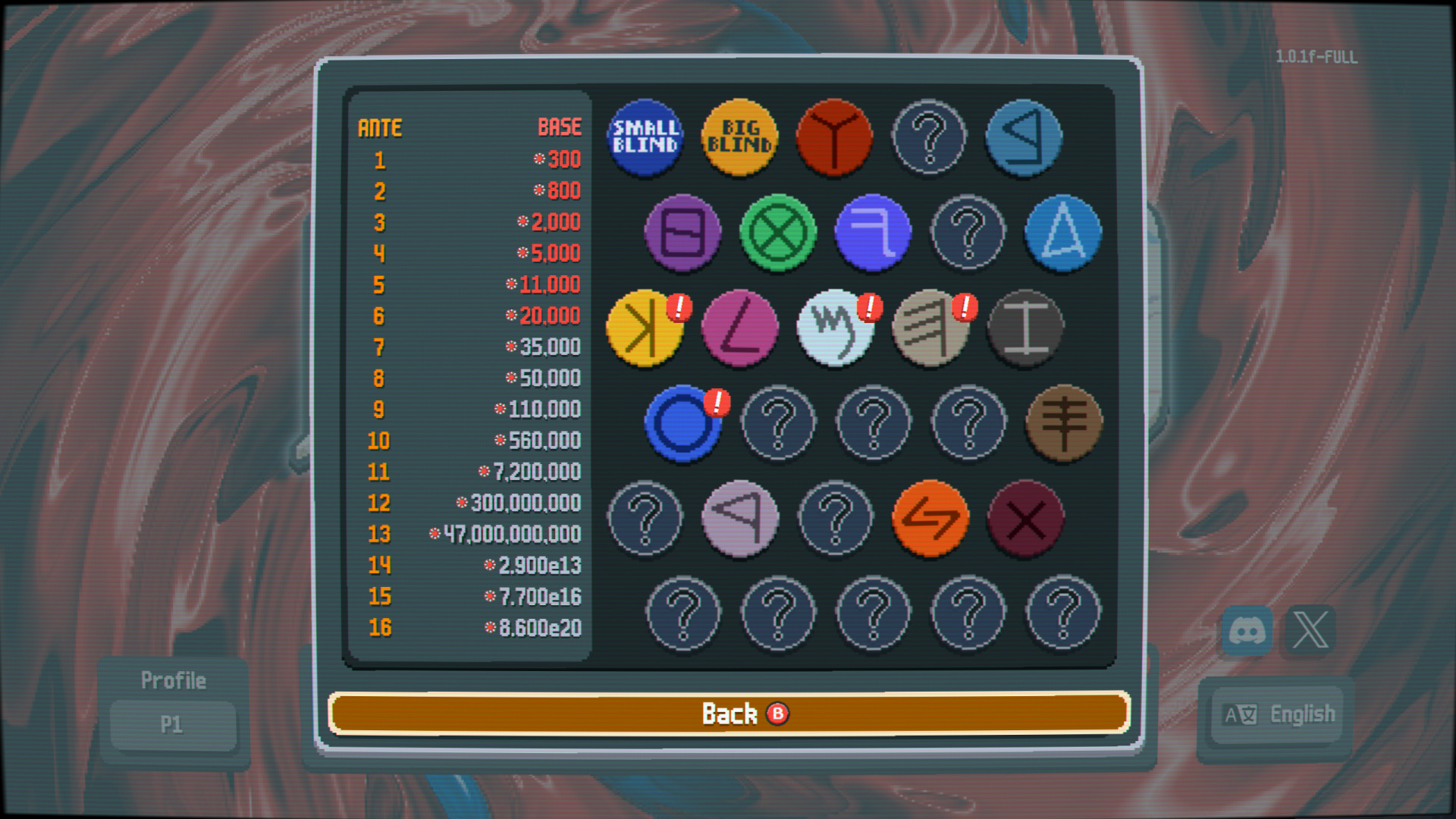 The Ante progression chart. Numbers stop being readable as integers at Ante 12. Endless mode is a leaderboard surface, not a finite-difficulty curve. Source: Game UI Database.
The score escalator
Each Ante's Small Blind = base; Big Blind = 1.5× base; Boss Blind = 2× base. So Ante 1 plays:
- Small: 300 chips
- Big: 450 chips
- Boss: 600 chips
Ante 8 plays:
- Small: 50,000
- Big: 75,000
- Boss: 100,000
Endless (Ante 9+) is exponential; the rate of growth approximately doubles per Ante.
Boss Blinds: the catalogue
There are 30 named Boss Blinds, each with a unique debuff. The Boss Blind is rolled at the start of each Ante (the player can see which Boss is coming). Examples:
| Boss | Debuff |
|---|---|
| The Hook | Discards 2 random cards from your hand at end of each round |
| The Wall | 4× chips required (this is additive to the 2× base) |
| The Wheel | 1 in 7 cards drawn flipped face down |
| The Window | All Spade cards debuffed (give no chips, no mult) |
| The Manacle | -1 hand size for the round |
| The Eye | No repeats: no playing the same hand type twice this round |
| The Mouth | Only one hand type can be played this round |
| The Plant | All face cards debuffed |
| The Fish | All cards drawn face down until played |
| The Goad | All Spades debuffed |
| The Water | Start with 0 discards (the canonical "lock the player out of their primary tool" boss) |
| The Tooth | $1 lost per card played |
| The Needle | Play only 1 hand |
| The Pillar | Cards previously played this round are debuffed |
| The Ox | Playing your most-played hand this round sets money to $0 |
| The Club | All Clubs debuffed |
| The Psychic | Must play 5 cards |
| The Wheel of Fortune | Random Joker is debuffed for the round |
| The Verdant Leaf | All cards debuffed until 1 Joker is sold |
| The Violet Vessel | 6× chips required |
| The Cerulean Bell | Forced random cards selected for play |
The full list is ~30 entries. Some bosses (The Wall, The Violet Vessel) crank the score requirement; others (The Hook, The Manacle) reduce the player's resources; others (The Goad, The Plant, The Window, The Club) selectively debuff card categories.
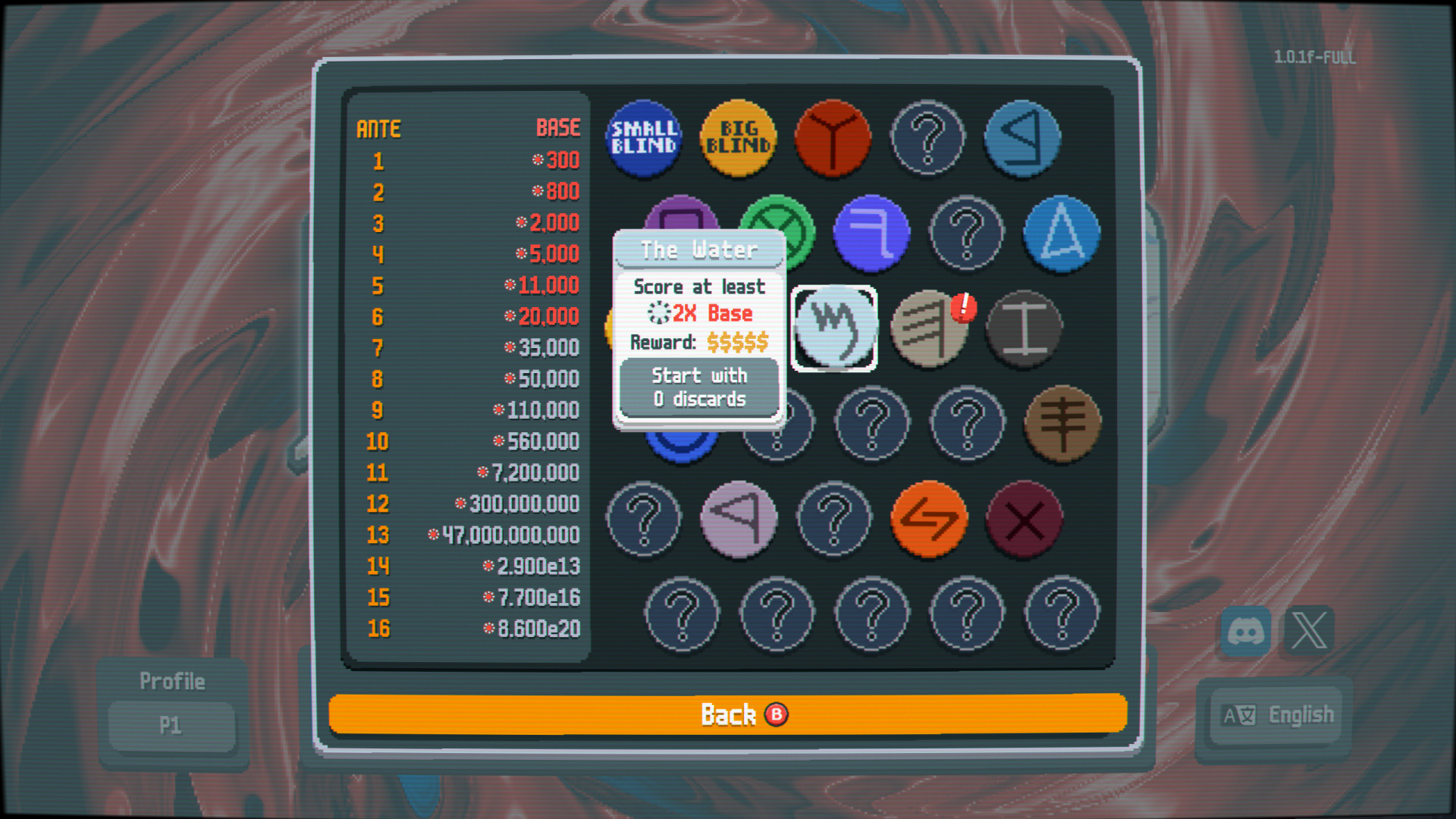 The Water boss tooltip. The single-line debuff "Start with 0 discards" is enough to break most discard-dependent builds for one round. Players have to commit to one good hand. Source: Game UI Database.
Why selective debuffs work
The boss-blind catalogue's structural cleverness: each boss attacks one specific build axis.
- A Spade-heavy build dreads The Goad / The Window.
- A discard-heavy build dies to The Water.
- A high-base-score build can shrug off The Wall.
- A Joker-stack build trembles at The Verdant Leaf (sell a Joker to release the debuff).
So the player's run is continuously stress-tested against axis-specific debuffs. A "perfect build" doesn't exist; even Sega's most-stacked engine has at least one boss that hits its weak point.
This is cumulative-modifier-staircase operating as an anti-build layer: the difficulty doesn't get harder uniformly; it gets targeted at the player's specific build.
The pre-Ante reveal
Crucially, the Boss Blind for the upcoming Ante is shown before you enter the Small Blind. Players see "Ante 3 Boss = The Water" while still on Ante 2's Big Blind, and can plan: this Ante I should bank cards for one big hand (since I'll have 0 discards on the Boss).
Without the reveal, players would adapt only after seeing the boss debuff. With the reveal, the entire 3-Blind sequence is shaped by the Boss's threat. Players will:
- Hoard Spectral consumables before The Water.
- Skip the shop reroll to bank dollars.
- Buy a specific Tarot to thin the deck before The Plant (face card debuff).
The reveal turns the Boss Blind into a planning constraint, not a surprise.
Skip option
Each Blind (Small, Big, Boss) can be skipped. Skipping forfeits the dollar reward and the shop visit, but progresses the Ante. Skipping pays a small bonus (a tag; see Tags below).
So a player with a strong build can skip the Small Blind to grab the Boss Blind reward without grinding through the Small/Big sequence.
The skip-tag interaction creates a sub-strategy: certain runs benefit from skipping aggressively (Tag-stacking builds), some from never skipping (interest-banking builds).
What this teaches
- Pre-revealing the threat changes the game from reactive to planned. Boss Blinds work because the player sees them coming. Hidden bosses would feel arbitrary; revealed bosses feel like puzzles.
- Selective debuffs are the right anti-build layer. Targeting build axes (suit, rank, hand type, joker count) instead of raw stat scaling produces continuous build stress-testing. No build is perfect; every Ante is a re-evaluation.
- A 30-boss catalogue is a lot, but the count earns it. Different bosses on different runs means even an experienced player still encounters fresh threats at run #50+. The boss roll is the variety axis.
- Score escalators don't need to stay realistic. Endless mode crosses 10²⁰ at Ante 16. The numbers are decorative at that scale; what matters is the percent of base the player can hit. Once you're ×100,000+ over base, the threshold is just decoration.
Patterns this exemplifies
cumulative-modifier-staircase: base score doubles per Ante, plus boss multipliers stacked on top. The clearest score-escalator pattern in the knowledge base.bonus-with-drawback: every Boss Blind is a forced negative modifier. Some can be partially mitigated; none fully avoided. The Verdant Leaf forces the player to sell a Joker to release the debuff, a real opportunity-cost trade.