Soul & focus
The healing system is the combat system. You heal by spending Soul; you generate Soul by hitting enemies. So mid-fight, every heal is a moment of vulnerability you have to earn first.
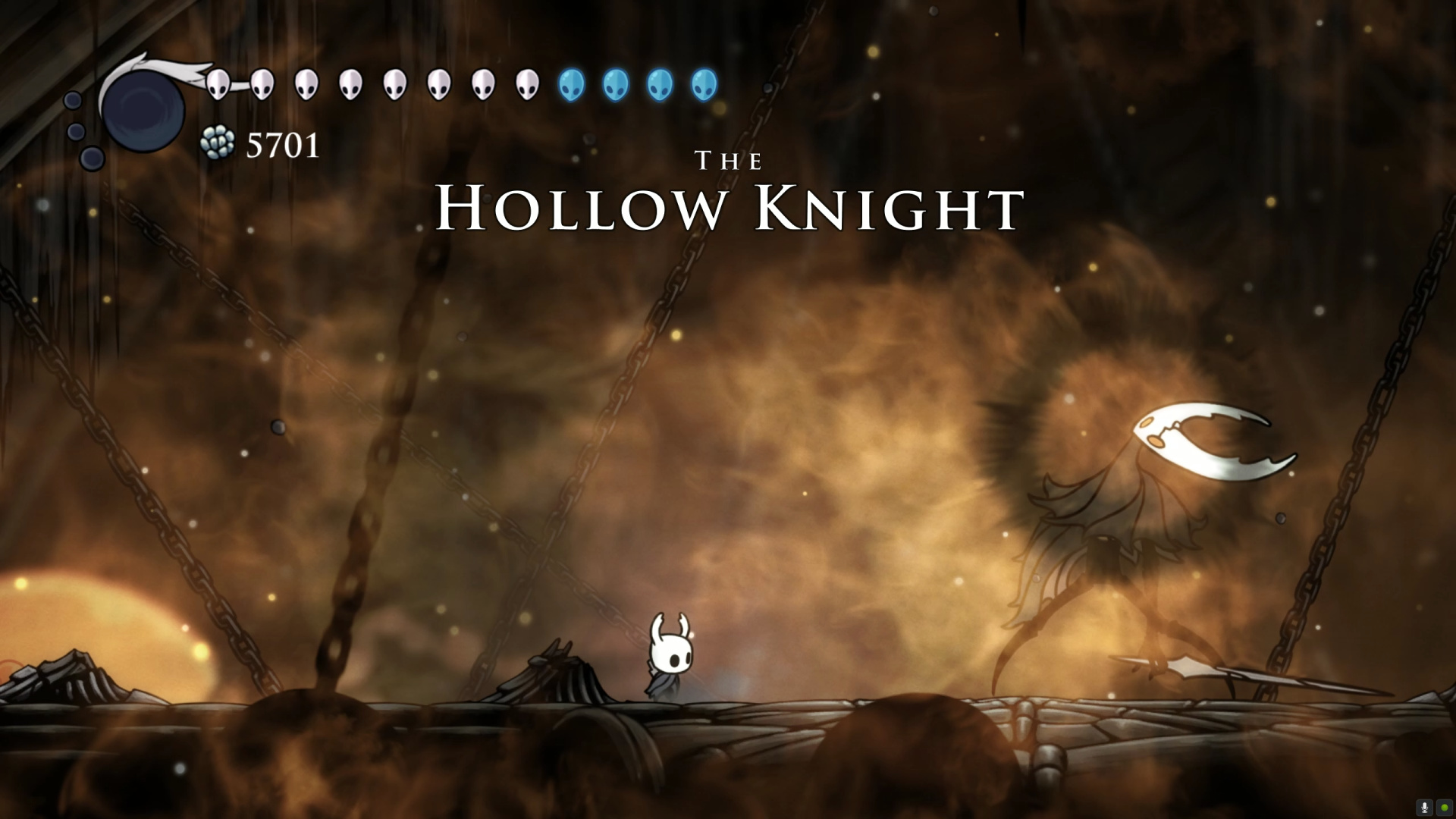 Boss intro for the eponymous Hollow Knight. Top-left: 11 mask icons (max HP, plus blue Lifeblood). To the right of those: Soul orbs (the dark circle = main Soul vessel, blue/white pellets = Spell uses) and the Geo counter (5701). The boss banner ("The Hollow Knight") names the enemy. Source: Game UI Database.
How Soul + Focus works
- Soul vessel caps at 99 (one main vessel, fillable to 33 by default; +33 per Vessel Fragment found, max 4 vessels).
- Hitting an enemy with the Nail generates Soul (~11 per hit base; +20% with Soul Catcher charm).
- Holding the Focus button consumes 33 Soul over ~1.5 seconds and heals 1 mask (HP).
- Focus locks the Knight in place: you can't move, can't attack, can't dodge.
- Getting hit during Focus cancels it and wastes the Soul.
So the heal decision is explicit risk management:
"I have 33 Soul. The boss is 6 frames into a wind-up. Do I have time for a Focus before they swing?"
Most boss fights become Soul economy puzzles: hit-and-run for Soul, find a 1.5-second opening, heal, repeat. The boss design is fully aware of this; many bosses have explicit post-attack recovery windows where Focus is safe.
Soul as build axis
Soul is the resource that fuels:
| Use | Cost | Effect |
|---|---|---|
| Focus (heal) | 33 Soul | +1 mask |
| Vengeful Spirit / Shade Soul (spell) | 33 Soul | Ranged projectile |
| Desolate Dive / Descending Dark | 33 Soul | Vertical AoE drop |
| Howling Wraiths / Abyss Shriek | 33 Soul | Upward AoE |
So the same 33-Soul pool fuels healing OR offense. Spend on a heal, you have less for spells. Spend on spells, you can't heal. Every Soul decision is a healing-vs-damage trade.
This is the fight's load-bearing tension. The combat is designed for it.
Charms that warp the Soul system
Several charms invert the Soul economy entirely:
| Charm | Effect on Soul / heal |
|---|---|
| Quick Focus | Focus completes faster (~1.0s instead of 1.5s) |
| Deep Focus | Focus heals 2 masks instead of 1, but takes longer |
| Soul Catcher | +20% Soul per hit |
| Soul Eater | +50% Soul per hit (4-notch, the heavy version) |
| Spell Twister | Spells cost 25% less Soul |
| Joni's Blessing | Removes Focus entirely: you cannot heal with Soul. +40% max HP as compensation. |
| Hiveblood | Last mask regenerates over time (alternative healing path). |
Each charm is a loadout decision that changes the basic combat feel. A Quick Focus + Soul Eater build heals constantly. A Joni's build never heals; you have to dodge perfectly. Two different games, same character.
Why this design works
It works because the design intent and the mechanical structure align:
- Combat is about earning the heal, not avoiding the hit. (Compare to: Dark Souls, where heals are flask-based and don't require offense.)
- The Focus animation is the punishment for greed. Try to heal while a boss is about to swing? You eat the swing, and the heal is wasted. Players learn pattern timing because the system requires it.
- The same resource fuels offense and defense. This is a scarcity-as-design move; PoE2's combat similarly forces resource allocation. (See
enemy-intent-telegraph: Hollow Knight bosses telegraph attacks to give Focus windows.)
Boss design = telegraphed Focus windows
Most major bosses in Hollow Knight follow a wind-up → attack → recovery pattern with recovery long enough for Focus. Players who learn boss patterns aren't memorizing damage; they're memorizing when the Focus window is safe.
This is the soulslike combat lineage applied at metroidvania scale: telegraph + dodge + counterattack + Soul-gain + heal. The pattern is widely imitated; Hollow Knight is one of the cleanest 2D-side-on implementations.
What this teaches
- A single resource fueling offense AND defense forces real decisions every encounter. Don't bifurcate health and mana if you want tense combat.
- Healing that locks you in place is dramatically more interesting than healing that's free. The 1.5-second Focus animation is a feature, not a UX problem.
- Telegraph + Focus-window design lets boss difficulty scale without cheap one-shots. Hollow Knight's hardest bosses are hard because their patterns leave fewer Focus windows, not because they hit harder.
Patterns this exemplifies
bonus-with-drawback: Joni's Blessing trades the entire heal system for HP. Soul Eater spends a 4-notch budget for Soul-gen.enemy-intent-telegraph: boss design uses wind-ups + recovery to make Focus windows readable. Soulslike combat in metroidvania form.