Through the ludonarrative resonance lens
A reading of Moonlighter 2's mechanics through the ludonarrative resonance lens, does what the player does affirm what the game says it's about?
Mechanic read: the dual-life loop, the backpack puzzle, and shop pricing.
Verdict: Affirms. The fiction is "Will/Teagan runs the shop by day and dungeons by night to fund it." The mechanics are this, not metaphorically, structurally. The day/night split is a literal halving of gameplay; the backpack puzzle is the act of physically packing loot before sale; pricing is reading customer faces.
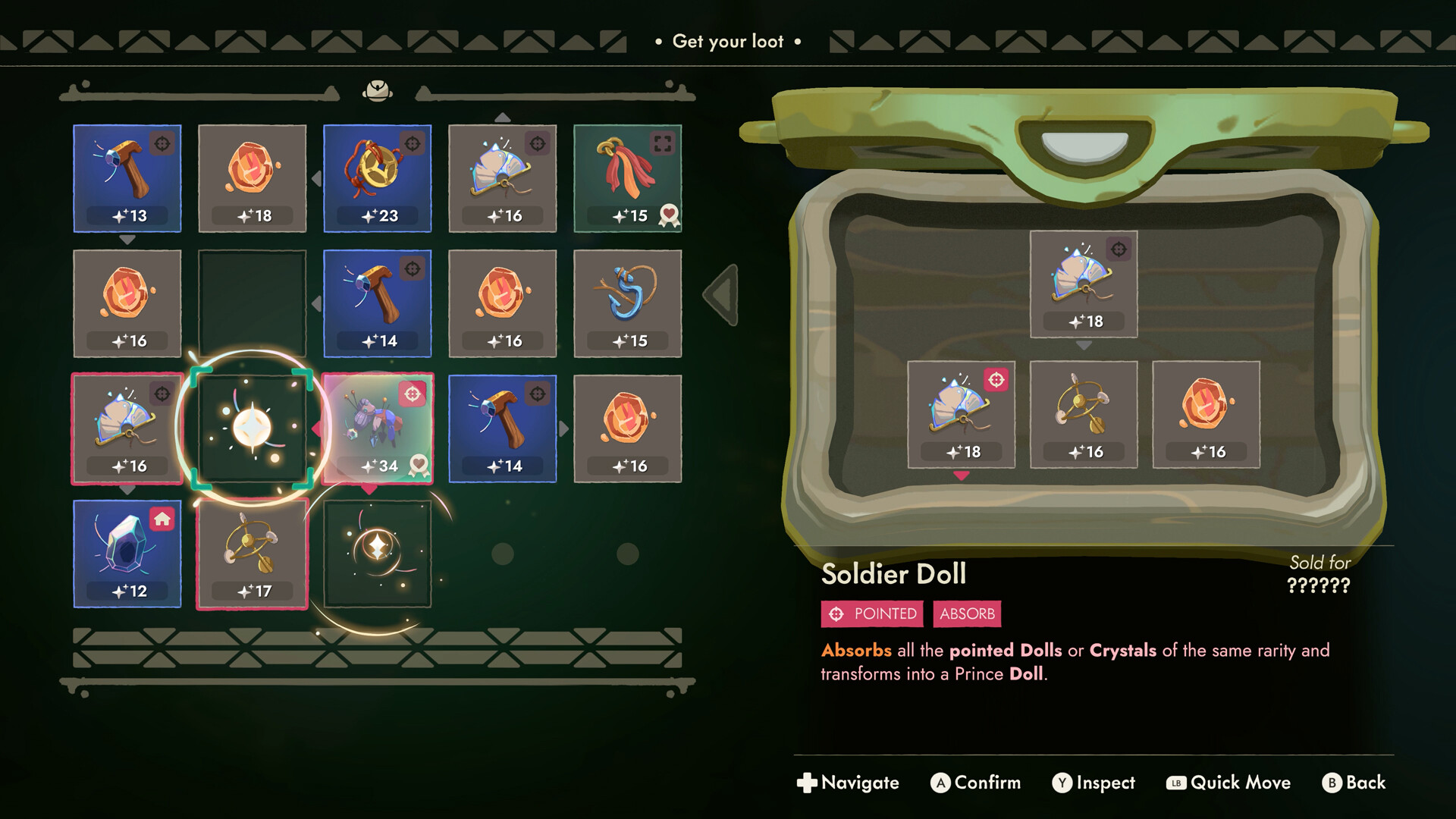 The backpack: you don't have a flat inventory and a separate shop. You have a packing puzzle whose adjacency rules determine what survives the trip back. The puzzle is the shopkeeper's act. Source: Steam.
Why it lands
The lens diagnostic is describe the loop without the fiction; does it still read as a story about this character? For Moonlighter 2:
You enter a dungeon at night. You kill enemies. You carefully pack loot into a grid where placement matters. You return at dawn, place the items in display cases, set prices, and watch customer reactions to decide who's bluffing.
That description is the game and the protagonist's narrative position. There is no gap between "what the player does" and "what the character does." The shopkeeper-by-day-dungeon-runner-by-night frame isn't decoration; it's the structure of the gameplay's halves.
Specific resonance moments:
- Backpack as sales prep. A traditional roguelite has a flat inventory. Moonlighter has a physical grid where placement triggers synergies (POINTED, ABSORB, corner, row). Fictionally, this is what packing a haul for resale would feel like: adjacency matters because items damage each other, complement each other, or stack value. The puzzle isn't a UI; it's the shopkeeper's workspace.
- Shop pricing as customer-reading. Customer faces tell you whether your price is a gift, fair, or too high. You watch the body language of fictional NPCs and adjust. The mechanic is haggling-as-microexpression, exactly what running a shop in a fantasy town would actually demand.
- Dual-life as enforced rhythm. You can't skip either side. The dungeon haul needs to come back, and the shop day needs its inventory. The fiction's "two lives" is a hard mechanical constraint, not a thematic flavour.
What makes the resonance dense, not nominal
Compare the failure mode: a roguelite where you fight in dungeons and a shop is a between-runs vendor screen. That game has a shopkeeper character in the fiction and no shopkeeping in the mechanics. The fiction is decoration; the loop is action-roguelite-plus-vendor.
Moonlighter 2 instead made the shop the other half of the loop, with its own mechanics, its own puzzles, its own rhythms. The day's pricing decisions feed the night's dungeon budget; the night's loot determines tomorrow's display. Each side mechanically depends on the other. The fiction's claim that Will/Teagan lives both lives is something the gameplay schedule enforces.
What the loop says
I am a shopkeeper who needs stock. The dungeons have stock. The packing matters because the way I bring things home determines what they're worth on sale. The pricing matters because customers are real people who will leave if I'm greedy.
That describes the gameplay and the fiction simultaneously.
Where it could have failed
The same game with a flat inventory and a "set a default price" UI is competent roguelite design but a different game. Each mechanical decision toward physicalising the shopkeeper's work is what makes the resonance dense. The lens is what diagnoses why "small UI conveniences", auto-pricing, infinite inventory, one-click sale, would each individually weaken the game's identity.
See also
- Mechanic pages: Dual-life loop, Backpack puzzle, Shop & pricing
- Lens (overview): Ludonarrative resonance
- Adjacent pattern:
loadout-as-budget: the backpack puzzle is one of its variants; the lens explains why the spatial version of the budget feels diegetic in a way a pure numeric budget wouldn't.