Through the ludonarrative resonance lens
A reading of the Xenoblade series's mechanics through the ludonarrative resonance lens, does what the player does affirm what the game says it's about?
Mechanic read: each entry's signature system, Vision (XC1), Driver-Blade pairing (XC2), Class & Ouroboros (XC3), Skells & FrontierNav (XCX).
Verdict: Affirms, and deliberately, across four entries. Monolith Soft's signature design move, repeated for fifteen years: each entry's load-bearing mechanic is also its load-bearing fiction beat. The series is the cleanest worked example on the site of "design the signature system to be the story's central image."
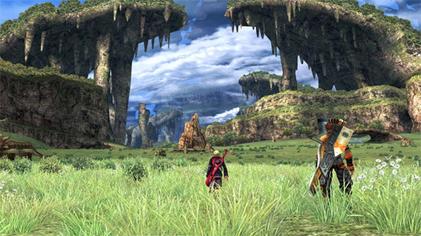 Two characters on the leg of a god-corpse, looking at another god-corpse. The fiction (you live on a dead god) is also the world geometry: and the signature mechanic of each entry is similarly the signature image of its plot. Source: Wikipedia.
Why this is unusual
Most series reskin a stable mechanic across entries (Mega Man Battle Network's 6×3 grid; Hades's death-as-narrative; PoE's passive tree). Xenoblade does the opposite: each entry invents a new signature mechanic, and that mechanic is the one the entry's fiction is most about. The mechanic is not chosen for combat-design reasons; it's chosen because it is the playable image of what the entry is saying.
Read each entry through the lens individually:
XC1: Vision system
Verdict: Affirms perfectly.
Shulk wields the Monado, a sword whose canonical power is precognition, he sees the future. Mechanically, the Vision system shows you enemy attacks 5-10 seconds before they happen, with their damage and target preview. You react by repositioning, popping defensive arts, or ordering a party member to draw aggro.
The mechanic is the fiction. The plot keeps revealing what Shulk's precognition can and can't do, and the gameplay re-states this every fight: "you saw the future; now you have time to act on it." A standard JRPG would have the precognition exist only in cutscenes (Shulk has visions during plot beats; combat is normal). Monolith made the cutscene-power the combat-mechanic. The lens calls this the rare case of the fiction's signature image being mechanically literal.
XC2: Driver-Blade pairing
Verdict: Affirms.
Blades are weapons that are also people, partners bonded to a Driver. The fiction is "you fight alongside a Blade you have a personal connection to." Mechanically, the Driver-Blade pair is a unit: you switch Blades to switch element/weapon-type/playstyle, but the pairing produces unique combo arts only that pair can pull off. The Pyra/Mythra/Rex relationship is both the central romance arc and the player's combat loadout.
A weaker version of XC2 has the Blades as item-grade weapon swaps. The actual XC2 makes the Blade a character with whom you have field-skill conversations, NG+ trade decisions, and unique Heart-to-Heart cutscenes that gate Blade-specific Affinity progress. The fiction's claim that you are bonding with this person is mechanically substantiated.
The Rare Blade gacha element complicates this, the lens would note that summoning Blades from a randomised pool is a less-resonant mechanic than the rest of the system. The fiction doesn't really say "Pyra crystallised because of summoning RNG." But the pairing mechanic, once you have the Blade, lands.
XC3: Ouroboros
Verdict: Affirms hard.
The fiction: six soldiers from two warring nations are trapped together. They were raised to kill each other. Over the campaign they discover they can interlink into fused forms (Ouroboros), paired into three units, each pair a literal mechanical fusion of two characters' arts and stats.
The mechanic is the political plot's central image. Two enemies-by-design merging into one entity to fight a shared threat is the entire premise of the game. A standard JRPG has cutscene-friendship arcs that the combat doesn't deliver. XC3 made the friendship arc a transform sequence with stats. Six characters / three Ouroboros pairs mirrors the cast-pairing structure of the writing: Noah-Mio (Keves-Agnus, the central pair), Lanz-Sena, Eunie-Taion. The mechanical fusions are the writing's pairings.
XCX: Skells & FrontierNav
Verdict: Affirms (more weakly).
The fiction: you are a colonist on alien planet Mira, surveying it for resources, building infrastructure to support the colony. Mechanically, FrontierNav is a probe-network mini-game where you place data probes on hex-tiles to extract resources funding base operations. Skells are mech suits you license ~30 hours into the game, after surveying enough to justify them. The signature image (settler-on-Mira) is the loop (survey, probe, mech-up, expand range).
This affirms more weakly than XC1-XC3 because the fiction itself is thinner, XCX has less character-driven story than its siblings, leaning instead into the colonisation-and-survey atmosphere. But within that thinner fiction, the mechanics still reflect what the story says: you are colonising; you are surveying; you are funding the base.
What the lens diagnoses about the series
Most series re-use a mechanic. Monolith Soft re-uses a design move: "make the signature system the plot's central image." This is a meta-level resonance. They've shipped this commitment four times, in four different mechanic shapes, with the consistency of a studio that plans this from the start of each project.
For designers, the takeaway is the meta-move: which one mechanic in your game is doing the most fiction-work? Make sure that mechanic is also the one your plot's central image is about. If your protagonist's defining trait is precognition and your combat is generic, you have a fiction-mechanic gap. Xenoblade's career is a case study in closing that gap deliberately, every time.
What the loop says
Each entry, in turn:
- XC1: I see the future. I act on what I see.
- XC2: I fight alongside someone I have bonded with.
- XC3: I was raised to kill these people; we discovered we are stronger when we fuse.
- XCX: I am a colonist surveying an alien planet so my people can live here.
Each sentence describes both the gameplay and the entry's plot.
Where it could have failed
The same series with a stable combat shell across all four entries would have been competent and forgettable. The decision to invent a new signature each entry that matches the entry's specific fiction is the move that makes the series identifiable. The lens names why.
See also
- Mechanic pages: Combat foundation, Vision system (XC1), Driver-Blade pairing (XC2), Class & Ouroboros (XC3), Skells & FrontierNav (XCX)
- Lens (overview): Ludonarrative resonance
- Adjacent pattern:
late-introduced-mechanics: Xenoblade's other signature move; the lens explains why the late-introduced mechanic so often is the entry's biggest narrative pivot.