Vision system (XC1)
The signature mechanic of the original Xenoblade Chronicles. Shulk's sword (the Monado) gives him precognition: he sees enemy attacks ~5 seconds before they happen, and the rest of the fight is about preventing the future he just saw.
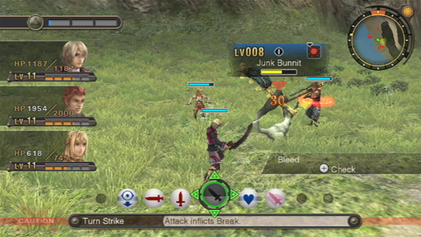 The player has just received a Vision: an arrow icon points to a party member, and a banner reads "Attack inflicts Break." The next 5 seconds are about changing that future: by shouting a warning to the targeted party member, switching their gear, or healing them up before the strike lands. Source: Wikipedia.
How it works
Mid-combat, when an enemy is about to use a high-damage attack:
- Time stops. A short cinematic plays showing the attack landing on a specific party member (or the whole party).
- A damage number is shown, plus the status effect (Break, Topple, Sleep, etc.) the attack would inflict.
- Time resumes. The player has roughly 5–15 seconds to prevent the future they just saw.
Tools to prevent it:
- Aggro shift: pull the enemy onto the tank instead of the squishy support.
- Shouts: Shulk has a "Warn" art that grants the targeted ally a buff; another character can use a Talent Art to draw aggro.
- Buffs / heals: Buff the target to survive, or pre-heal so the inevitable hit isn't fatal.
- Interrupts: Some arts cancel the enemy's wind-up entirely; "Topple" the enemy before they swing and the Vision becomes moot.
- Monado modes: Shulk can switch the Monado to a mode that grants party-wide buffs against the specific damage type the Vision predicted.
If the player does nothing, the future plays out exactly as shown. If they act correctly, the Vision is replaced by a different (often less-bad) future.
Why this is a textbook telegraph
This is enemy-intent-telegraph cranked to its narrative limit. Slay the Spire shows you an icon; PoE2 shows you a wind-up animation; Xenoblade shows you a cinematic of the actual outcome with the damage number rendered.
What it solves:
- High-skill ceiling combat without high reflex demand. The player has time to think. The challenge is reading the situation and finding the cheapest counter, not pressing the right button in 200ms.
- Death feels earned. When you take a fatal hit, you almost always saw it coming and failed to act. Frustration shifts from "the game cheated" to "I didn't prepare."
- Mid-combat replanning. Visions force the player to break out of an attack rotation and adapt. A fight that's been going well for 90 seconds can change shape entirely the moment a Vision drops.
- Lore integration. The Vision system is also the central narrative conceit (Shulk's prophetic Monado, the question of whether the future can be changed, the climactic confrontation with a god who also sees the future). Mechanics-and-narrative interlock cleanly.
This is rare in games. Mechanics often gesture at the lore; XC1's lore is the mechanic and vice versa.
How later entries handle the same problem
The Vision system was not carried forward as a literal mechanic into XC2, XC3, or XCX. The series replaces it with subtler telegraphs:
- XC2: enemy attack wind-ups + visible AoE markers; some bosses telegraph "Break Resist" / "Topple Resist" as a phase indicator.
- XC3: same wind-ups + chain-attack predictive overlays during the menu.
- XCX: wind-up animations only; XCX is more action-leaning generally.
So the Vision system is specifically XC1's signature, and the rest of the series treats "you can see the future" as a narrative device when it appears, not a combat device. The trade-off the later games made: speed up combat, accept less prep-driven decision-making.
Compared with the broader telegraph family
| Game | Telegraph form | What player solves |
|---|---|---|
| Slay the Spire | Icon above enemy showing next action | Allocate energy this turn |
| MMBN | Tile flashes / row highlights on the 6×3 grid | Where to stand |
| PoE2 | Boss wind-up animations + ground markers | When to dodge-roll |
| Xenoblade Chronicles 1 | Full cinematic of the future hit with damage number + status | Replan the next 5–15 seconds |
Xenoblade gives the player the most information of any telegraph in this knowledge base, and gives them time to act on it. It's the heaviest, most-deliberate telegraph in the genre.
Why it's hard to copy
The Vision system requires three things working together:
- A combat system slow enough that a 5-second prep window is meaningful. Action combat doesn't have that window; the hit has already landed.
- A toolkit of cheap-to-execute mid-combat options. Shulk's "Warn" / aggro shifts / buffs are designed for the Vision; a game without those would just have an inert "you'll die in 5s" notice.
- Lore that justifies it. A future-sight ability needs a reason. Without narrative anchoring, "you see the future" feels like a game-y crutch.
Most games can't satisfy all three. That's why the Vision system has been admired but not directly imitated.
Patterns this exemplifies
enemy-intent-telegraph: the most narrative-rich case in the genre.bonus-with-drawback: the Monado has requirement states (charge, mode-locked) that gate when Visions and Monado arts can fire. Power with hard limits.