Mega Man Battle Network (series)
Six mainline games, 2001–2005, one game a year, one engine. Capcom welded their action-game reflexes onto a TCG-style chip-folder economy and shipped it on the GBA. The result is one of the cleanest examples of action + card hybrid ever made, and a 5-year iterative case study where the team kept the core combat shell frozen and refined every meta-system on top until BN6 found the synthesis.
Treated here as a single series entry tracking how each system evolved across BN1 → BN6. Re-released as the Legacy Collection (April 2023) on PC / Switch / PS4.
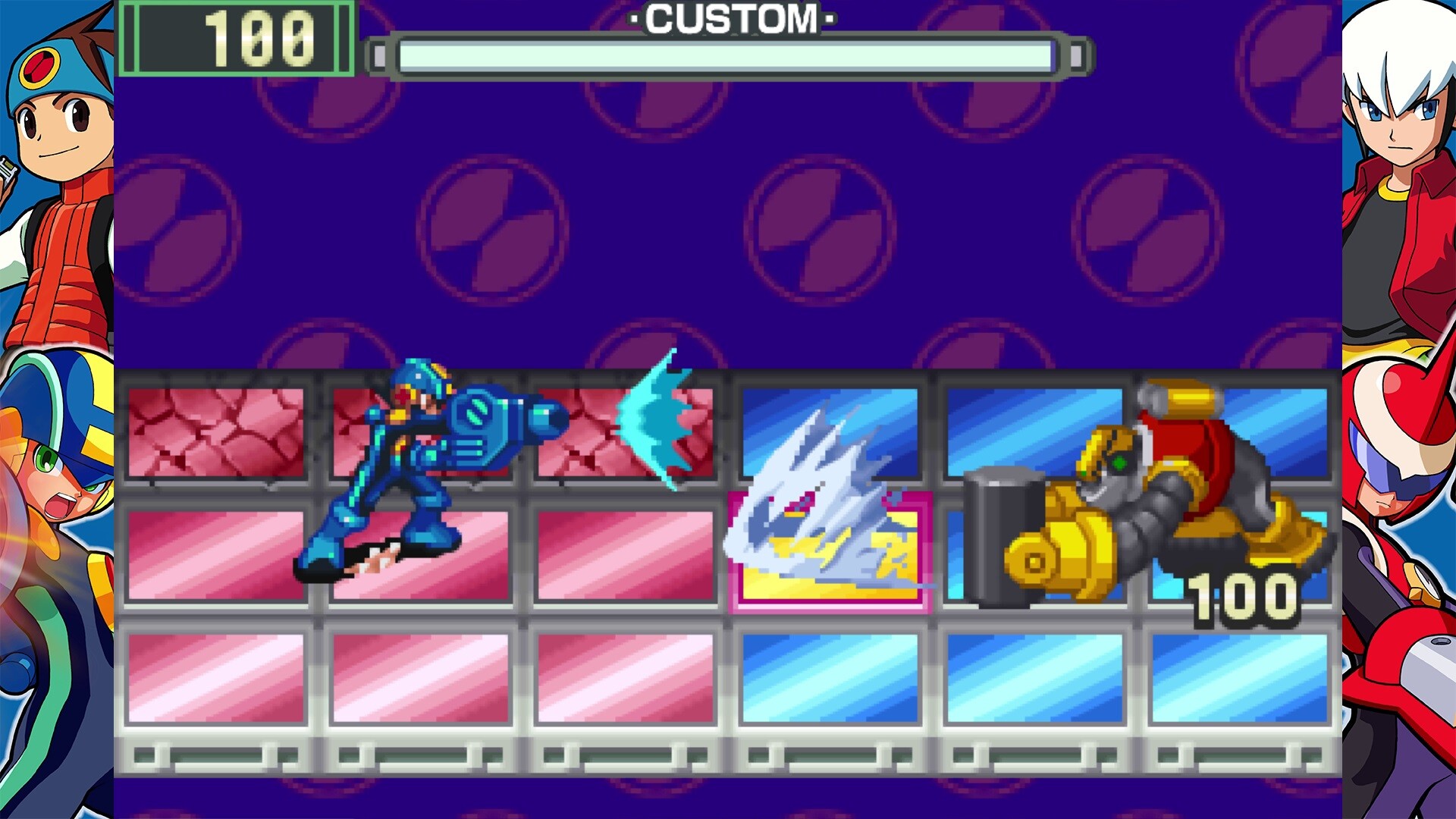 The single iconic frame of the entire series: 6×3 grid, Custom Gauge across the top, MegaMan firing his buster, an enemy queued on the right. The Gauge fills in real time; tap Custom and the action freezes to draw a new hand of chips. Source: Steam (Legacy Collection Vol. 1).
Snapshot
| Studio | Capcom |
| Released | BN1: 2001 · BN2: 2001 · BN3: 2002 · BN4: 2003 · BN5: 2004 · BN6: 2005 (re-released 2023 as Legacy Collection Vol. 1 [BN1–4] + Vol. 2 [BN5–6]) |
| Director | Masakazu Eguchi (series) |
| Producer | Keiji Inafune |
| Platforms | Original: GBA · Legacy Collection: PC / Switch / PS4 |
| Run length | Battle: ~30s–3min · Campaign: ~25–35 hrs per game · Series: ~150 hrs |
| Iconic mechanic | 6×3 real-time grid combat + Folder of Battle Chips + Custom Gauge |
| Core dialectic | Action reflexes + card-game collection: combined, not alternated |
| Genre that didn't exist | "Action + Card Hybrid": Eguchi's own framing. No predecessor; few imitators. |
Macro loop
Overworld (Lan), talk to NPCs, accept jobs, plug into devices via "Jack-In"
  ↓
Cyber World (MegaMan.EXE), explore network, hit virus encounters
  ↓
Battle (6×3 grid, real-time)
  → Hand of chips drawn from your 30-card Folder
  → spend Custom Gauge to draw new hands
  → manage panels, status, dodging, and PA recipes
  → win → loot more chips, drop bigger boss chips
  ↓
Folder edit (between battles, between bosses)
  → tune your 30-chip deck for upcoming opponents
  ↓
NaviCust (BN3+), block-puzzle inventory for stat / ability upgrades
  ↓
Power forms, Style Change (BN3) → Soul Unison (BN4–5) → Cross + Beast (BN6)
  → another meta-progression layer
Mechanic deep-dives
- Battle system: 6×3 real-time grid + the Custom Gauge rhythm.
- Folder & chip codes: 30-chip deckbuilding constrained by letter codes.
- Program Advance: undocumented multi-chip combo recipes.
- NaviCust: block-puzzle stat upgrades. The genre-bridging move.
- Power forms: Style → Soul → Cross → Beast Out, the BN3→BN6 evolution.
- Series evolution: what each entry kept, changed, walked back.
Through other lenses
- Ludonarrative reading: these mechanics read through the resonance lens. Verdict: affirms, fiction-as-mechanics with no translation step; the verbs are literal programmer-verbs.
What this game teaches
- Pause-to-draw inside real-time combat is the defining hybrid move. The Custom Gauge is the only "draw step" mechanic I've seen that's literally embedded in a real-time fight. Players attack and defend the gauge as a resource, not just a timer.
- Code-constrained deckbuilding is a different shape than Spire or MTG. Letter codes mean two chips that share a name OR share a code can be played together: so Folders converge on archetypes ("mono-B", "mono-★") for combinatorial reasons, not just synergy reasons.
- NaviCust is a textbook grid-inventory: the same family as Sparklite's patch-board and Moonlighter 2's backpack puzzle. Tetris-shaped programs on a grid, with adjacency rules; violations cause Bugs (debuffs), not failures. Players can opt into chaos for a buff slot. Ships in 2002, predates both.
- Yearly iteration on a frozen core works: BN1 → BN6 kept battle + Folder unchanged and refined the meta-progression layer (NaviCust + transformation systems) every year. The BN6 final design is the synthesis: always-available baseline form (Cross) + high-stakes consumable (Beast Out) + self-balancing downside (Bug Out timer).
- Bug Out is one of the cleanest
bonus-with-drawbackimplementations in any action game: Beast Out gives you a super-form and a forced fallback debuff state when the timer runs out.
See lessons for the longer take.