Warframe
Twelve years of accreted systems on top of a co-op looter-shooter spine. The game most worth dissecting if you want to understand how to keep multiple progression systems coherent over a decade. Also home to one of the cleverest F2P economies ever shipped.
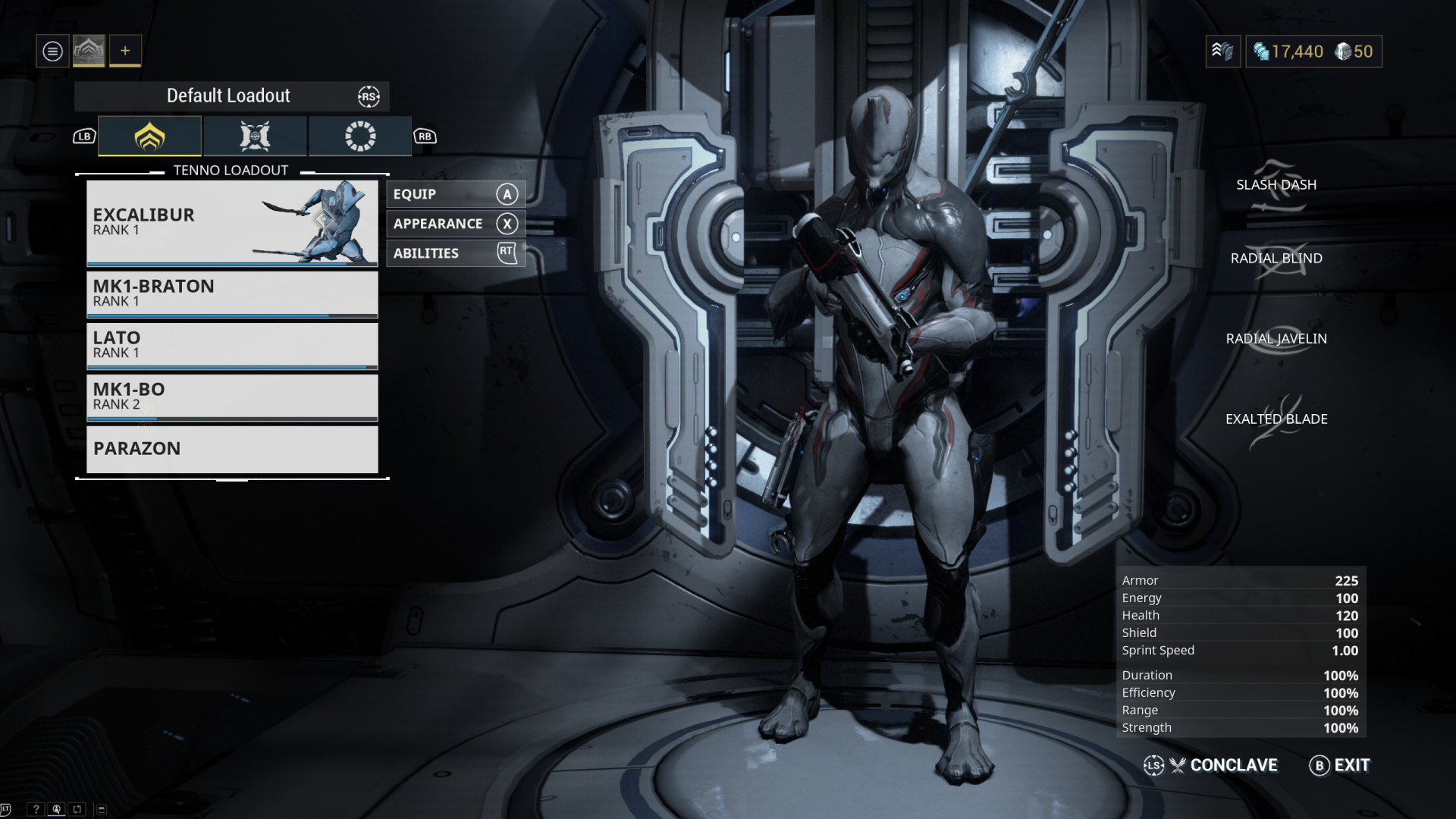 The loadout summary screen: frame + 3 weapons + companion. Each slot has its own progression chain (acquisition → leveling → modding → Forma). Source: Game UI Database.
Snapshot
| Studio | Digital Extremes (London, Ontario) |
| Released | March 2013 (still in active development) |
| Platforms | PC, PS4/5, Xbox, Switch, mobile |
| Run length | 5–20 min per mission |
| Iconic mechanic | Forma + Riven Disposition |
| Core dialectic | Power fantasy vs grind |
| Business model | F2P + Platinum (premium, tradable) + Prime Access subscriptions + cosmetics |
| Setting | The Origin System. Warframes are bio-mech suits piloted by Tenno. |
Macro loop: five nested loops
Warframe isn't one loop, it's five concurrent loops, each feeding the next:
1. Mission loop (~5–20 min)
   pick a node from the Star Chart → fight → extract
   rewards: credits, mods, resources, sometimes a relic or part

2. Build loop (~hours to days)
   farm parts/blueprints → submit to Foundry (12h weapons, 12h frame parts, 72h frame assembly)
   level the new gear from 0→30

3. Modding/optimization loop (~tens of hours per build)
   farm mods → fuse them up → polarize slots with Forma (each Forma resets gear to 0)
   chase Riven mods, re-roll Riven stats with Kuva, slot Arcanes

4. Mastery loop (~hundreds of hours, the meta-progression)
   rank EVERY weapon/frame/companion to 30 once → +Mastery Points
   MR gates equipment, syndicate caps, daily standing caps, Steel Path

5. Live-service loop (~weekly/seasonal/quarterly)
   daily login tribute, Nightwave seasons, Riven dispositions rebalance, new frame cadence
The Foundry's real-time wait detaches "I farmed this" from "I'm using this", which forces players to multi-task across loops, or pay Platinum to skip.
Mechanic deep-dives
- Acquisition pipeline: blueprints, Foundry, Void Relics. The canonical loot example.
- Modding system: capacity, polarity, Forma, Rivens, Disposition. The actual core game.
- Progression layers: Mastery, Focus, Arcanes, Helminth, Steel Path. A graph, not a track.
- Reward & retention loops: daily/Nightwave/Sortie/Prime Access cadence.
- Monetization model: "the cleverest economy in F2P."
- Combat: bullet-jumping, damage matrix, 4-player co-op.
Through other lenses
- Ludonarrative reading: these mechanics read through the resonance lens. Verdict: split, cinematic-quest peaks resonate hard; the median minute of farming is orthogonal. The intermittent case.
What this game teaches
- A massive system stays coherent if every layer is roughly orthogonal: Mastery doesn't compete with Forma doesn't compete with Rivens.
- Convert "time spent" into permanent slot expansion via a consumable. Forma is one of the best designs in live-service.
- Soft balance is better than nerfs. Riven Disposition rebalances power without touching base stats. Players hate nerfs; they accept Riven Disposition shifts.
- Let players trade premium currency. Counter-intuitive, but it makes the F2P economy self-balancing instead of zero-sum.
- Don't punish lapsed players. Daily login is milestone-based, not streak-based. Missing a day costs nothing.
See lessons for the longer take.