Clair Obscur: Expedition 33
A ~30-person French studio's first game swept Game of the Year at every major 2025 ceremony and sold 8 million copies in a year, on the back of one central bet: turn-based combat where the defender is never idle. You pick actions from menus, but every enemy attack is dodged, parried, or jumped in real time, and every skill lands harder if you press the button on the beat. It's in the knowledge base as the strongest recent proof that "dated" genre conventions are usually just unexamined ones, and as a masterclass in layered build systems (Pictos → Luminas) and per-character mechanical identity.
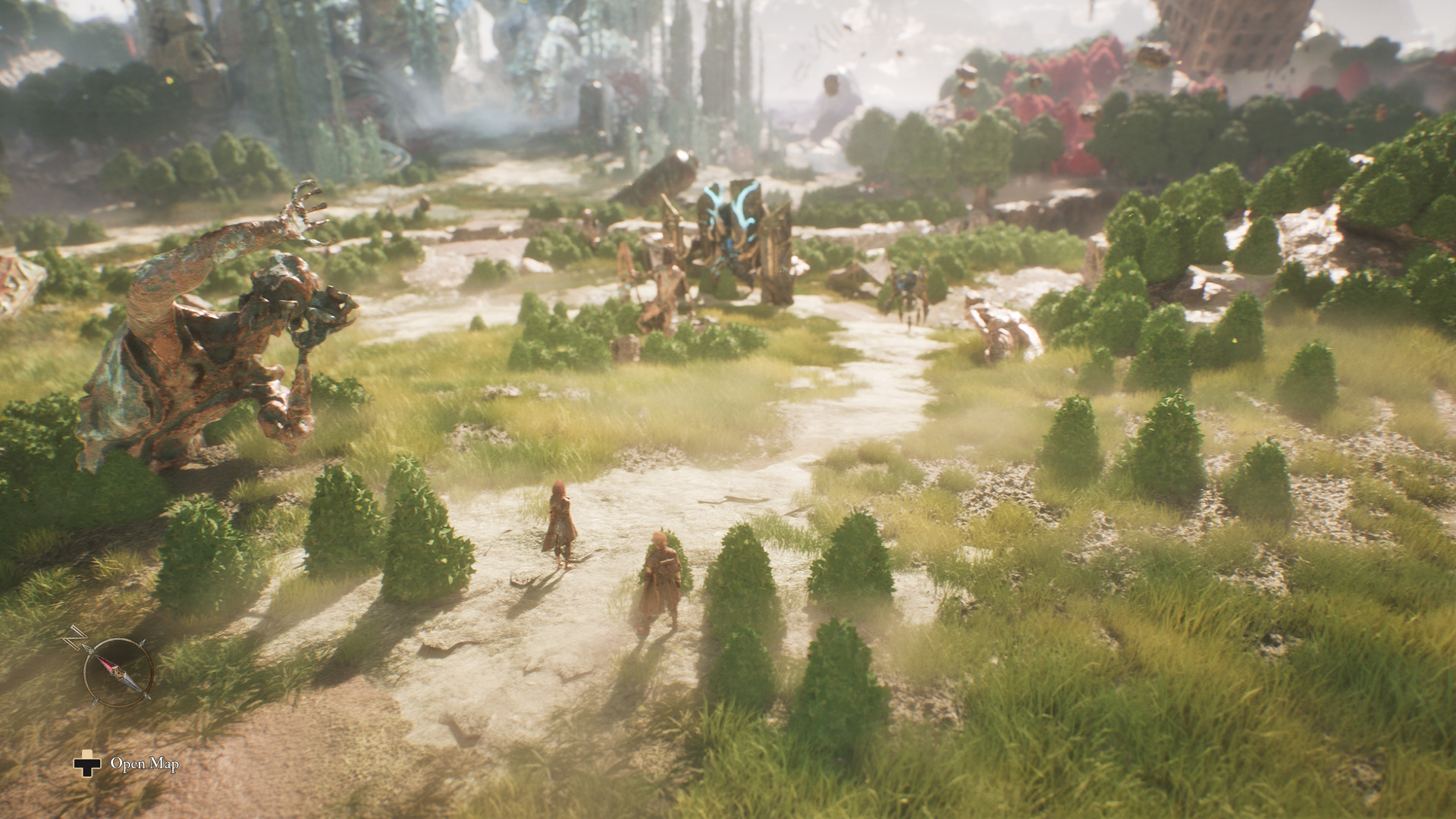 The Continent overworld: the party walks a miniaturized painted world between full-scale levels. Source: Game UI Database.
Snapshot
| Studio | Sandfall Interactive (Montpellier, ~30 core devs + outsourcing) |
| Publisher | Kepler Interactive |
| Released | April 24, 2025 (PC, PS5, Xbox Series, day-one Game Pass) |
| Engine | Unreal Engine 5, Blueprint-heavy workflow |
| Budget | Under $10M |
| Run length | ~30 h main story, 60+ h with endgame |
| Iconic mechanic | Reactive turn-based combat: real-time parry/dodge inside menu combat |
| Core dialectic | Plan in turns, survive in real time |
| Inspirations | Final Fantasy VIII–X (structure), Persona 5 (UI, battle camera), Sekiro (parry), Paper Mario / Lost Odyssey (timed hits) |
| Reception | Metacritic ~92, TGA 2025 GOTY (9 wins), BAFTA Best Game, 8M+ sold in year one |
Macro loop
Lumière prologue → the Continent (expedition of 33-year-olds; everyone older is already gone)
  → overworld map: walk between regions, visible monsters, optional detours
    → region/level (hand-crafted, linear-ish, deliberately no minimap)
      → expedition flag: rest, refill tints, spend attribute/skill points
      → visible encounter → strike first for First Strike advantage
        → battle: YOUR turn  = Attack (+1 AP) / Aim (spend AP) / Skill (spend AP, timed hits) / Item
                  THEIR turn = read the wind-up → dodge / parry / jump / Gradient Counter
        → Victory: Chroma + XP (+20% if No Damage) ... or Expedition Failed → back to flag
      → boss → new party member / traversal unlock → next region
  → camp: party conversations, Curator upgrades, Lumina builds
  → Act III: Continent opens up (Esquie swims/flies), optional superbosses, cap-breaking builds
The hook: the downtime is gone. Turn-based RPGs traditionally alternate "my fun turn" with "watch damage happen." Expedition 33 makes the enemy's turn the most engaged part of the fight, then pays the defender in AP for taking the risk.
Mechanic deep-dives
- Reactive combat: the headline system. Timeline turns, timed hits on offense, dodge/parry/jump/Gradient Counter on defense.
- AP & Gradient economy: the two combat currencies that link offense and defense into one loop.
- Character kits: six characters, six different resource subsystems (Overcharge, Stains, stances, Foretell cards, Perfection ranks, Bestial Wheel).
- Pictos & Luminas: the build system. Equip a Picto, win 4 battles, keep its passive forever.
- Weapons, attributes & skills: scaling letters, catalyst-gated weapon levels, five attributes, free-ish respec.
- World & camp: overworld map, expedition flags, camp, Esquie, Gestrals, and what "Expedition Failed" means.
Through other lenses
- Ludonarrative reading: read through the resonance lens. Verdict: affirms, densely. The whole systems vocabulary is paint, and the whole structure is inherited failure.
What this game teaches
- Give the defender a verb. The single most transferable idea here: the enemy's turn is the player's most alert moment, not their least.
- Pay for risk in resources. Parry is harder than dodge and generates AP; dodge is safe and generates nothing. The economy, not a tutorial, teaches mastery.
- Layer a universal passive system under unique character kits. Luminas give every character the same build language; kits keep them mechanically distinct.
- Equipment that teaches is stronger than equipment that buffs. Learning Lumina passives by fighting with Pictos equipped forces experimentation (an FF9 idea, modernized).
- Telegraph honesty is a tunable dial, not a binary. E33 tells you what is coming but makes when the skill test, which produced both its mastery ceiling and its accessibility complaints.
See lessons for the longer, more opinionated take.