Mina the Hollower
Yacht Club's first game after Shovel Knight: a top-down gothic-horror action-adventure that looks like a lost Game Boy Color cartridge and plays like a 2D Dark Souls. The whole game is built around one verb, Hollowing, the ability to burrow underground for a beat. It's your dodge-roll, your gap-crossing traversal, and your ambush-from-below, all at once. Worth dissecting because a single mechanic carries the dodge layer, the level design, and the enemy design, and because the death economy (drop a Spark, lose your Bones only if you're careless) reworks the Souls "bloodstain" into a more forgiving, more legible form.
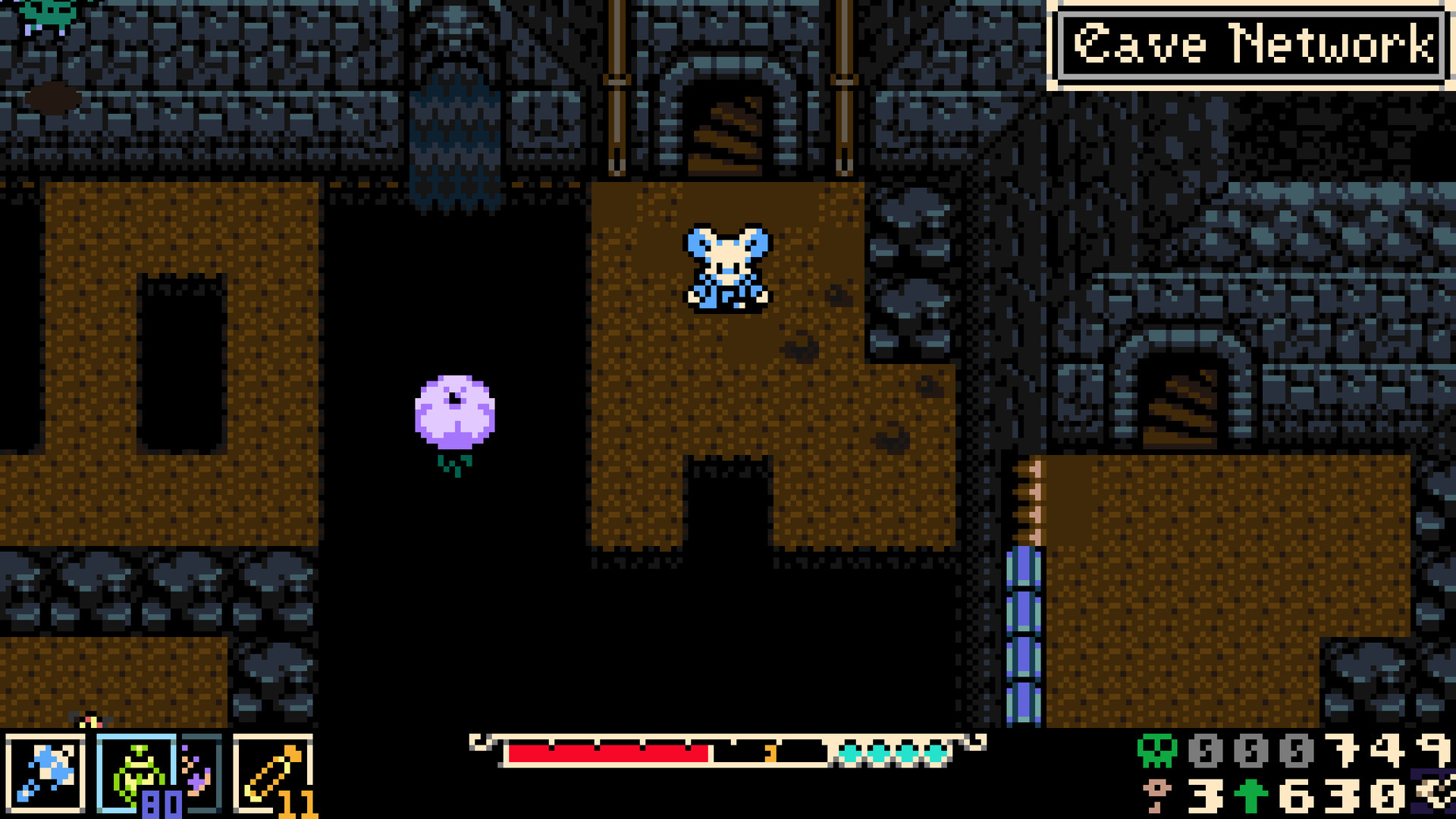 Top-down traversal in a Cave Network dungeon. The blighted Game Boy Color palette, the chunky tile grid, and Mina's burrowing silhouette are the whole pitch in one frame. Source: Game UI Database.
Snapshot
| Studio | Yacht Club Games (Marina del Rey, CA): self-published |
| Director | Sean Velasco · Lead designer Alec Faulkner |
| Music | Jake Kaufman, with two guest tracks by Yuzo Koshiro |
| Released | May 29, 2026 (Windows / macOS / Linux, PS5, Xbox Series, Switch, Switch 2) |
| Funded | Kickstarter, Feb 2022: $1.24M from 21,439 backers; ~6-year development |
| Iconic mechanic | Hollowing: burrow underground as a dodge / traversal / ambush verb |
| Core dialectic | Deliberate, punishing Castlevania combat inside a Zelda-shaped open world |
| Inspirations | Castlevania (deliberate whip combat, theming), Zelda: Link's Awakening (top-down GBC adventure), Bloodborne / Dark Souls (aggression + death economy) |
| Content | ~28 bosses · 60 trinkets · 5 weapons · a deep sidearm roster · multiple regions of Tenebrous Isle |
| Reception | Metacritic ~91 (PC/PS5); OpenCritic 93, 98% recommend: the highest-rated game of 2026 at launch |
| Sales | 300k copies in 3 days; 500k in 2 weeks |
Macro loop
The Underlab  (Mina's lab / hub)
  ├─ Refill health + Sparks at a restored Spark Generator (checkpoint / save)
  ├─ "Bone Up", spend Bones to level Attack / Shield / Plasma Vial
  ├─ Refit loadout: weapon + shield + one sidearm + a trinket set (limited slots)
  └─ Fast-travel out to a region of Tenebrous Isle
       │
       ▼
Region (top-down, Zelda-shape): Ossex · Septemburg · Backwaters · Western Wilds …
  ├─ Town: shops (Provisioner, sidearm & trinket vendors, pay Bones / Bonestone),
  │         NPC quests, and the Tenebrous Times newspaper (lore + run stats + ciphers)
  ├─ Field & dungeon: deliberate, telegraphed combat ,
  │     approach → read the wind-up → HOLLOW (burrow = i-frames + reposition)
  │               → surface-attack → bash / block / parry with the shield
  │               → spend Joules on a sidearm for burst / utility / traversal
  ├─ Collect: Bones (the XP currency), trinkets, sidearms, keys, Spark containers
  ├─ Restore the region's Spark Generator → re-lights the map, opens gates
  └─ Boss (~28 across the isle) → key item / weapon / sidearm / region clear
       │
       ├─ Die → drop 1 Spark at the death spot, respawn at the last Generator,
       │        KEEP your Bones (while you still have Sparks). Run back to grab it ,
       │        or level up on the way ("Bone Up!") to auto-retrieve every lost Spark.
       │        Die with 0 Sparks left → forfeit all carried Bones.
       ▼
Back to the Underlab, bank Bones into levels, refit, push the next region.
The hook: the dodge button is also the traversal button is also an attack opener. Every encounter, gap, and puzzle is authored against the same verb, so getting better at Hollowing makes you better at everything simultaneously, and the game can keep finding new things to do with one input thirty hours in.
Mechanic deep-dives
Sub-pages, in reading order:
- Hollowing: the burrow verb, why one input is the dodge, the traversal, and the ambush; i-frames, surfacing rhythm, and the trinkets/sidearms that bend it (wall-burrow, seismic pulse).
- Combat & weapons: deliberate, committed attacks; the 5 weapons; the shield's bash / block / parry / Grave Counter; the hold-attack moveset.
- Sidearms & Joules: Joule-powered tools (offensive / utility / traversal), one equipped at a time; the economic and death cost of leaning on them.
- Trinkets: the build layer, 60 collectible passives, a limited equip budget, and the deliberately reckless ones (Uranium Bracelet, Wallower's Gauntlets).
- Bones & progression: Bones as XP-currency, the Attack / Shield / Plasma Vial level tracks ("Boning Up"), Bonestone as the shop currency.
- Death & Sparks: the two-tier death penalty, Spark Generators as checkpoints, and the "Bone Up" auto-retrieval safety valve.
- World, map & the Tenebrous Times: Tenebrous Isle's region/completion structure, gating via Spark Generators, and the in-world newspaper that doubles as your stat screen and a cipher puzzle.
Through other lenses
- Ludonarrative reading: Mina built the Spark Generators that now spread the blight; she's an engineer cleaning up her own mess. Read against the resonance lens.
What this game teaches
- One verb can carry a whole game if you author everything against it. Hollowing is dodge + traversal + opener; mastering it improves every system at once. See lessons.
- A graduated death penalty stays scary without being cruel. Sparks absorb the first deaths (you keep your Bones); only carelessness: dying with no Sparks banked, actually costs you. Levelling up auto-forgives. It's a Souls bloodstain with a mercy rule.
- Deliberate combat needs a generous dodge. The attacks commit you, so the i-frame burrow has to be reliable: punishing offense is only fair next to trustworthy defense.
- Make your stat screen diegetic. The Tenebrous Times newspaper delivers run stats, lore, quests, and a cipher puzzle in one Victorian broadsheet: UI as worldbuilding.
- A hardware-style constraint is a focusing device. The GBC palette and chunky grid force readable telegraphs and clean silhouettes, exactly what a timing-based combat game needs.