Type chart + dual typing
The signature Pokémon mechanic. 17 types in Gen 3 (Normal, Fire, Water, Electric, Grass, Ice, Fighting, Poison, Ground, Flying, Psychic, Bug, Rock, Ghost, Dragon, Dark, Steel, Fairy was added in Gen 6). Every Pokémon has 1 or 2 types. Every move has exactly 1 type. Every type has a fixed effectiveness against every other type, 0× (immune), 0.5× (resisted), 1× (neutral), or 2× (super-effective).
Dual typing multiplies. So a Bug move on a Grass/Poison Pokémon (Bulbasaur) does 2× × 0.5× = 1× damage; a Bug move on a Bug/Flying (Beedrill) does 1× × 0.5× = 0.5×; a Rock move on Charizard (Fire/Flying) does 2× × 2× = 4×.
This is the load-bearing layer of every Pokémon battle.
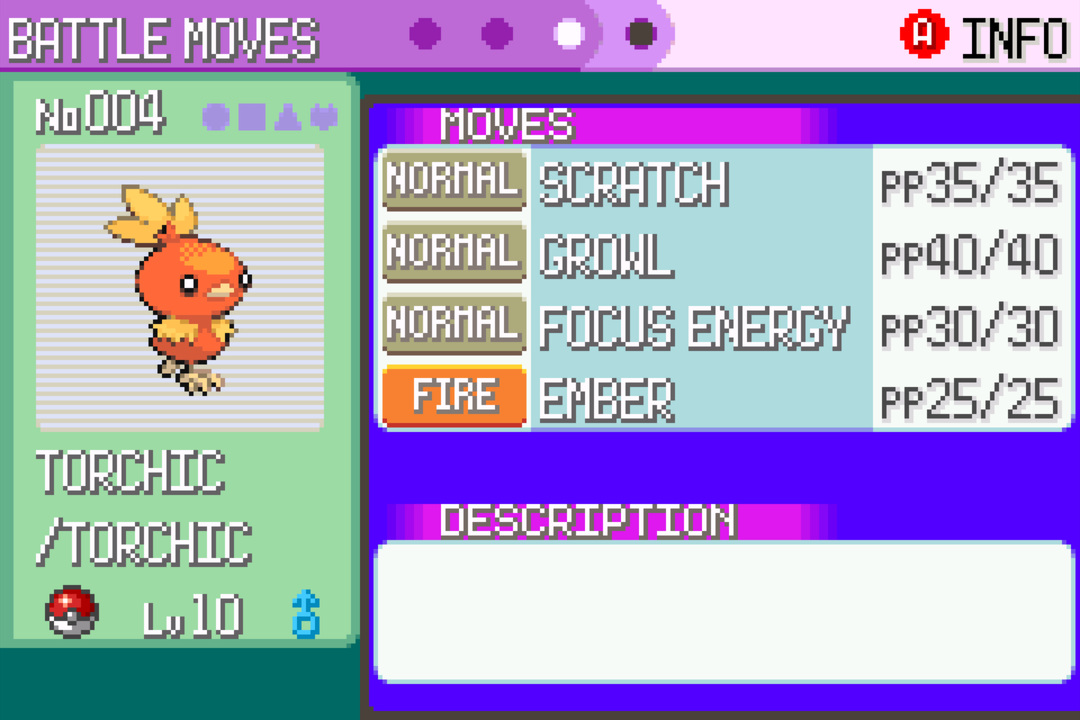 Every move's type is shown on the left of the BATTLE MOVES screen. The type tag is the first thing the player learns to read. Source: Game UI Database.
The matrix
The 17×17 type chart is 289 cells total, 25 of them 2×, 53 of them 0.5×, 7 of them 0× (immunities), the rest 1×. The most important asymmetries:
| Type | 2× against | 0.5× against | Resisted by | Immune |
|---|---|---|---|---|
| Fire | Grass, Bug, Ice, Steel | Fire, Water, Rock, Dragon | Fire, Water, Rock, Dragon | : |
| Water | Fire, Ground, Rock | Water, Grass, Dragon | Water, Grass, Dragon | : |
| Grass | Water, Ground, Rock | Fire, Grass, Poison, Flying, Bug, Dragon, Steel | Same | : |
| Electric | Water, Flying | Electric, Grass, Dragon | Electric, Grass, Dragon, Ground | Ground |
| Ground | Fire, Electric, Poison, Rock, Steel | Grass, Bug | Same | Flying, Levitate |
| Ghost | Ghost, Psychic | Dark, Steel | Same | Normal, Fighting |
| Dragon | Dragon | Steel | Steel | : |
The Fire / Water / Grass triangle is the canonical introduction: each starter beats one and loses to another. This is the first systems lesson the game teaches, in the very first battle (Treecko vs Poochyena, etc).
Dual typing as a designer's lever
A Pokémon with two types has a multiplied weakness/resistance profile. This produces a much wider range of distinct defensive identities than 17 types alone:
- Skarmory (Steel/Flying): resists 9 types, immune to 1, weak only to Electric and Fire. The defensive fortress.
- Heracross (Bug/Fighting): hit 4× by Flying. Glass cannon, high attack, fragile profile.
- Aggron (Steel/Rock): 4× weak to Fighting and Ground. Looks like a tank, dies to common moves.
- Spiritomb (Ghost/Dark, Gen 4) and Sableye (Ghost/Dark): were 0 weaknesses pre-Fairy, the only two such Pokémon. The puzzle box.
Dual typing is the single biggest reason the same six-stat creature can feel fundamentally different from another with similar stats. The matchup matrix is doing the work, not the numbers.
Same-Type Attack Bonus (STAB)
If a Pokémon uses a move that matches one of its own types, the move does 1.5× damage on top of any type-effectiveness multiplier. This is "STAB."
So a Fire-type Pokémon using Ember on a Grass type: 2× (super-effective) × 1.5× (STAB) = 3× damage, before anything else. STAB is the single biggest reason competitive moves on most Pokémon are of their own type.
How this teaches the player
The type chart is never explicitly taught. The game shows type tags on every move, names every Pokémon's type in its Pokédex entry, prints "It's super effective!" or "It's not very effective…" or "It doesn't affect [target]…" after each hit. But the matrix itself is never displayed in-game.
Players learn the chart inductively over the first ~10 hours, building a mental model from feedback. By the time the player faces gym 5, they know Water beats Rock; by gym 8, they know Ghost beats Psychic but is weak to Dark. The game treats the chart as a real-world fact the player will absorb.
Children, in particular, build this knowledge over months and treat it as personally-discovered. The chart's complexity (289 cells) is much higher than what would normally be learnable through play, but Pokémon's repetition (~1000+ battles in a playthrough) gives the player enough exposure to internalise it.
Type chart at the design layer
Two design decisions worth flagging:
- The chart is asymmetric and irregular. Fighting hits Normal for 2× but is resisted by Flying: there's no underlying "fast vs heavy" rule that generates the matrix; it's a hand-tuned table. The asymmetry is what gives each type a real character.
- Some types are deliberately weak. Bug, in Gen 3, is bad offensively: 2× against only Grass, Psychic, and Dark; resisted by 7 types; STAB-ed by Pokémon that mostly have low Attack. This creates categories of Pokémon that can't carry a team, which (paradoxically) creates space for niche builds. The designers don't try to make every type viable in every role.
Patterns this exemplifies
type-rps-matrix: the canonical instance. Asymmetric N-way RPS where every move is tagged with one of N types and every target has 1–2 of N types, multiplying. Dozens of game-design students rebuild a 6×6 or 8×8 version in their first prototype.
Adjacent patterns
loadout-as-budget: the type chart matters because each Pokémon has only 4 moves; the type-tags become a coverage problem.coverage-vs-power: competitive teambuilding always trades raw STAB power against type coverage. A pure-Fire team has a 4× weakness to Water; a coverage build dilutes STAB but plugs the holes.