Through the ludonarrative resonance lens
A reading of Hades's mechanics through the ludonarrative resonance lens, does what the player does affirm what the game says it's about?
Mechanic read: Death-as-narrative: every death returns the player to the hub, where every NPC has fresh dialogue tracking what just happened.
Verdict: Affirms. Dying is how the plot moves. The rollback that most roguelikes treat as narratively meaningless is, here, the storytelling beat itself.
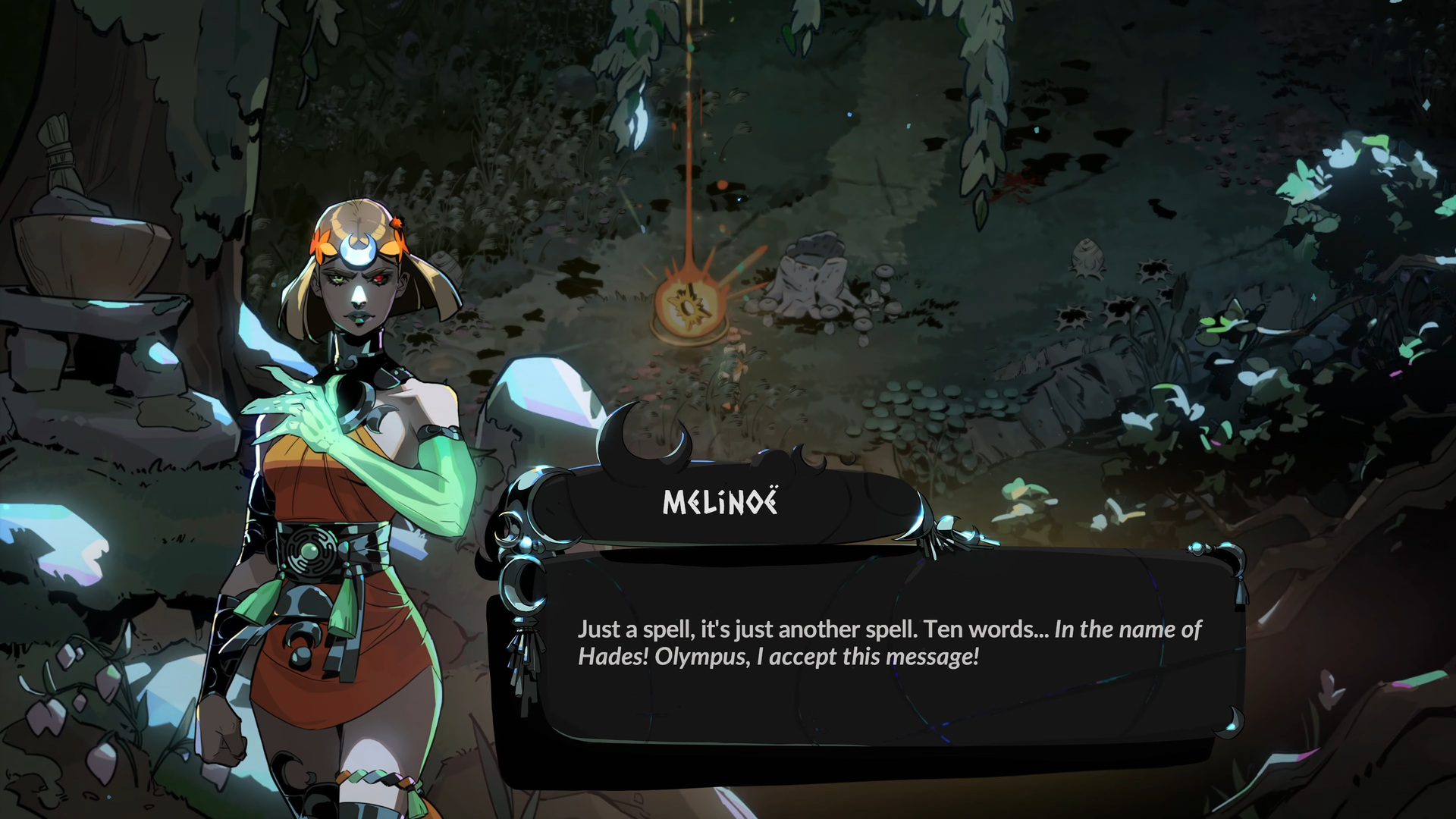 Hub dialogue is canonical: it only fires because of what happened on the run that ended a moment ago. Source: Game UI Database.
Why it lands
The premise of Hades 1 is Zagreus, son of Hades, repeatedly attempting to escape the Underworld. The premise requires failed attempts. So the same act ("I died, take me back to the hub") reads simultaneously as:
- Gameplay-true: the run is over; reset to the hub for the next attempt.
- Plot-true: Zagreus has, narratively, been resurrected in the Pool of Styx; his family in the House is physically present and reacts to what just happened.
There is no parallel path. You cannot reach the next dialogue beat without re-running and re-failing. The plot literally moves through the rollback.
Compare this to most roguelikes, where death is rolled-back state: narratively meaningless, mechanically a reset. Supergiant didn't add a story to a roguelike; they noticed that a roguelike already has a story shape (cycle of attempt → failure → return) and built a fiction whose plot has the same shape. The fit is tautological. That's why it lands so hard.
What makes the resonance dense, not nominal
The lens distinguishes between theme-fits-genre (cheap) and triggers-fit-events (expensive). Hades does the expensive version. Dialogue triggers are granular:
- "Died to Megaera ≥ 3 times" unlocks Megaera's softer, more personal lines.
- "Cleared Asphodel for the first time" triggers Hades's reluctant, grudging-respect line.
- "Gifted Achilles Nectar 5 times" advances his arc by one beat.
- "Carried 4+ Aphrodite boons last run" has Aphrodite tease about commitment.
This isn't "dialogue on death." It's a dense state machine where the specifics of the run become character beats. Each NPC carries 200-600+ unique lines, most firing once and never again, with a background pool of repeating filler so silence never feels mechanical.
What the loop says
I am the son of the King of the Dead. I am trying to leave home. The Underworld is built to stop me, and the people who built the Underworld are my family. Each failure is them seeing me again.
That sentence describes both the gameplay and the plot. That is what affirmation looks like.
Where it could have failed
Three things had to hold for "death advances story" to work, and each is a failure mode if missing:
- Death lands in the same place every time (the hub). A roguelite that respawns the player elsewhere can't anchor stateful dialogue.
- The hub has characters who care: mentors, family, antagonists. Few roguelites have the writing budget for a populated hub.
- Triggers are granular enough to surface specific events, not just "you died." This requires real engineering on the trigger condition system.
Take any of those away and the affirmation collapses into nominal flavor text.
See also
- Mechanic page: Death as narrative
- Lens (overview): Ludonarrative resonance
- Adjacent pattern:
late-introduced-mechanics: most NPC arcs unlock 5-30 hours in.