Poker hands as a chip × mult ladder
The base scoring engine. Every poker hand has a base chips count and base mult, multiplied to produce the round score. Everything else in the run modifies one or the other.
This is a five-line table that the entire 200+ hour endgame is built on.
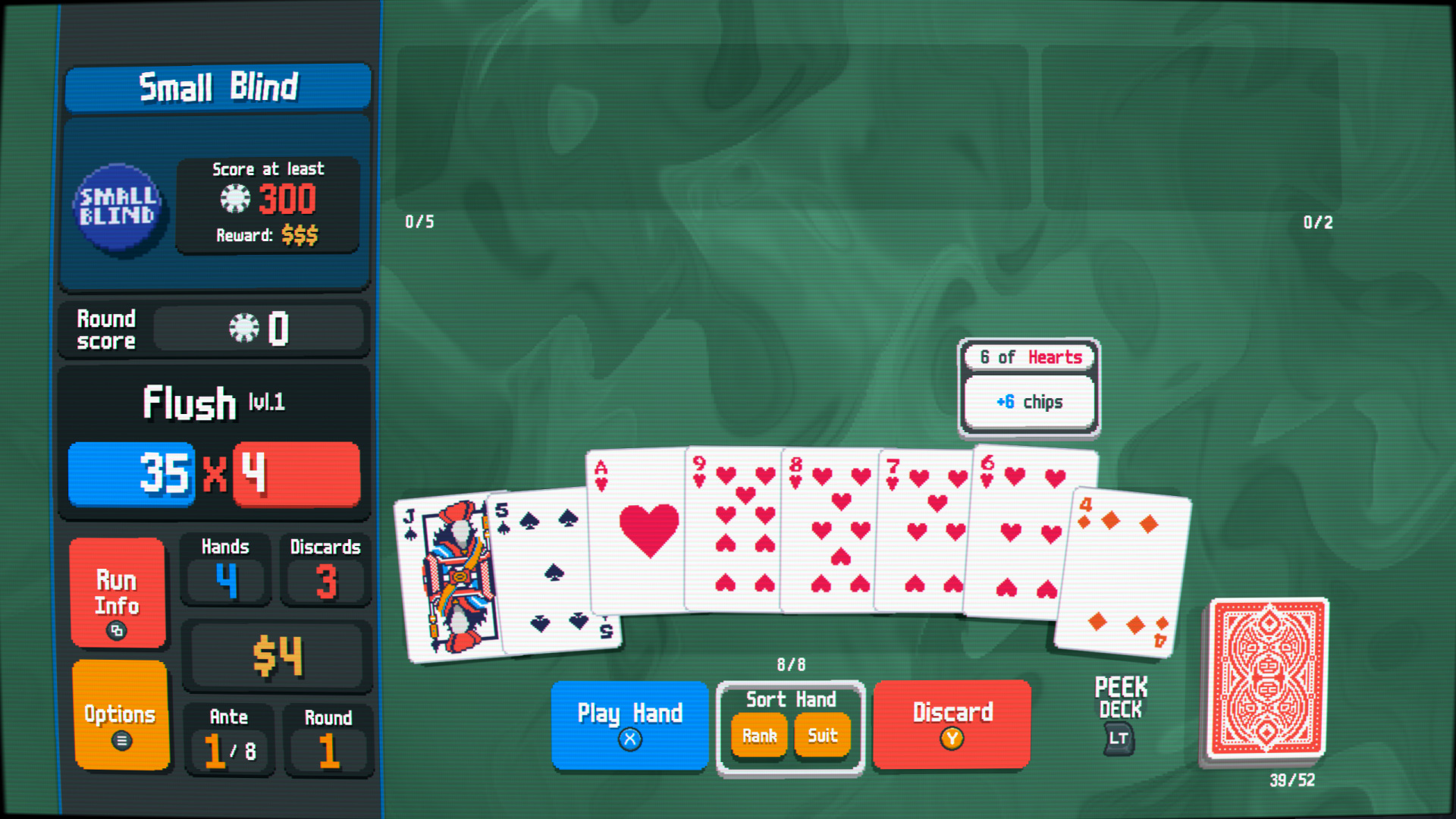 A Flush about to fire. The base "35 × 4" appears on the left panel: those are the unmodified chips and mult for a Flush at lvl.1. Every chip and mult contribution from cards / Jokers / Enhancements gets added to those two numbers before the multiplication runs. Source: Game UI Database.
The base table
| Hand | Base chips | Base mult | Base score |
|---|---|---|---|
| High Card | 5 | 1 | 5 |
| Pair | 10 | 2 | 20 |
| Two Pair | 20 | 2 | 40 |
| Three of a Kind | 30 | 3 | 90 |
| Straight | 30 | 4 | 120 |
| Flush | 35 | 4 | 140 |
| Full House | 40 | 4 | 160 |
| Four of a Kind | 60 | 7 | 420 |
| Straight Flush | 100 | 8 | 800 |
| Royal Flush | 100 | 8 | 800 |
| Five of a Kind (mod) | 120 | 12 | 1,440 |
| Flush House (mod) | 140 | 14 | 1,960 |
| Flush Five (mod) | 160 | 16 | 2,560 |
The last three "secret" hands unlock as the player builds Wild Cards / Stone Cards / specific Joker combos that allow same-rank multiples or all-same-suit-and-rank conditions.
The scoring formula
Once a hand is selected and Play Hand pressed:
1. Hand type recognized → look up base chips, base mult
2. For each scoring card in hand:
     base_chips += card_chip_value (2 of Clubs = +2, K = +10, A = +11, etc.)
     trigger any Enhancements (Bonus Card +30 chips, Mult Card +4 mult, etc.)
     trigger any Editions (Foil = +50 chips, Holographic = +10 mult, Polychrome = ×1.5 mult)
     trigger any Seals (Gold Seal = $3 on score, Red Seal = trigger card again, etc.)
3. For each Joker in slots (left to right):
     apply Joker's effect (varies, many add chips, mult, or x_mult)
4. Final: chips × mult = round score contribution
5. Add to round total; check against Blind threshold
The order matters: Jokers fire left to right, so the slot you put a Joker in changes the run's total because earlier Jokers' outputs feed later Jokers' multipliers.
Planet Cards level the ladder
The base table isn't fixed across a run. Planet Cards (consumables, blue/cosmic-themed) level up specific hand types permanently within the run.
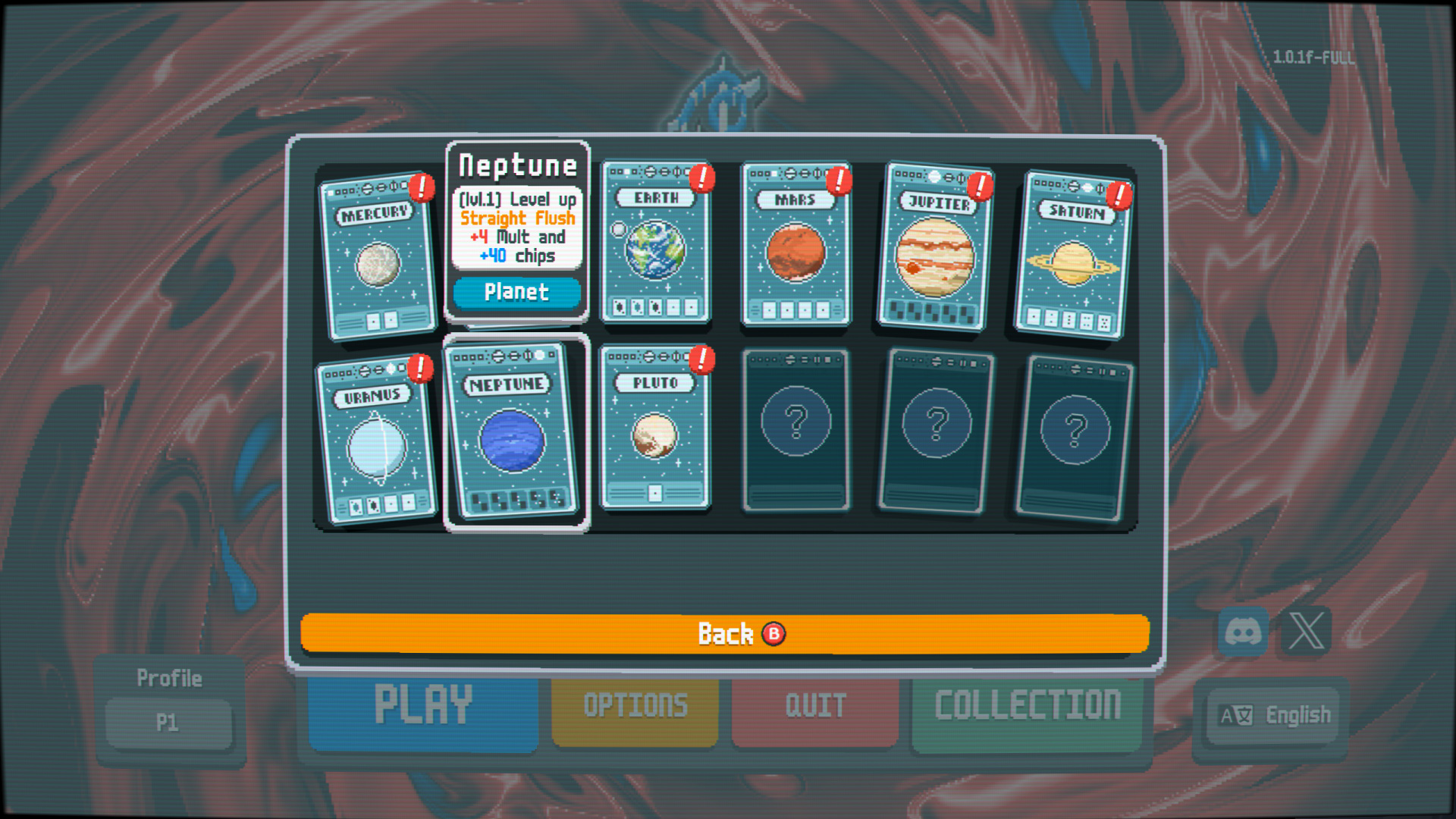 Each planet levels its named poker hand. The Neptune card adds +4 mult AND +40 chips to Straight Flush every time it's used. Stack 5 Neptunes in a run = +20 mult / +200 chips on every Straight Flush. Source: Game UI Database.
| Planet | Hand | Effect (per use) |
|---|---|---|
| Pluto | High Card | +1 mult / +10 chips |
| Mercury | Pair | +1 mult / +15 chips |
| Uranus | Two Pair | +1 mult / +20 chips |
| Venus | Three of a Kind | +2 mult / +20 chips |
| Saturn | Straight | +3 mult / +30 chips |
| Jupiter | Flush | +2 mult / +15 chips |
| Earth | Full House | +2 mult / +25 chips |
| Mars | Four of a Kind | +3 mult / +30 chips |
| Neptune | Straight Flush | +4 mult / +40 chips |
| Planet X | Five of a Kind | +3 mult / +35 chips |
| Ceres | Flush House | +4 mult / +40 chips |
| Eris | Flush Five | +3 mult / +50 chips |
Planet Cards drop in Celestial Packs, in the Shop, and from Black Hole Spectral Cards. A run that finds many Jupiter cards turns Flush into the dominant hand even when other hands score higher in raw base.
Why this design works
Three structural reasons the chip×mult ladder is more interesting than a flat damage system:
1. Two separable axes
Most card games scale on one axis (damage, points). Balatro scales on chips AND mult independently. So a player can:
- Chip-stack: pile additive chip bonuses (Bonus Cards, Steel Cards, Stone Cards, suit-pip-counting Jokers). Big base, small mult.
- Mult-stack: pile multiplicative mult bonuses (Polychrome jokers, Mult Cards, ×_mult jokers like Blueprint, Brainstorm, Photograph). Small base, huge mult.
- Hybrid: moderate stacks of both. Most actual builds.
The type of build matters; the direction of stacking changes which Jokers, Enhancements, and Hands are valuable.
2. Multiplication beats addition
A run that's collected chip-stacking only ends at score = base + chip_pile = ~10,000. A run that's also added a single ×3 mult Joker triples that to ~30,000. Multiplicative bonuses produce emergent skill ceilings that no purely additive system can match.
By Ante 8, a casual run scores ~50,000 (just hitting the threshold). An optimal run scores 50,000,000 (1000× over). The same chip×mult formula, the same hand types, the same shop, but exponentially different outcomes based on Joker chains.
3. The numbers can be insane and it doesn't matter
Endless mode scoring crosses 10²⁰ at Ante 16. The numbers stop being readable as integers; they become decimal-place identity. "I crossed 1e20" is the milestone, not the specific digit.
This is unique to multiplicative-stacking games. An RPG that capped at 999,999,999 damage would feel hollow at the cap; Balatro feels more satisfying as the numbers explode because every order of magnitude is a build identity.
What this teaches
- Two scoring axes is more interesting than one. Whether you call them chips and mult, attack and crit, or something else: separating "size of input" from "amplifier on output" is the move.
- Permanent run-level power-ups should also be lookups. Planet Cards level individual hand types. The game doesn't say "+50% damage for the run": it says "Flush is now stronger." Players can specialise.
- Multiplication is the lever. Designers who lean too heavily on additive bonuses get linear progression. The juice is in stacking multipliers. Balatro's most-discussed Jokers (Blueprint, Brainstorm, Mime, Baron) are all triggers-of-other-triggers: meta-multipliers.
- Familiar input formats compound on themselves. Players who already know Pair < Two Pair < Three of a Kind get the entire scoring identity-tree on the first run. The game's depth grows on knowledge they already have.
Patterns this exemplifies
chip-and-mult-stacking: twin scoring axes (additive base × multiplier output). Uncurated; Balatro is the canonical case.cumulative-modifier-staircase: Planet Cards permanently level hand types within a run. Adjacent to Slay the Spire's Ascension staircase, but operating on hand types rather than difficulty modifiers.
Adjacent
subtractive-deckbuilding: Balatro's deck mutation lets you remove cards via Tarots; this matters because hand-type frequency depends on which cards remain.