Xenoblade Chronicles
A four-game series from Monolith Soft (under Nintendo) running 2010–2025. Auto-attack + arts on cooldown + positional bonuses is the shared combat grammar; on top of that, each entry layers a new signature mechanic, and each entry keeps revealing major systems dozens of hours in. The series is a 400-hour study in how long you can keep teaching a player.
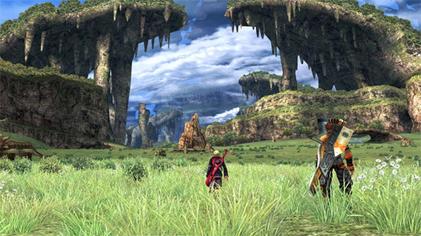 The Bionis. Two characters standing on the leg of a god-corpse, looking at the body of another god-corpse. The visual signature of the series: and the world the entire first game takes place on. Source: Wikipedia.
Snapshot
| Studio / publisher | Monolith Soft / Nintendo |
| Series span | 2010 (Wii) – 2025 (Switch DE remasters) |
| Genre | Action RPG with MMO combat lineage |
| Business model | Premium, single-purchase; substantial one-shot DLC for some entries |
| Iconic mechanic | Auto-attack + arts on cooldown + per-game signature on top |
| Core dialectic | Mechanic drip vs. tutorial overload |
| Hours to credits | XC1 ≈ 60–80h · XC2 ≈ 80–110h · XC3 ≈ 80–120h · XCX ≈ 60h main story (200+ for completion) |
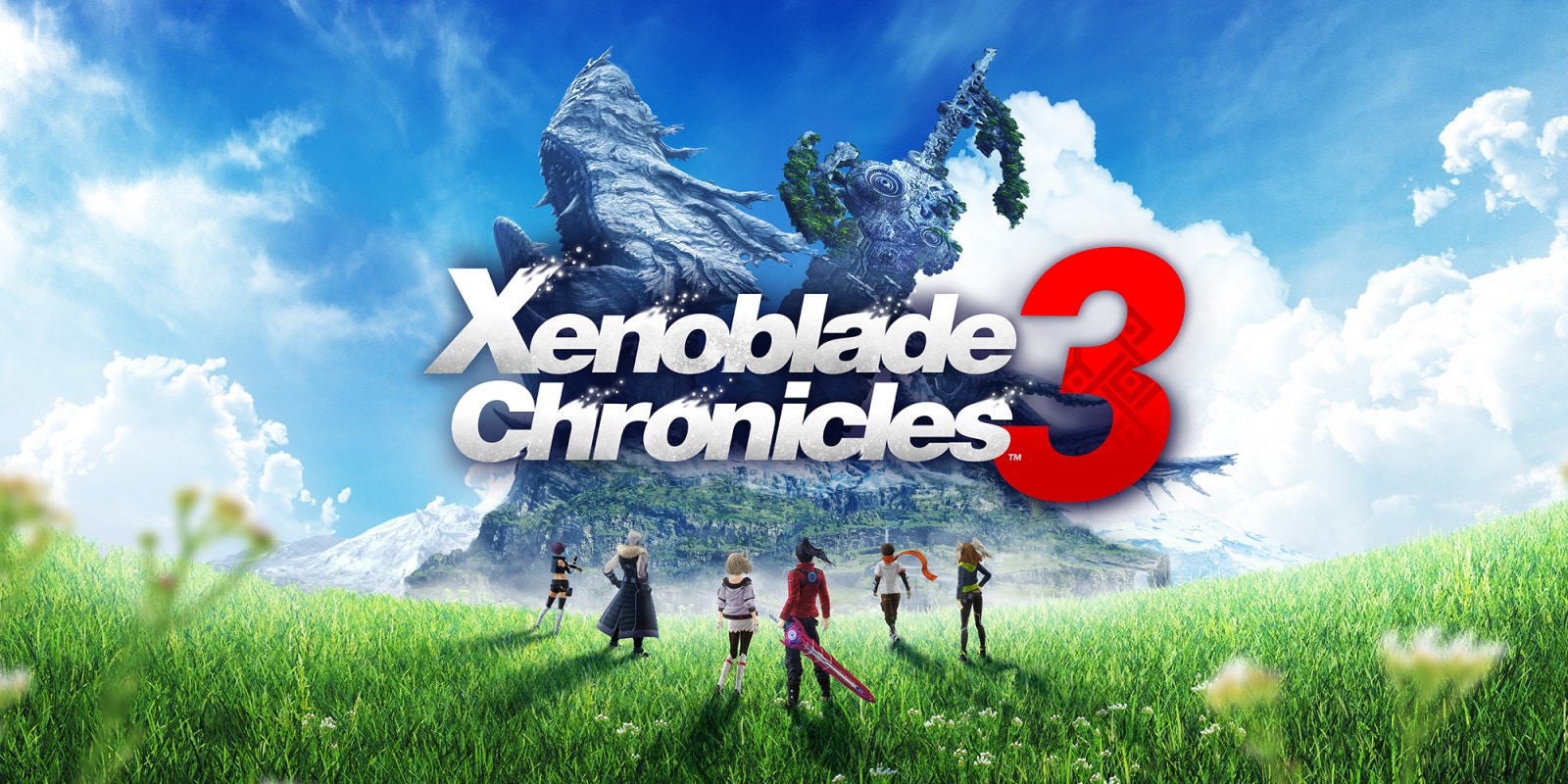 Xenoblade Chronicles 3: the synthesis entry. Six party members on a vast vista, the same series-iconic shape as the XC1 Bionis vista 12 years earlier. Source: Eurogamer.
The four entries
| Entry | Year | Iconic mechanic | What it adds late |
|---|---|---|---|
| Xenoblade Chronicles (XC1, 2010 / DE 2020) | Wii / Switch | Vision system: see enemy attacks before they happen | Affinity charts (community graph), gem crafting, skill links, Future Connected epilogue |
| Xenoblade Chronicles X (XCX, 2015 / DE 2025) | Wii U / Switch | Skell mechs + open-world planet exploration | Skell licensing (~30h in), FrontierNav probe network, online Squad missions, class trees branching out |
| Xenoblade Chronicles 2 (XC2, 2017) | Switch | Driver-Blade pairing + Rare Blade gacha | Field skills gating zones, Tiger! Tiger! mini-game, Mercenary missions, NG+ Blade trading, Torna DLC as standalone prequel |
| Xenoblade Chronicles 3 (XC3, 2022) | Switch | Open class system + Ouroboros interlinking + chain attacks | Hero NPCs (7th party member, ~20+ over the campaign), ascension classes, fusion arts, Future Redeemed DLC |
Macro loop (shared shape)
explore an open zone (huge, vertical, MMO-scaled)
  → encounter monsters levelled to zone (you fight what fits)
  → combat: auto-attack background DPS + arts on cooldown + position-aware
  → defeat a story boss → cutscene → next zone unlocks
  → side quests + heart-to-hearts + affinity chart fill in side story / characters
  → at ~5h, ~15h, ~30h, ~60h: a *new system* drops in, the game expands
The new system at 30h is the unusual move. Other JRPGs front-load. Xenoblade keeps holding things back.
Mechanic deep-dives
- Combat foundation: auto-attack + arts + positionals + chain attacks; the shared language across all four games.
- Vision system (XC1): precognition as enemy-intent-telegraph. The most-imitable single move the series ever made.
- Driver–Blade pairing (XC2): gacha summoning, driver combos, blade combos, fusion combos. The most-divisive entry's load-bearing system.
- Class & Ouroboros (XC3): open class swap across all 6 party members + Ouroboros interlink as a fusion form.
- Skells & FrontierNav (XCX): mech mode you license ~30 hours in + a planet you map probe by probe.
- Series evolution: what each entry added and when. The drip pattern.
Through other lenses
- Ludonarrative reading: these mechanics read through the resonance lens. Verdict: affirms (across all four entries), Monolith Soft's signature design move is making each entry's signature mechanic also its plot's central image.
What this game (series) teaches
- Front-loading isn't the only option. Xenoblade holds back major systems for 5–40 hours, betting that players who reach hour 30 will absorb a new mechanic eagerly. This works because the existing systems are deep enough to sustain the pre-reveal hours.
- Tutorials can be re-summoned. Each XC entry pulls up a "tutorial replay" log so a player who skipped past a system at hour 12 can rewatch at hour 50. Cheap, important, often forgotten in other big RPGs.
- MMO combat is a shape, not a model. Auto-attack + arts cooldown + positional bonuses gives single-player combat a texture (warmup, prep, burn) without needing other players. Every Xenoblade combat encounter is shaped like a small raid.
- Mechanic depth justifies length. A 60-hour campaign with one combat system bores. A 60-hour campaign with one combat system plus a new layer at hour 15, hour 30, and hour 50 keeps the player learning. Xenoblade's length is funded by the mechanic drip.
See lessons.md for the longer take.