Slay the Spire
The genre-defining roguelike deckbuilder. Codified the patterns now copied by Monster Train, Inscryption, Wildfrost, Across the Obelisk, Roguebook, and dozens more. Worth dissecting because almost every system in it is a fractal restatement of one principle: risk vs. reward.
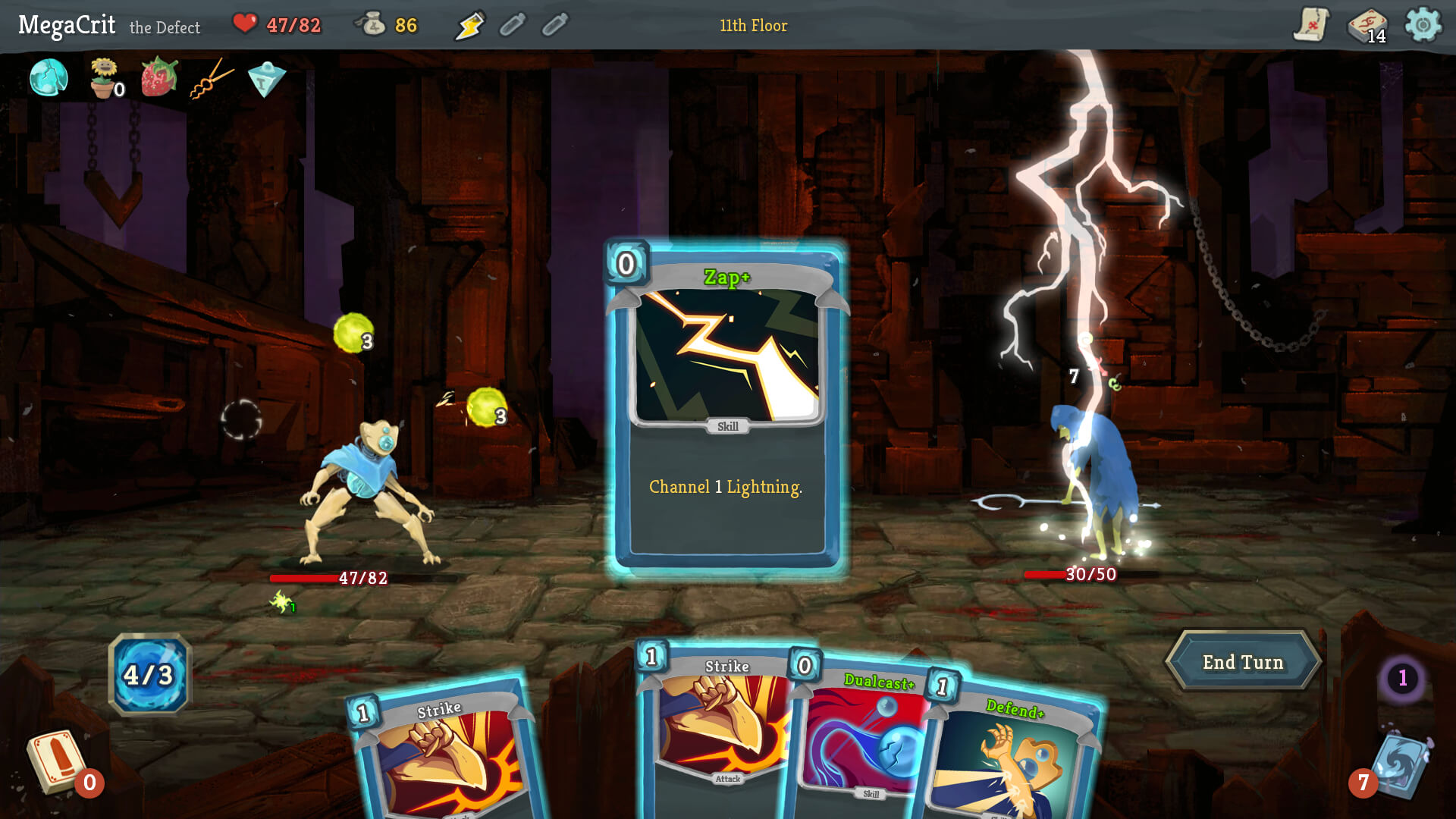 Defect combat. Card hand at the bottom, energy budget (4/3) bottom-left, the intent telegraph (lightning) visible above the enemy. Every Spire mechanic on one screen. Source: Steam.
Snapshot
| Studio | Mega Crit (Anthony Giovannetti, Casey Yano + small team), Seattle |
| Released | January 2019 (after ~2 years in Early Access) |
| Sequel | Slay the Spire 2 in Early Access (2025/2026) |
| Platforms | PC, Mac, Linux, PS4, Xbox, Switch, iOS, Android |
| Run length | ~45–90 min (faster late-Ascension) |
| Iconic mechanic | Card draft + Ascension staircase |
| Core dialectic | Risk vs reward, fractally |
| Business model | Premium one-time. No DLC for original. No microtransactions. |
| Content scope | 4 characters × 350+ cards × 200+ relics × ~50 events × 50+ enemies × 10 bosses × 20 Ascensions |
Macro loop
Pick character (Ironclad / Silent / Defect / Watcher) and Ascension level
  → start with starter deck (10 cards) + 1 starter relic
  → enter Act 1 map (a branching DAG of nodes)
    → choose path through node types: Monster, Elite, Event, Shop, Rest, Treasure, Boss
    → each fight earns a card-reward draft of 3 cards (pick 1 or skip)
    → relics, gold, potions, HP changes accumulate
  → defeat Act boss → choice of 3 boss relics + 3 rare cards
  → Act 2 → Act 2 boss (same structure, harder)
  → Act 3 → Act 3 boss
  → (optional) Act 4 → Heart final boss
  ← die → run ends, return to character select with score
    → unlocks: new cards/relics added to that character's pool
    → Ascension level for that character +1 if you won
Mechanic deep-dives
- Map & node types: branching DAG, anti-streak resolution, why the map is the load-bearing mechanic.
- Combat system: energy + block + intent. Complete-information per-turn puzzles.
- Deckbuilding: card drafts, deck thinning, archetypes.
- Relics: rule-breaking modifiers, bonus-with-drawback boss relics.
- Characters: four orthogonal designs, not stat reskins.
- Ascension & meta-progression: difficulty staircase, "variety not power".
- Daily climb & seeds: same-seed leaderboards.
Through other lenses
- Ludonarrative reading: these mechanics read through the resonance lens. Verdict: orthogonal, light fiction, heavy math, honest framing. Forcing resonance would weaken the loop.
What this game teaches
- One design principle, fractally restated. Risk vs reward shows up at every scale: the map, the draft, the rest site, the boss relic, the shop, every campfire. The whole game is one idea rendered at every level.
- Subtractive deckbuilding. Power lives in removing weak cards, not adding strong ones. Inverts the genre instinct.
- Cumulative-modifier difficulty staircase beats the slider. One new lesson per level, 20 levels, learnable.
- Meta-progression as variety, not power. Unlocks expand the space, never raise base stats. Run integrity preserved.
- Anti-streak RNG (pity counters on rare drops, on Unknown node resolution) smooths feel-bad runs without telling the player.
- Daily seed = community for free. One feature, almost no cost, enormous engagement.
See lessons for the longer take.