Trinkets: the build layer
Trinkets are Mina's passive build system: 60 collectible charms scattered across Tenebrous Isle, of which you equip a limited set at once. They're where a run stops being "Mina with a whip" and becomes your Mina, the glass cannon, the parry counter-build, the wall-burrowing explorer.
The design lineage is explicit: this is Hollow Knight's charm budget by another name: a large collectible pool, a small number of equip slots, and integer-flavoured decisions about what to wear. The difference is theme and risk appetite: Mina's trinkets lean harder into reckless, run-warping effects.
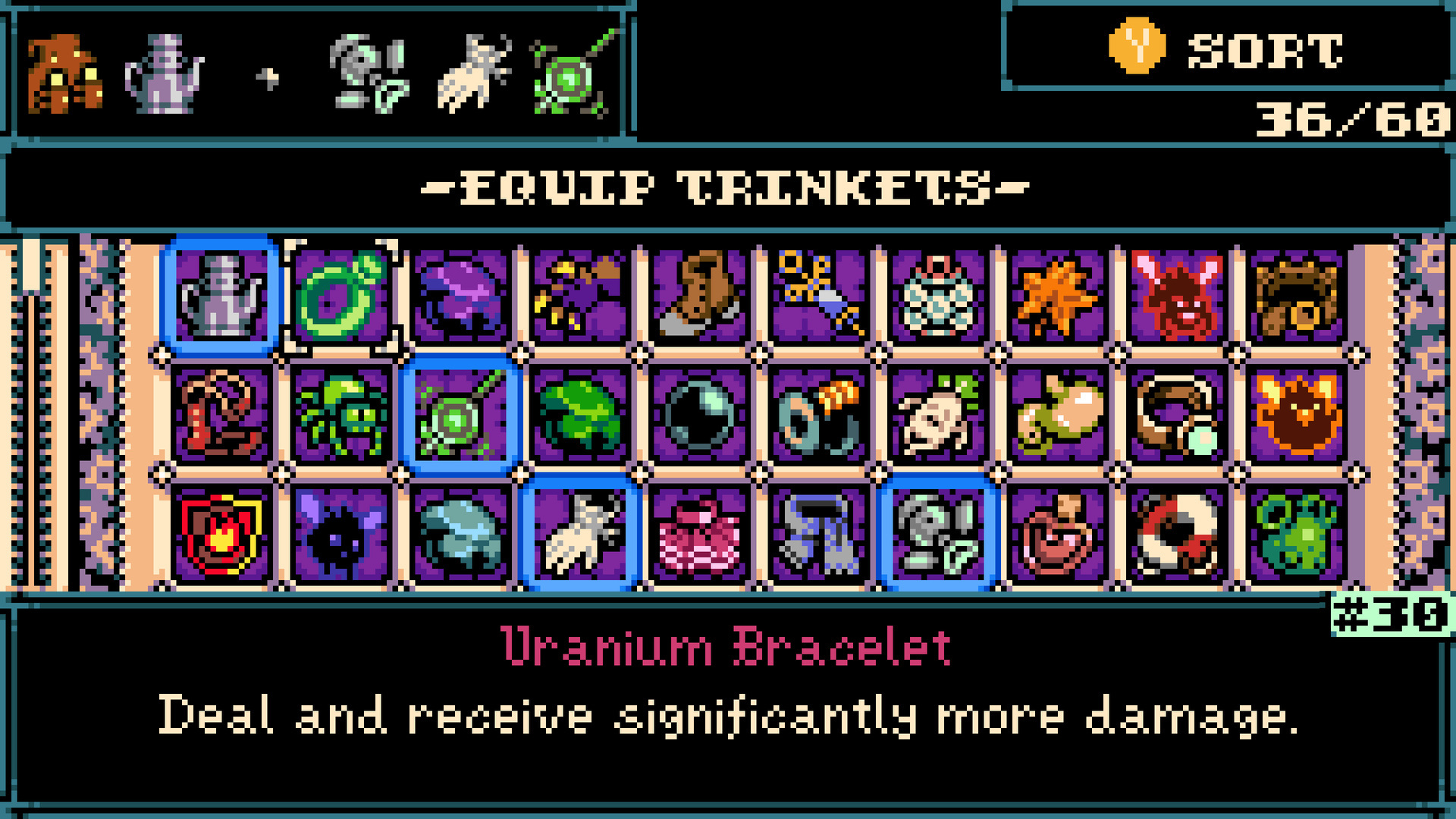 The trinket grid (36/60 collected). The Uranium Bracelet ("Deal and receive significantly more damage") is the genre's purest glass-cannon switch: pure upside and pure downside in one line. In a game where a few hits already kill, equipping it is a statement about how confident you are in your burrow timing. Source: Game UI Database.
Two grades of trinket
The 60 trinkets span a wide range, but they fall into two design buckets:
- Stat bumps: quiet, stackable boosts: +1 Attack level, +1 Defense, +1 Sidearm level, more Joules, longer burrow, faster heal. These are the "smooth out my build" trinkets. (The character screen even shows a weapon at "LVL 7**+1**"; the +1 is a trinket talking.)
- Mechanical overhauls: trinkets that change how Mina plays:
- Uranium Bracelet: deal and receive significantly more damage (glass cannon).
- Wallower's Gauntlets: burrow directly into walls, not just floor, converting the dodge into a traversal key that opens sealed rooms.
- Burrow-on-emerge effects, parry-reward trinkets, on-kill procs. Each one biases the run toward a particular verb.
The overhaul trinkets are the interesting ones because they don't add power so much as redirect it: Wallower's Gauntlets don't make you stronger, they make the map different; the Uranium Bracelet doesn't make you better, it makes you swingier.
The slot budget is the game
You own far more trinkets than you can equip, so every loadout is a set of foreclosed choices: the textbook opportunity-cost-loadout:
- Wearing the wall-burrow gauntlets for an exploration session is a slot not spent on combat power.
- Stacking damage trinkets to melt a boss means going into that fight with less defense or utility.
- The Uranium Bracelet's "+damage / −survivability" is a
bonus-with-drawbackyou opt into with a slot: the drawback is the effect, and the opportunity cost is the slot it occupies.
Because trinkets are re-equippable at will (at the Underlab / save points), the system encourages situational builds rather than one permanent setup: a wall-burrow loadout to sweep a region for collectibles, swapped for a parry-counter loadout before a boss, swapped again for a glass-cannon loadout once you've learned that boss's patterns and want to end it fast. The 60-trinket pool is wide enough that "what am I wearing for this" is a recurring, live question rather than a solved one.
How it differs from the other slots
Mina rations power across several slot systems, and trinkets are the persistent passive one:
| Slot | Grain | What it commits |
|---|---|---|
| Weapon | One equipped | Your core melee rhythm (reach vs speed) |
| Shield | One equipped | Your active defensive verb (block / parry) |
| Sidearm | One equipped | Your situational burst / traversal tool |
| Trinkets | Several slots from 60 | Your passive build identity and risk appetite |
Weapon, shield, and sidearm are each a single decisive pick; trinkets are the combinatorial layer that tunes those picks. Together they're why two players with the same weapon can be playing very different games.
Patterns this exemplifies
opportunity-cost-loadout: 60 trinkets, a few slots; every equipped charm is several you didn't wear.bonus-with-drawback: the glass-cannon and other reckless trinkets pair real upside with real, felt cost.