Meta-progression: Mirror, Pact, Arcana
How Hades pays you for runs you didn't win. The series ships three orthogonal meta-progression axes: Mirror of Night (variety unlocks), Pact of Punishment (difficulty), and (in Hades II) Arcana cards (a tarot-card meta-build).
Mirror of Night (Hades 1) → Arcana grid (Hades II)
The "what does my run start with" axis. Both games let the player invest a meta-currency (Darkness in H1, Ash in H2) into permanent slot upgrades that affect every run.
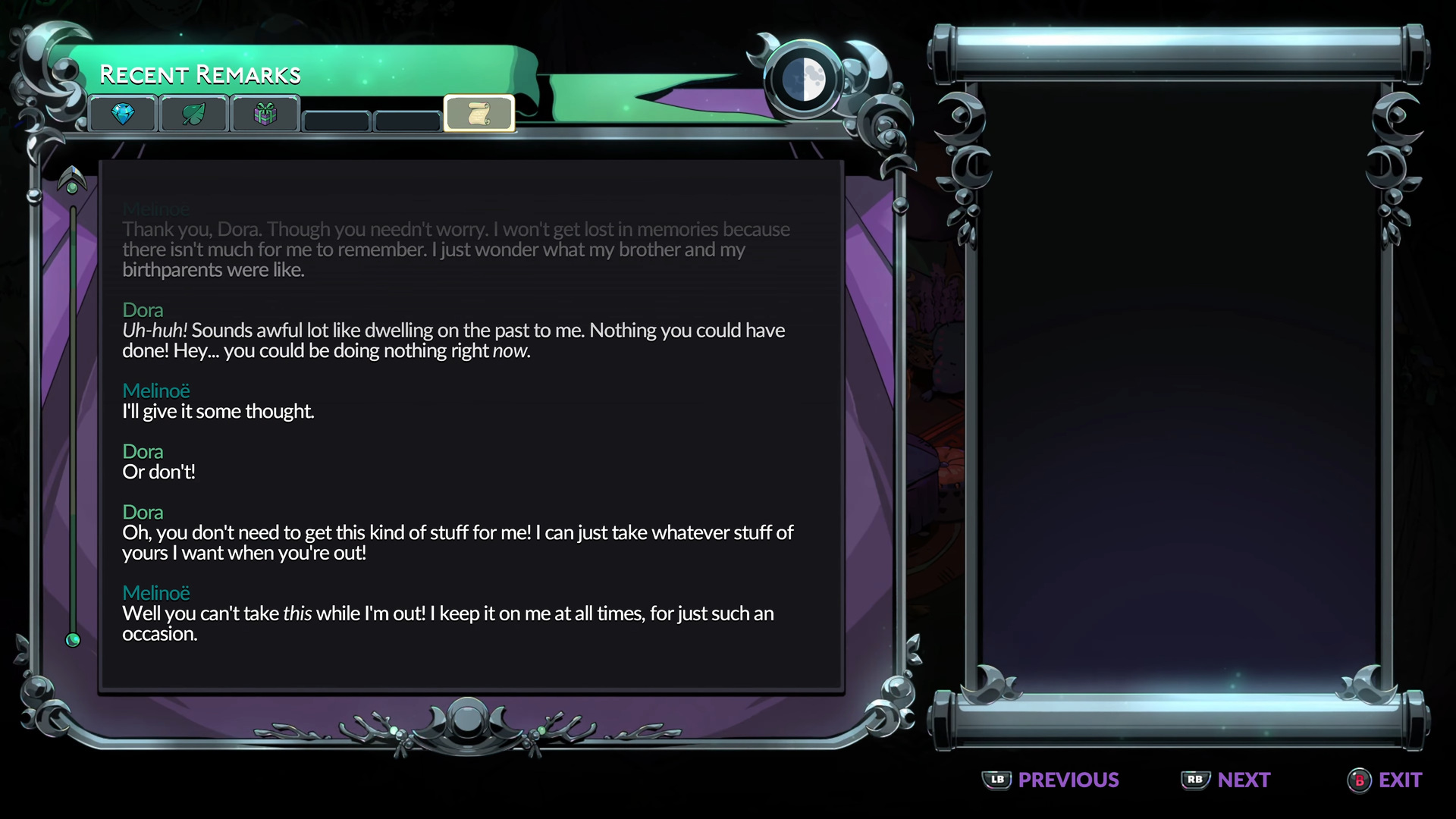 Hades 2's Arcana grid. Each card is a meta-talent: Ghost Onion "Whenever you exit a Location, fully restore your Life, up to a total of 50 Life this night." Cards rank up by clearing 25 Encounters with them slotted (right-side text). The layout is grid-shaped: total Grasp (capacity) limits how many cards you can fit. Source: Game UI Database.
The Arcana grid is more elaborate than Mirror of Night was. It's a loadout-as-budget combinatorial puzzle: which N cards fit your Grasp limit, given each card has a Grasp cost and synergies between adjacent cards.
| Hades 1 Mirror | Hades 2 Arcana |
|---|---|
| Linear slot list | Grid + Grasp budget |
| Each slot has 2 mutually-exclusive options | Each card is unique; you pick which to slot |
| Cost: Darkness, then Diamonds at higher tiers | Cost: Ash + Psyche; rank up by use |
| Stat-style upgrades (+ HP, + dash) + variety unlocks | Most cards are variety: new mechanics, conditional triggers |
Both are squarely meta-as-variety-not-power. The strict version of that pattern says only variety, never raw power. Hades sits a little softer, Mirror has +HP, +damage. But the interesting upgrades are the ones that change how the run plays (Stubborn Defiance gives you a one-shot revive; Olympian Favor doubles boon offers from one specific god per run).
Pact of Punishment: opt-in difficulty
Hades's answer to post-credits replayability. After beating the game, the player unlocks the Pact, a menu of difficulty modifiers (called Conditions) the player can stack to make runs harder. Each Condition adds:
- A Heat level (1–N)
- A reward bonus for clearing the run with that Heat applied
- A specific cap on stacking (e.g. Hard Labor max Heat = 5)
The player picks which Conditions to take. Conditions are bonus-with-drawback at the meta-level: opt-in difficulty in exchange for opt-in reward.
| Sample Condition | Effect | Heat |
|---|---|---|
| Hard Labor | Enemies deal +20% damage | 1 per level (max 5) |
| Lasting Consequences | You take +20% damage from each source already-dealt | 1 per level (max 4) |
| Convenience Fee | Charon's shop costs more | 1 per level (max 4) |
| Damage Control | Wells of Charon offer fewer items | 1 per level (max 2) |
| Tight Deadline | Bosses get a damage bonus over time | 1 per level (max 3) |
By Heat 32+ the game is brutally hard. This is the post-credits curve: the run length doesn't change, the ceiling of difficulty does, and the player picks which Conditions match the kind of challenge they want to chase.
This is the same shape as Slay the Spire's Ascension levels: a difficulty-modifier menu unlocked after the campaign, with bespoke rewards for each unlocked tier.
Nocturnal Arms: the weapon roster
 Nocturnal Arms select. Hades II's 4 weapons (so far in EA): Sister Blades, Umbral Flames, Moonstone Axe, Witch's Staff. Each weapon has its own Aspect tree (alternative forms unlocked through gameplay). The Silver / Cinder counters at the bottom are the meta-currencies for unlocking the next weapon. Source: Game UI Database.
Each Nocturnal Arm has multiple Aspects, alternate forms of the same weapon with substantially different combat mechanics:
- Sister Blades / Aspect of Artemis: dagger throws return like boomerangs
- Witch's Staff / Aspect of Circe: Special channels a beam instead of firing projectile
- Moonstone Axe / Aspect of Charon: trade Magick to slow time
Aspects unlock by spending Titan's Blood (from boss kills) at Hecate's altar. Late-game players carry 3–4 Aspects per weapon, each effectively a separate playstyle, picked per-run.
How the three axes compose
| Axis | Frequency | Cost | What it changes |
|---|---|---|---|
| Boon draft | Every chamber | None (in-run) | This run's build |
| Hammer | 1–2 per run | None | This run's weapon mechanics |
| Mirror / Arcana | Hub menu | Meta-currency | Permanent run-start state |
| Pact / Heat | Hub menu | Opt-in difficulty | Run difficulty + reward |
| Aspect select | Per-run | Already unlocked | This run's weapon identity |
A single run touches all 5: equip Aspect at hub → set Pact heat at hub → load Arcana → enter run → boon draft per chamber → hammer once or twice → die or win. Every layer is a different loadout decision at a different timescale.
This is nested-progression-graph, five orthogonal axes, each with its own optimization loop, all composing into a single run.
Patterns this exemplifies
meta-as-variety-not-power: most Mirror / Arcana upgrades change how runs play, not raw stat numbers.bonus-with-drawback: Pact Conditions are explicitly opt-in drawbacks for opt-in rewards.nested-progression-graph: five orthogonal meta-axes composing per run.