Decks + Stakes
The replayability axis. 15 starting Decks (each a persistent rule mod) × 8 difficulty Stakes (each adds modifiers) = 120 cells of completion to fill out. Each cell is one playthrough.
This is the meta-progression structure that turns a single ~2 hour run into a ~200 hour completionist game.
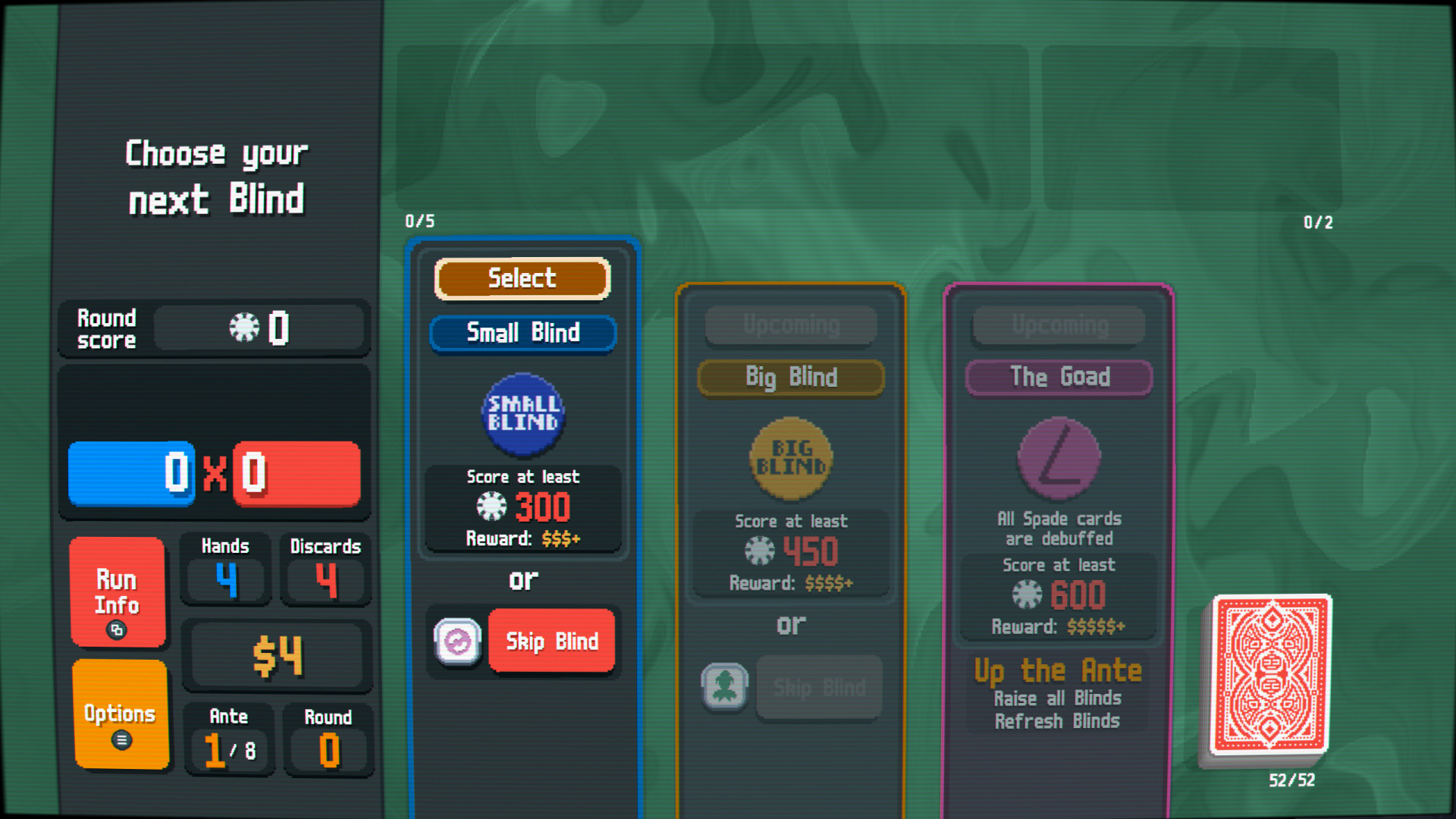 The pre-game lobby. Pick a Deck (Red Deck shown). The deck panel previews the deck's modifier and the Base Cards breakdown: rank counts and suit counts. Some decks remove cards, some add modifiers, some change the suit distribution entirely. Source: Game UI Database.
The 15 Decks
Each deck is a persistent rule mod for the whole run. The player picks one at run start.
| Deck | Modifier |
|---|---|
| Red Deck | +1 discard per round |
| Blue Deck | +1 hand per round |
| Yellow Deck | Start with $10 extra |
| Green Deck | Earn $2 per remaining hand at end of round; no interest |
| Black Deck | +1 Joker slot (5→6); -1 hand per round (4→3) |
| Magic Deck | Start with the Crystal Ball voucher and 2 copies of the Fool tarot |
| Nebula Deck | Start with Telescope voucher; -1 consumable slot |
| Ghost Deck | Spectral cards may appear in the shop; start with a Hex Spectral |
| Abandoned Deck | Start with no Face Cards (J/Q/K removed; 40-card deck) |
| Checkered Deck | Start with 26 Spades and 26 Hearts (no Clubs or Diamonds) |
| Zodiac Deck | Start with Tarot Merchant + Planet Merchant + Overstock vouchers |
| Painted Deck | +2 hand size; -1 Joker slot |
| Anaglyph Deck | After defeating each Boss Blind, gain a Double Tag (next pack is doubled) |
| Plasma Deck | Balance chips and mult before scoring (chips_avg = mult_avg = (chips+mult)/2); blinds 2× chip requirement |
| Erratic Deck | Each card's rank and suit is randomized at run start |
Each deck breaks the assumed shape of the run. The Plasma Deck is the most-discussed: by averaging chips and mult, it disables the entire chip-stacking-vs-mult-stacking dichotomy and rewards balance-builds. The Erratic Deck makes Flush builds nearly impossible (random suits) while making suit-agnostic builds dominant.
The Abandoned Deck (no face cards) has the highest skill ceiling: Royal Flush is impossible, Full House is harder, but Pair-and-Three-of-a-Kind builds become extremely consistent.
The 8 Stakes (difficulty tiers)
Stakes are difficulty modifiers that stack cumulatively. Beating a deck on White Stake unlocks Red Stake on that deck, etc.
| Stake | Modifier (on top of all previous) |
|---|---|
| White (1) | Base game |
| Red (2) | Small Blind reward → $1 (was $3); Big Blind → $2 (was $4); Boss → $3 (was $5), i.e. all rewards halved |
| Green (3) | Required score: Small Blind +25%, Big Blind +25%, Boss Blind +25% |
| Black (4) | Shop has Eternal jokers (cannot be sold or destroyed) |
| Blue (5) | -1 discard per round |
| Purple (6) | Required score: another +20% |
| Orange (7) | Booster Pack costs $1 more |
| Gold (8) | Shop has Perishable jokers (debuffed after 5 rounds) |
So Gold Stake (the hardest tier) combines: half the rewards × 1.5× score requirement × +$1 shop costs × Eternal AND Perishable Jokers × -1 discard. Most players never clear Gold Stake on every deck (15 × 8 = 120 cells; a top player has cleared maybe 80–110 of them).
This is cumulative-modifier-staircase at the meta-progression layer. Each Stake = one more rule. The staircase is built into the difficulty system itself.
The 15 × 8 completion grid
The Stake-completion screen on each deck shows 8 stakes-cleared markers. Cleared stakes are marked with the deck's color tint; uncleared are greyed.
A player who's cleared every deck on White Stake (15 cells) has played the game 15 times. A Gold Stake completionist has played 120 targeted runs, many more than 120 counting failures.
Compare to:
- Slay the Spire's Ascension staircase: 4 characters × 20 ascensions = 80 cells. Balatro's grid is ~50% bigger.
- Hades's Pact of Punishment: score-driven, no fixed cells.
- Pokémon RSE Battle Frontier: 7 facilities × 2 Symbols = 14 cells.
The Balatro grid is one of the densest completion structures in modern roguelites.
Why decks-as-rule-mods is the right call
A casual roguelite would have unlocked decks be power upgrades ("Yellow Deck has +5 starting mult"), drifting the meta toward optimal-deck-meta. Balatro's choice: each deck has a rule modifier, not a power bump. Yellow Deck has $10 extra (which mostly evaporates by Ante 3); Black Deck has +1 Joker slot but -1 hand (a real tradeoff); Plasma Deck has fundamentally different scoring (which is harder, not easier).
The rule-mod choice produces:
- Variety, not power. Every deck plays differently; no single deck is objectively best.
- Completion as a play directive. Clearing Black Deck on Gold Stake forces you to learn 3-hand discipline, an unusual skill the other decks don't develop.
- Build identity tied to deck. A Magic Deck run plays around its starting Fool tarots; an Erratic Deck run gives up on Flush builds entirely.
This is the meta-as-variety-not-power pattern in its purest form.
What this teaches
- 15 × 8 grid = 200 hours of self-paced completion. A 15-cell axis × an 8-cell axis = ~120 distinct goals. Players self-pace through the grid; LocalThunk doesn't have to fund 120 individual unlock cinematics.
- Difficulty modifiers as cumulative > as toggles. Stake 8 is not "harder than Stake 1." It's "Stake 1 + 7 more rules." Each Stake teaches the player to handle one more constraint at a time.
- Rule mods > stat mods. "+5% damage on Yellow Deck" is forgettable. "Yellow Deck starts with $10 extra" is a tactical asymmetry that reshapes the early-Ante decisions.
- Completion structures are cheaper than content. A 120-cell grid uses the same shop, same Jokers, same Boss Blinds; the variation is in the rules around them. Author one strong run-engine, mod it 120 ways.
Patterns this exemplifies
meta-as-variety-not-power: the canonical case in this knowledge base. Decks are rule mods, not power bumps. Stakes are difficulty modifiers, not stat boosts.cumulative-modifier-staircase: Stakes stack cumulatively (Stake 8 = Stake 1 + 7 rules). Hades's Pact of Punishment is the closest analogue.bounded-roguelite: the run ends at Ante 8 (Boss Blind 8). Endless is opt-in; the canonical experience is bounded. ~2-hour runs.