The Legend of Zelda: Breath of the Wild
Nintendo EPD's 2017 open-world Zelda for Wii U + Switch, directed by Hidemaro Fujibayashi, produced by Eiji Aonuma. A single visible mountain, a paraglider, a stamina ring, a "chemistry engine" of fire/ice/wind/water rules, and 120 small shrines scattered through Hyrule. The pitch: everything you can see, you can reach. The reason this works is that almost every system in the game is designed to interact with the others, what Fujibayashi called "multiplicative" rather than "additive" design.
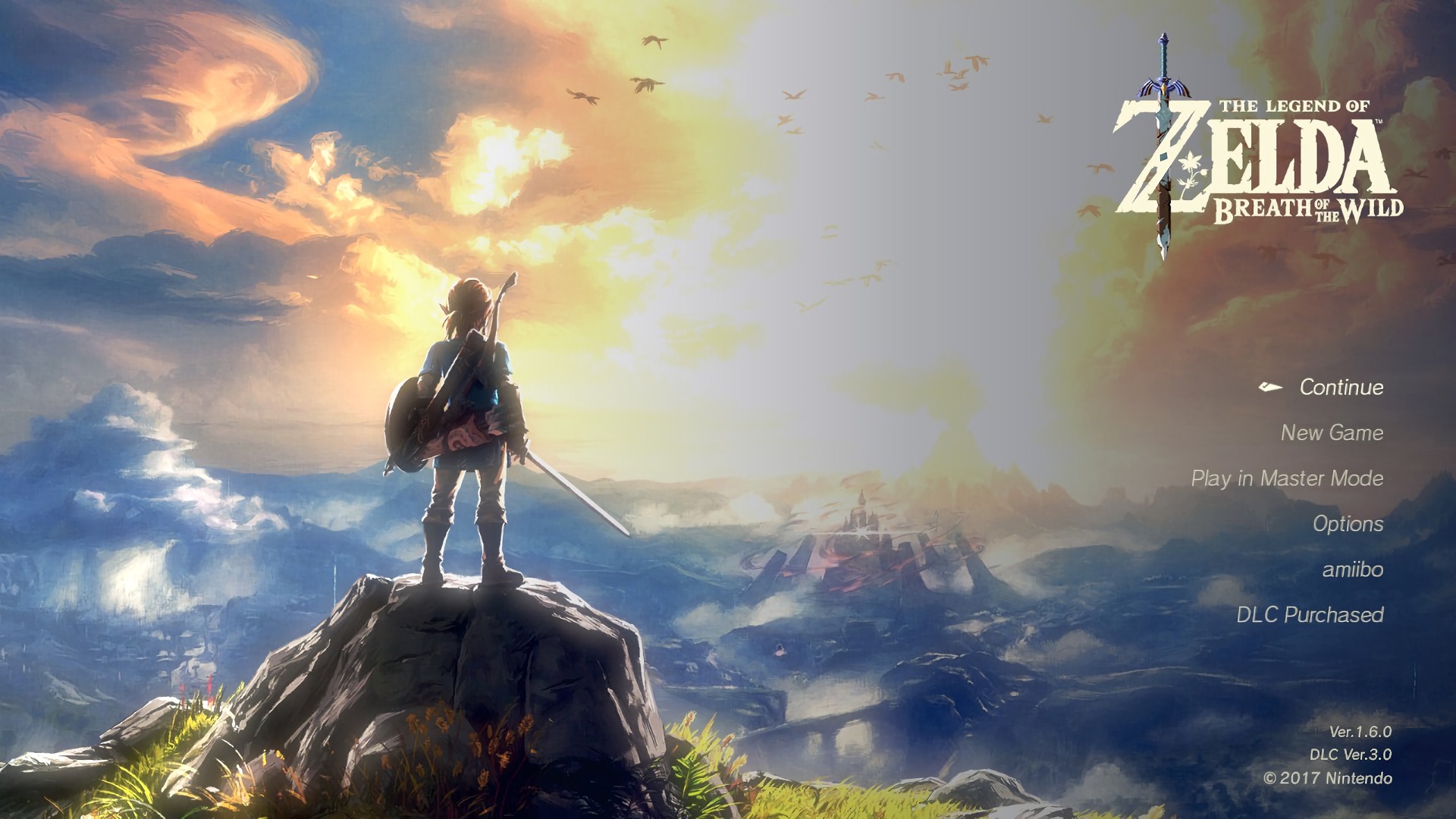 Breath of the Wild's title screen: the iconic "looking out at the world" framing is also the game's design pitch: pick any visible point, walk there. The hero is positioned the same way the player will be on the Great Plateau ledge ~30 minutes into the game. Source: Game UI Database.
Snapshot
| Studio / publisher | Nintendo EPD (Entertainment Planning & Development): successor to Nintendo EAD. Published by Nintendo. |
| Director | Hidemaro Fujibayashi (also directed Skyward Sword, Tears of the Kingdom). Producer Eiji Aonuma (Zelda series producer since 2005). |
| Released | March 3, 2017 (Switch launch title; also Wii U). DLC: The Master Trials (Jun 2017) + The Champions' Ballad (Dec 2017). |
| Platform | Switch (primary, ongoing) · Wii U (released; never updated past launch) |
| Genre | Open-world action-adventure; physics-and-chemistry sandbox; long-form exploration |
| Business model | Premium one-time purchase + paid Expansion Pass (single $20 pack) |
| Iconic mechanic | The "chemistry engine": fire, ice, wind, water as systemic rules that interact with the physics engine. Plus: climb anywhere with stamina cost; weapons break; 120 shrines as scattered puzzle nodes. |
| Core dialectic | "Reach for any visible point: and pay for it in stamina, weather, or weapons." Freedom + cost. |
| Hours to credits | ~30h to credits with 4 Divine Beasts; ~50h+ for full shrine completion; ~100h+ for korok seeds + master sword + DLC |
| Sales | 30M+ copies as of 2024: best-selling Zelda title ever; one of the best-selling games of all time |
| Hyrule shape inspiration | Director Fujibayashi used a map of Kyoto (his hometown) as a reference for shrine placement and traversal density. |
Macro loop
loop:
  open the map → see a shrine icon, a tower, a question-mark, or a peak
  pick one → walk / climb / paraglide / horse-ride toward it
  encounter:
    weather (rain blocks climb, lightning hits metal, cold drains hearts) → adapt
    enemies (camp, bokoblin, Lynel) → fight or sneak (chosen weapon may break)
    cooking pot → assemble ingredients → cook food / elixir
    shrine → solve a ~10 min physics puzzle → earn Spirit Orb
    Sheikah Tower → unlock that region's map
  every 4 Spirit Orbs → trade for Heart Container OR Stamina Vessel at a Goddess Statue
  every 4 dungeons (Divine Beasts) → cleared → Champion's Blessing
  story spans 30+ hours; player can fight Calamity Ganon at any time, of any HP
weather and time:
  day/night cycle (~24 in-game minutes); affects enemy aggression, blood-moon respawn
  weather drives climb / fire / electricity / cold rules; you check sky before commitment
Mechanic deep-dives
- The chemistry engine: fire, ice, wind, water, electricity as systemic rules. Burn grass to make updrafts; freeze water to make pillars; metal weapons attract lightning. The "multiplicative" core.
- Climbing + the stamina ring: almost every surface is climbable; vertical movement is gated by a stamina meter that recharges and is upgraded by Stamina Vessels. The ring is the entire traversal economy.
- Weapon degradation: every melee weapon, bow, and shield breaks. Aonuma's defense, the divisive reception, and what the system actually does for combat pacing.
- The shrine network: 120 small puzzles (~10 min each) replacing classic Zelda's 8 long dungeons. Why Fujibayashi made the trade, and how it changes the game's exploration shape.
- Sheikah Slate runes + traversal devices: Magnesis, Stasis, Cryonis, Bombs, Camera, plus the paraglider, horse, and (DLC) Master Cycle. The fixed verb-set you carry into every shrine.
Through other lenses
- Ludonarrative reading: these mechanics read through the resonance lens. Verdict: affirms, Hyrule's "long quiet after the calamity" reads in the texture of every system: weapons break, the world hasn't been cared for in 100 years, the shrines are quiet, the climb is slow.
What this game teaches
- "Multiplicative" design is more useful than "additive" design. Fujibayashi's GDC 2017 framing: objects don't just respond to the player, they respond to each other, produces a sandbox where players invent solutions the team didn't author. Adding a 6th rule to a chemistry system multiplies expressiveness more than adding a 6th item to an inventory.
- A small, fixed verb-set scales further than a deep one. Link gets ~5 runes + paraglider + climb in the first hour. Those verbs combine, in 120 shrines and 60 km², without ever expanding. You don't need new toys; you need new contexts for the same toys.
- Climb-anywhere is a one-line rule that re-shapes the whole game. The decision to make almost every surface climbable means the player can break the encounter designer's lines of approach for every combat in the game. The cost is a stamina meter: small, simple, sufficient.
- A shrine network beats one big dungeon for an open-world. 120 × 10 minutes ≠ 12 hours of one dungeon. The structure rewards short attention windows: the most under-served budget in modern open-world play.
- Weather as a real constraint changes the player's planning horizon. Rain blocks climb. Cold drains hearts. Lightning hits metal. Players check the sky before committing to a route. This is a single environmental layer doing 5 design jobs.
See lessons.md for the longer take.
See also
- Design tensions: Fujibayashi / Aonuma quotes on multiplicative design, weapon durability, and shrines-vs-dungeons
- Patterns: full pattern table
- Sources: bibliography