Deckbuilding
The actual loadout system. Fills the role that the patch board plays in Sparklite, or that mods/Forma play in Warframe.
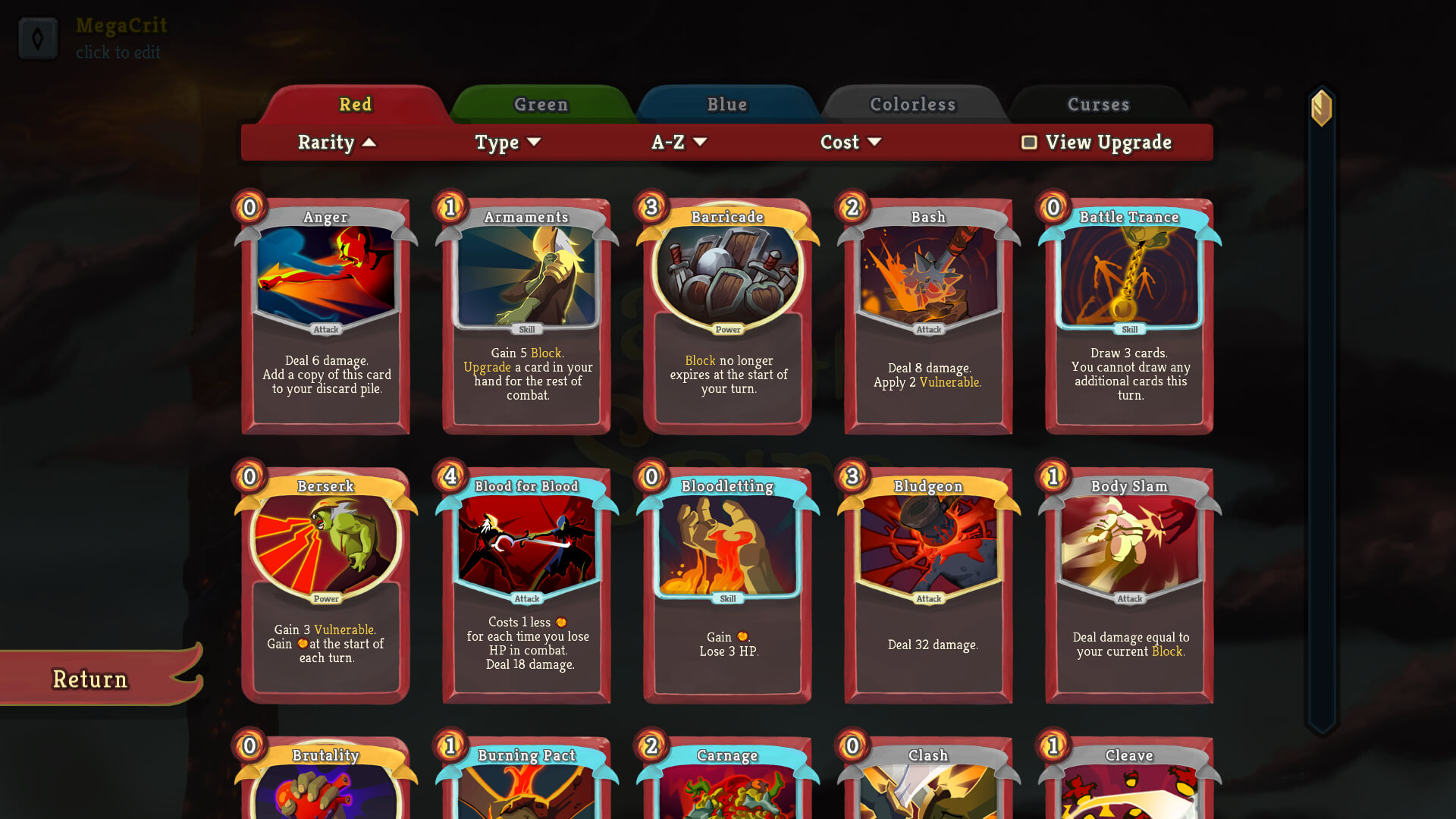 The card compendium: a slice of the ~75 Red (Ironclad) cards. Each card is hand-tuned; the run-time question is which 15–20 you can stitch into a coherent deck. Source: Steam.
Card rarities and rewards
- Common, Uncommon, Rare + special unlocks.
- Card-reward draft post-fight: 3 cards, pick 1 or skip.
- Rarity distribution depends on what you just did:
- Normal monster: mostly Commons, some Uncommons, occasional Rare.
- Elite: more Uncommons + Rares.
- Boss: 3 Rares (always).
Pity system
A hidden "rare drift" counter:
- Starts at -5%.
- Every common rolled bumps the rare chance by +1%.
- Rolling a rare resets the counter.
Result: you can't go too long without seeing a rare. Same anti-streak philosophy as Unknown node resolution. See pity-system-anti-streak.
Card upgrades
Almost every card has a + version with better stats / extra effect.
Where upgrades come from:
- Rest Site smith option (1 per rest, the alternative to healing).
- Specific events.
- Whetstone / War Paint potions.
- Some boss rewards let you upgrade in one shot.
Note that the smith vs heal choice at every campfire is itself a small risk-vs-reward decision. Heal now (survive the next fight) or upgrade (snowball longer). See the recurring pattern.
Deck thinning: the canonical strategy
You start with 10 starter cards (mostly basic Strikes/Defends). The new-player intuition is "more cards = more power." The actual best play, almost always, is fewer, better cards.
A 15-card deck cycles fast and reliably draws its synergies. A 35-card deck dilutes everything.
Tools for thinning:
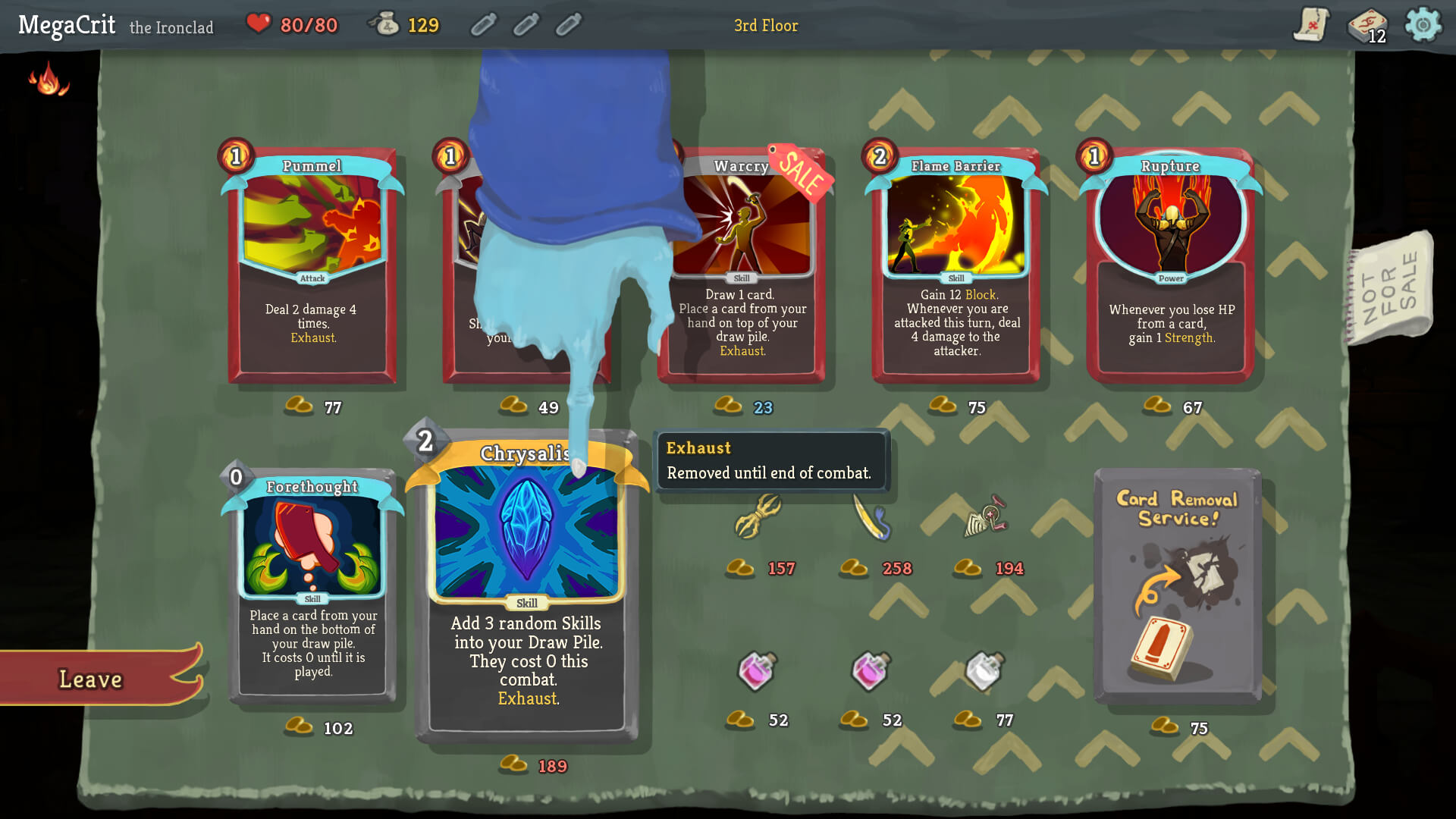 The merchant shop. The "Card Removal Service" on the right is the canonical thinning tool: pay gold to remove a card from your deck. Cost escalates per visit, capped per shop. Source: Steam.
- Shop card-removal (escalating cost, capped per shop visit).
- Events that exhaust/transform/remove cards.
- Exhaust mechanics (Ironclad's whole archetype: cards that one-shot themselves out of the run, generating value as they do).
- Innate cards always start in your opening hand → effectively reduce the random draw.
This makes deckbuilding subtractive, not just additive. You're not stacking power on top of stuff, you're carving out a tight loop. That's the inversion that defines the genre.
Card draft with skip
Each post-fight draft: pick 1 of 3 cards or skip. Skipping has real value, fewer cards is better, but you need some cards. So every draft is a question: "is this card better than nothing?"
Skip is a first-class option, not a punishment. That changes the entire shape of decision-making vs. games where you must pick. See card-draft-with-skip.
Archetypes
Each character has a few well-known archetype templates competent players recognize:
- Ironclad: Strength scaling, Heavy Blade, Limit Break / Exhaust, Corruption, Feel No Pain / Block, Barricade, Body Slam.
- Silent: Poison ramp, Shivs, Thousand Cuts, Footwork-scaling, Discard synergies.
- Defect: Frost-block, Lightning-volley, Focus scaling, Claw spam.
- Watcher: Wrath/Calm stance dance, Retain, mid-combat card generation.
Archetypes aren't strictly defined. They emerge from the cards/relics you happen to find. The skill is in recognizing what archetype the game is offering you 5 cards into Act 1 and committing.
This is a deliberate design call, Mega Crit explicitly rejected letting players pre-pick a starting rare card to direct their deck. Forcing players to react to what's offered is the design principle. See design tensions.
Patterns this exemplifies
subtractive-deckbuildingcard-draft-with-skippity-system-anti-streak