Through the ludonarrative resonance lens
A reading of Sparklite's mechanics through the ludonarrative resonance lens, does what the player does affirm what the game says it's about?
Mechanic read: the patch board, the permalife loop, and the Refuge hub.
Verdict: Mild affirm. The patches and sparklite are literally what the fiction says they are; the Refuge upgrade loop fits the "rebuild the home base" frame. But the affirmation is partial, combat doesn't say much about being this character, and the fiction is a setting, not a deep world. Sparklite gets a row in the lens not because it's a canonical case but because it shows what light but real resonance looks like.
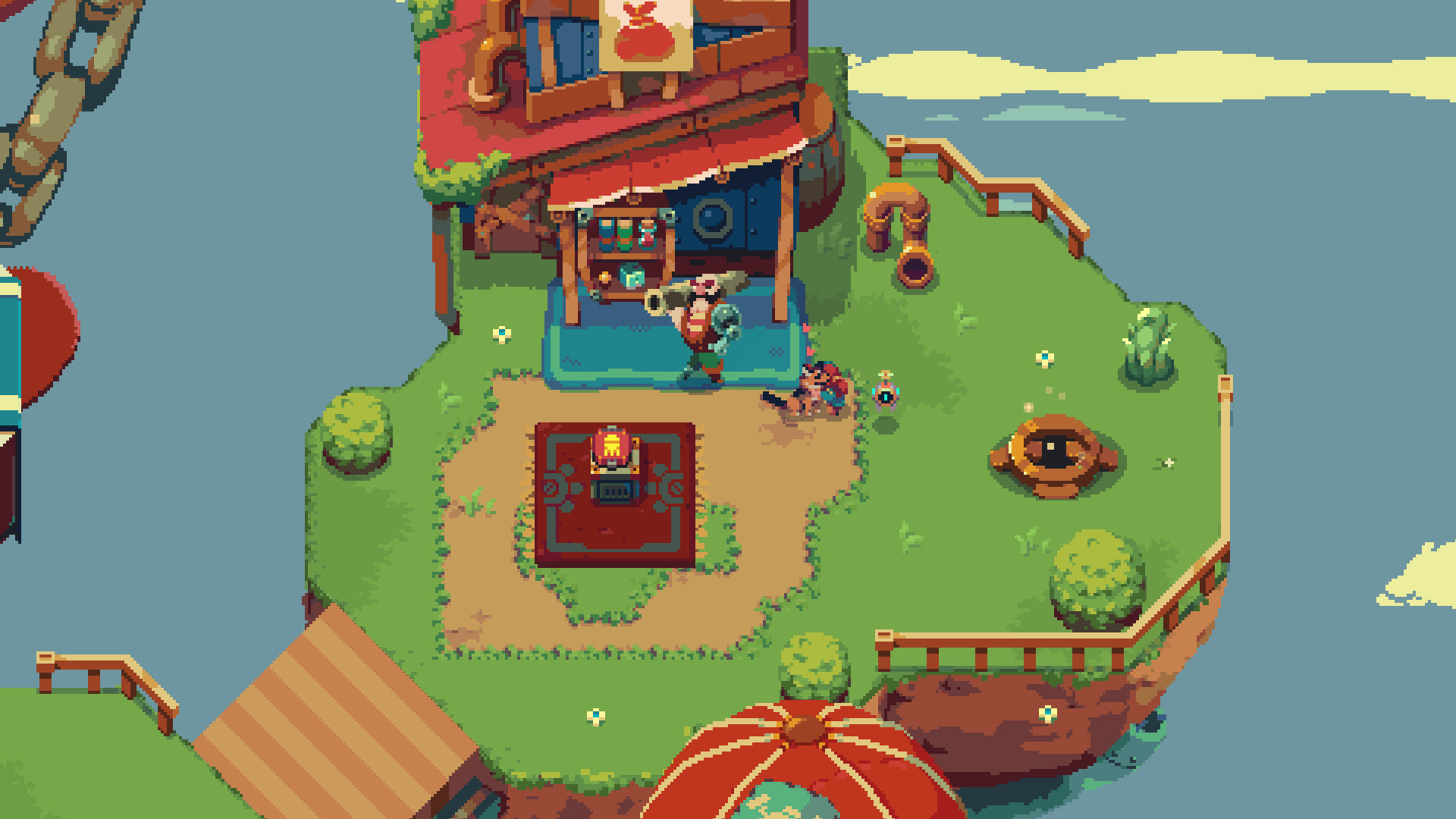 The Refuge: a persistent flying-island home base that grows across deaths. The fiction is "you crashed here, the sky-pirates rebuilt you, you owe them": the hub-upgrade loop is the literal payback. Source: Steam.
What the fiction is
Geodia is a fractured world powered by sparklite-crystals, a setting with a steampunk-fantasy aesthetic and a soft anti-industrial allegory (Baron Mineau is mining the planet to ruin). You crash-land, the Refuge sky-pirates pick you up, you fight back into the world. Death isn't death, the Refuge med-bay rebuilds you. The devs call this permalife.
It's a setting, not a complex world. There are NPCs with personality, light politics, an environmental theme. None of it is doing Hollow-Knight-density work.
Where the resonance lands
Three mechanics actually carry the fiction:
- The patch board. You arrange Tetris-shaped patches on a grid in your med-bay. Fictionally, these are sparklite patches: physical augments installed in your character's recovered body. The grid isn't a stat menu; it's the med-bay workspace. Fiction and mechanic share nouns.
- Sparklite as currency. The world's macguffin material is also your spendable resource. The Baron is mining it; you're collecting it; the Refuge runs on it. Every "gold pickup" is a fictionally-grounded action. The currency isn't generic.
- Permalife. Death triggers a world re-fracture: the procedurally-arranged tiles rearrange, but your character keeps progress. The fiction's claim that the Refuge rebuilds you is mechanically what happens. The world's instability is not arbitrary roguelite reset; it's the planet itself reacting.
These three are real resonance. Each is a mechanic where the fiction's nouns are the mechanic's nouns.
Where the resonance is light
But most of the loop is neutral or orthogonal:
- Combat verbs are generic. Sword swing, gadget toss, boss patterns. None of it says anything specific about being the protagonist (who is barely characterised). Combat could be reskinned for a different setting and the loop wouldn't notice.
- NPC dialogue is light. Refuge inhabitants exist and accumulate, but the writing volume is low. There's nothing like Hades's stateful per-NPC dialogue trigger system. The hub doesn't carry the narrative weight; it's a backdrop with shopkeepers.
- The Baron-Mineau allegory exists but isn't load-bearing. The fiction has a theme (industrial extraction is bad). The mechanics don't deliver that theme: you're harvesting sparklite all run; the protagonist is functionally an extractor too. There's an accidental dissonance there, though small.
What the lens diagnoses
Sparklite is the case-study in partial resonance done well. It commits to resonance where the fiction's load-bearing nouns appear (patches, sparklite, Refuge), and lets the rest stay neutral (combat verbs, dialogue density). The result is a game that feels coherent without spending a Hades-sized writing budget.
Compare to a game that reaches for resonance everywhere and only delivers half, that game feels dissonant because the unfulfilled reach is visible. Sparklite's modesty about how much fiction it can carry is part of why the resonance it does land doesn't ring hollow.
What the loop says
I crash-landed on a fractured planet. The locals patched me back together with the planet's own crystal-energy. I go out to fight back the people destroying it, and I bring fragments home to make myself stronger.
That sentence describes the patch-board, the sparklite economy, the permalife loop. It doesn't describe the combat encounters or the moment-to-moment dialogue, but it doesn't have to, the frame of the game is what the lens reads, and that frame holds.
Where it could have failed
If the patch board were a flat stat tree instead of a Tetris-grid, the literal "rebuilding-your-body-with-crystal-fragments" connection evaporates. If sparklite were renamed "gold," the world's macguffin disconnects from the player's currency. Each of those moves is small individually; collectively they would erase the resonance Sparklite does have.
See also
- Mechanic pages: Patch board, World & loop, Combat
- Lens (overview): Ludonarrative resonance
- Adjacent pattern:
grid-inventory: the patch-board is one of its variants; the lens explains why a spatial loadout reads more diegetic than a numeric stat tree would for this fiction.