Balatro
A 2024 roguelike deckbuilder by the pseudonymous solo developer LocalThunk, published by Playstack. Played with a 52-card poker deck. The pitch, "my modern indie take on solitaire with a poker coat of paint", undersells it. Underneath the familiar surface, Balatro is a multiplicative scoring engine: poker hands × Jokers × deck-mutations × planet-card-levels × seals × editions. By Ante 8, a single Flush can score billions. The play is in building the engine; the poker is just the input format.
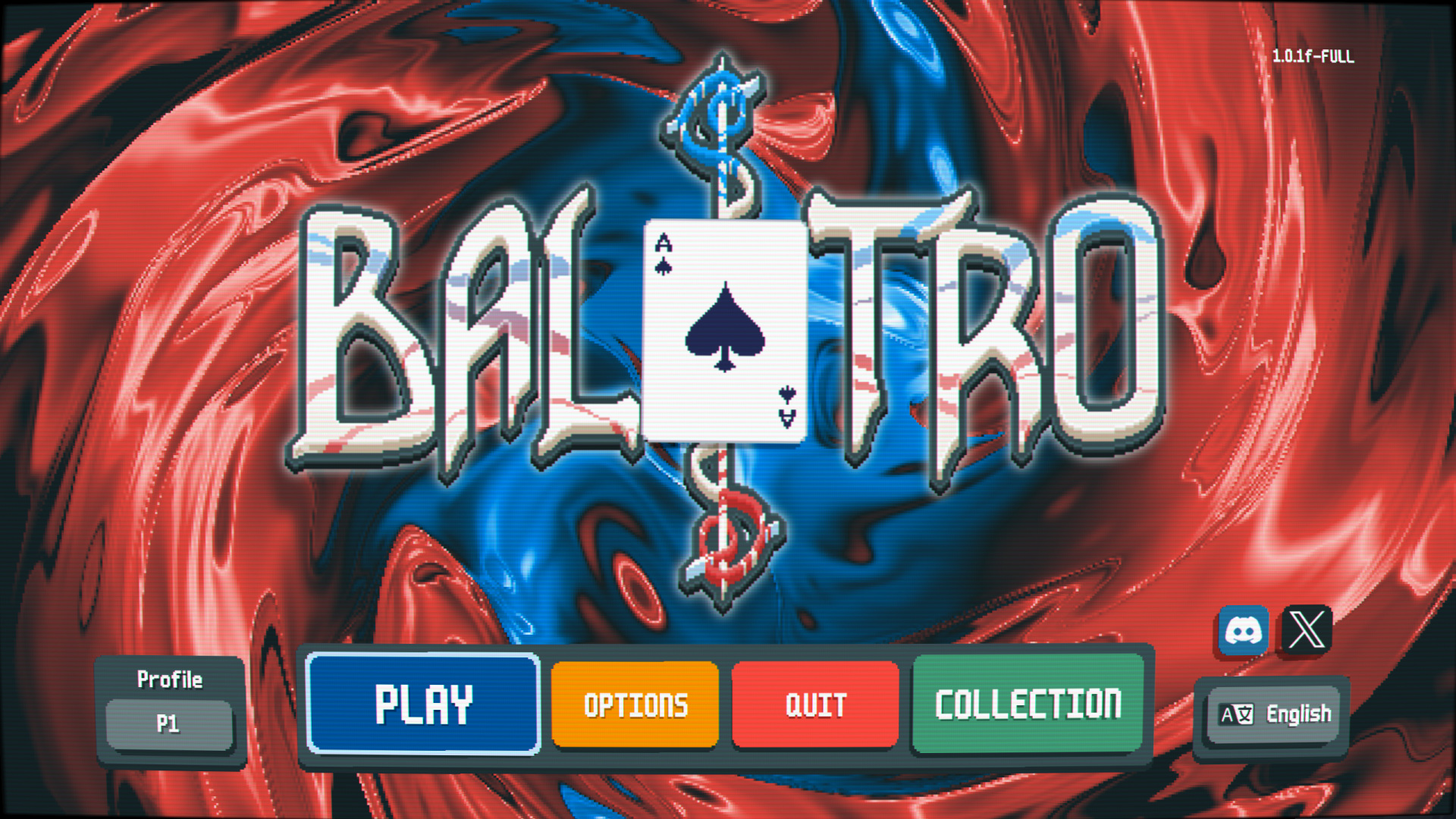 Balatro's title screen. The Collection button is the load-bearing surface for replayability: every joker / deck / voucher / tarot you discover unlocks an entry there. Source: Game UI Database.
Snapshot
| Studio / publisher | LocalThunk (solo dev, pseudonymous) · Playstack (publisher, also published Talos Principle 2 etc) |
| Director / designer / coder / artist | LocalThunk: single person doing everything but the audio (Louis F. for music) |
| Released | February 20, 2024 (PC, console) · 2024 mobile port · ongoing patches and the Friends of Jimbo free DLC packs |
| Engine | LÖVE (Lua framework): open-source 2D engine |
| Genre | Roguelike deckbuilder; solo card game with run-based meta-progression |
| Business model | Premium one-time purchase (~$15 launch); no MTX |
| Iconic mechanic | The chip × mult scoring: every poker hand has a chip count and a mult; everything in the run multiplies one or both |
| Core dialectic | "Familiar surface, deep math underneath": poker is the input format, not the game |
| Hours to credits | ~2h to first Red Deck Stake clear; ~50h to most decks × white stake; ~200h+ for full Gold Stake completion |
| Sales | 5M+ copies as of late 2024: among the best-selling indie games ever |
| Awards | The Game Award for Best Independent Game 2024; multiple GOTY shortlists |
Macro loop
loop:
  pick deck (15 variants, each with one persistent rule mod)
  pick stake (8 difficulty tiers; each adds modifiers)
  every Ante (1..8):
    Small Blind  → score X chips → reward + shop
    Big Blind    → score X*1.5 → reward + shop
    Boss Blind   → score X*2 + a run-warping debuff → reward + shop
    shop:
      buy Jokers (passive multipliers)
      buy Tarot/Planet/Spectral packs (consumables)
      buy Vouchers (run-permanent shop modifiers)
      buy playing cards (deck additions)
      reroll for $5
  Ante 8 Boss Blind cleared → run win
  endless mode: continue past Ante 8 (the chip thresholds explode exponentially)
on every hand played:
  pick up to 5 cards from your hand of 8
  game scores hand-type → chips × mult
  Jokers fire in slot order, modifying chips/mult
  cards trigger Enhancements / Editions / Seals
  Round score accumulates; if it meets the blind, you advance
on death (failing Boss Blind):
  unlock new Joker / Voucher / Deck if you crossed milestones
  return to deck-select; the meta-progression ratchet has clicked
What's the trick
Three structural moves working together:
- The hand-type ladder. Each poker hand has a base chip count and base mult (High Card 5×1; Pair 10×2; Two Pair 20×2; Three of a Kind 30×3; Straight 30×4; Flush 35×4; Full House 40×4; Four of a Kind 60×7; Straight Flush 100×8; Royal Flush 100×8; Five of a Kind / Flush House / Flush Five: secret hands unlocked via mods). Everything in the run modifies these numbers.
- Jokers as multiplicative modifiers. Up to 5 Joker slots (more with Negative editions), each a passive trigger. They add chips, multiply chips, add mult, multiply mult, scale by suit, scale by rank, scale by hand-type, scale per-trigger. Stacking Jokers is the build.
- The Ante staircase. Required scores grow ~exponentially: 300 → 800 → 2,000 → 5,000 → 11,000 → 20,000 → 35,000 → 50,000 across 8 Antes. Endless mode goes 110k → 560k → 7.2M → 300M → 47B → 8.6 × 10²⁰. The numbers don't pretend to be reasonable.
Mechanic deep-dives
- Poker hands as a chip×mult ladder: the hand-type table and how Planet Cards permanently level up specific hands. The base scoring engine.
- Jokers as multiplicative modifiers: 150 jokers, 5 slots, multiplicative stacking. The build. Why solving Balatro = solving joker synergies.
- The deck as the build: playing cards aren't input; they're equipment. Tarots mutate them, Spectral cards transform them, Enhancements + Editions + Seals stack three orthogonal modifier dimensions per card.
- Shop economy + interest: the run economy: between rounds, you buy from a randomly-stocked shop, and unspent dollars earn 1$ interest per $5 held (cap $5). The greed-vs-spend dialectic of every Spire-like, sharpened.
- Blinds + Boss Blinds: the round structure (Small / Big / Boss × 8 Antes) and the Boss Blind catalogue: 30 named modifiers that warp specific runs (debuff suits, ban hand types, force discards).
- Decks + Stakes: 15 starting decks (each a persistent rule mod) × 8 difficulty stakes. The replayability axis: a single play of the game is one cell of a 15 × 8 = 120-cell completion grid.
Through other lenses
- Ludonarrative reading: these mechanics read through the resonance lens. Verdict: orthogonal, Balatro has effectively no fiction; the game is honest about being a math sandbox in poker drag. Like Slay the Spire, this is the right call.
What this game teaches
- Familiar input formats lower onboarding cost dramatically. Players already know what a Flush is. LocalThunk didn't have to teach the noun set; he reused poker's. The first-five-minute friction in Balatro is near-zero, and the depth grows entirely on the player's existing schema.
- Multiplicative scoring is the load-bearing trick. Once one Joker says "+10 mult" and another says "× 1.5 mult", players' brains light up at the combinatorial possibilities. Additive design ("damage += 5") is forgettable; multiplicative design ("damage *= 1.2") is sticky.
- A 5-slot Joker loadout is plenty. Balatro's Joker count (150 base) is huge, but you only ever hold 5. The constraint produces real per-run identity: you can't run "all the Jokers"; you must commit to a build axis.
- The "Collection" tab is a meta-progression ratchet. Unlocked items appear in the Collection, visible in greyed-out form before discovery. Players see what they don't have yet. Discovery is the long-tail engagement engine.
- Solo dev + tight scope = a 5M-copy hit. LocalThunk's single-author authority over every decision (mechanics, art, balance, UI) is part of why Balatro lands so coherently. Committee balance would have softened the engine's edges.
See lessons.md for the longer take.
See also
- Design tensions: LocalThunk's interview quotes on solitaire-with-a-poker-coat, the avoiding-Spire stance, and the "balance by feel" philosophy
- Patterns: full pattern table
- Sources: bibliography