Folder & chip codes
The deckbuilding layer. 30 chips per Folder, constrained by letter codes that determine what plays well together.
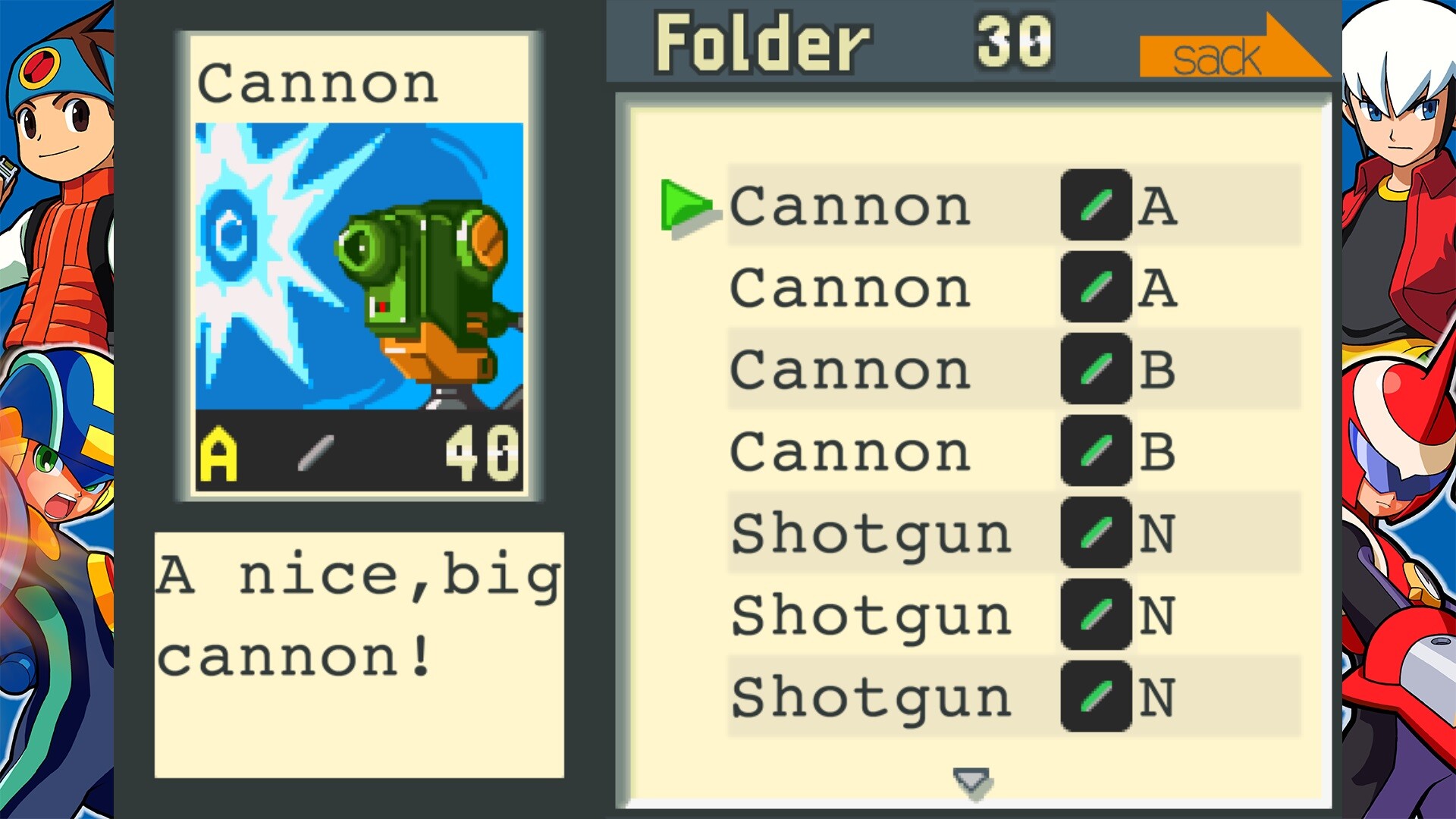 The Folder editor. Each chip carries a name and a letter code (A, B, N, ★…). Code-coherence between chips is what determines hand-stack play, so deckbuilding converges on archetypes: "mono-A folder," "mono-★ defensive suite." Source: Steam.
Structure
- A Folder is exactly 30 chips.
- Each chip is identified by name + letter code (A–Z, plus the ★ wildcard added in BN2).
- Standard chips: cap of 4 of any one chip name (codes don't matter for the cap).
- Mega Chips (BN3+): cap of 5 in a folder, max 1 of each name.
- Giga Chips (BN3+): cap of 1 per folder.
- Sub-chips (HP recovery, escape) are inventory-based, not folder-based.
- Some Navis you ally with seal a "Regular Chip" slot: this chip is auto-included in your opening Hand every battle, the only deterministic anchor in the otherwise random draw.
The code rule: the actual deckbuilding lever
At the chip-draw screen, you can pick multiple chips per turn only if they share:
- The same name (any code), OR
- The same letter code (any name)
- The ★ wildcard counts as any code.
So a Hand of:
- Cannon A, Cannon B, Cannon C → all three playable (same name)
- Cannon A, Sword A, FireBurn A → all three playable (same code)
- Cannon A, Sword B, FireBurn C → only one of these is playable per turn
This is the constraint that makes BN deckbuilding distinctive. Hearthstone and MTG let any cards combine; BN's letter-code rule is a combinatorial constraint on co-play. Folders converge on:
- Mono-code folders ("mono-B", "mono-C"): many different chips all sharing one code, so the random hand is full of co-playable chips.
- Name-stacked folders: 4 of one chip + supporting variants → reliable spam pattern.
- ★-heavy folders: wildcards as flex slots.
- Hybrid folders: a code spine + signature chips with code variants.
The result is closer to drafting a poker hand than building a Magic deck.
The opening Hand as an anchor in randomness
Each battle, you draw the first 5 chips from a shuffled Folder. The opening Hand is random, but:
- Regular Chip (1 slot) is auto-included.
- PA recipes (see Program Advance) are targets: folders are deliberately stuffed with the chips needed to hit a specific PA.
- Custom+1 / Custom+2 programs in NaviCust increase Hand size to 7+, which dramatically improves draw consistency.
This converts deckbuilding into a probability puzzle, given my Folder of 30, what's the chance my opening 5 contains a co-playable triple? More chips of one code = better probability of usable Hands.
Subtractive thinking, but at the seams
Spire's deckbuilding is subtractive, fewer cards = better draws. BN's Folder is fixed at 30, so subtraction doesn't apply directly. What's subtractive is the code spread:
- Spread your codes across A–Z and your hand will be uncoordinated more often.
- Concentrate codes and your hand will frequently have 2-3 co-playable chips.
So the design lever is "cohesion within fixed size" rather than "shrink the deck." Same effect as Spire's deck thinning, achieved differently.
What this teaches
- A simple rule (letter codes) can carry a whole deckbuilding game. No life points to track, no mana curve, no resource progression. Just: "do these chips share a code or a name?"
- Constraints should compose with the random draw. BN's Folder uses random Hand draws and the code rule together: neither would be interesting alone.
- Anchors in randomness ease the friction. The Regular Chip slot guarantees one always-available chip per battle. Without it, low-coherence opening Hands would be too punishing.
Patterns this exemplifies
subtractive-deckbuilding: different shape (cohesion vs. count) but same insight: tighter focus = stronger draws.code-constrained-deckbuilding: BN's specific lever. Letter codes as a co-play constraint.opportunity-cost-loadout: every chip slot taken by a B-code chip is a slot not held by an A-code chip. Folder commits matter.