Through the ludonarrative resonance lens
A reading of Warframe's mechanics through the ludonarrative resonance lens, does what the player does affirm what the game says it's about?
Mechanic read: the moment-to-moment loop (acquisition, modding, reward loops) versus the cinematic-quest spine (The War Within → The Sacrifice → The New War).
Verdict: Split, and unevenly. Mostly orthogonal, but with intermittent reach for resonance via cinematic quests. The reading isn't clean: Warframe wants its fiction to matter and built infrastructure for that wanting (a deep mythos, voice-acted setpieces, identity-shaking quest beats), but the actual day-to-day loop is farming. The lens names this tension.
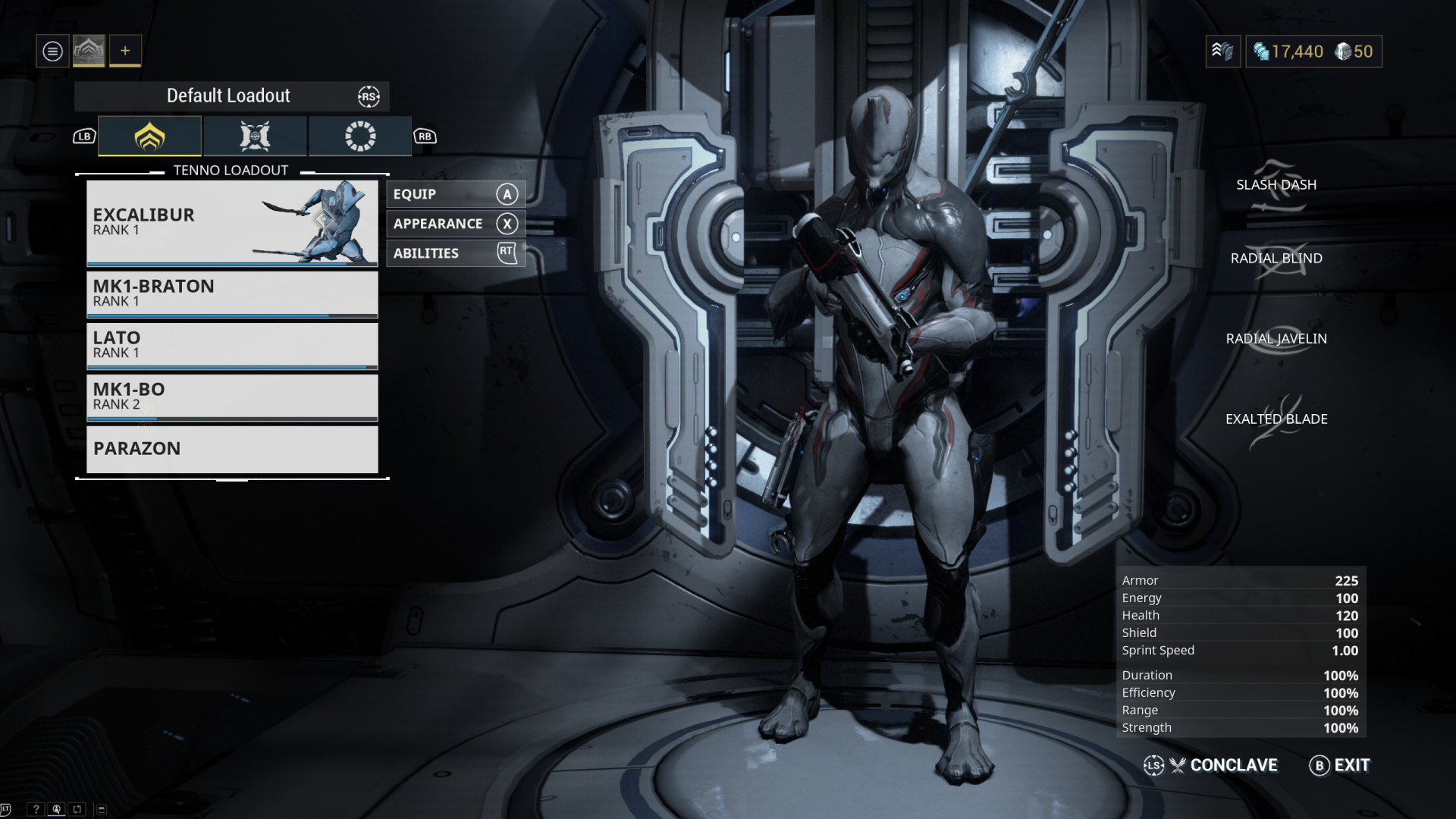 The loadout summary: the surface where most player time is spent. Each slot is a numeric optimisation problem. None of these decisions reach the fiction. Source: Game UI Database.
What the fiction is
Warframe's mythos is rich. Tenno are children exposed to the Void who can pilot bio-mech suits ("Warframes") remotely. The cinematic-quest spine, The War Within, The Sacrifice, The New War, peels back layers of identity: who you actually are inside the Warframe, what the Warframes themselves remember, which faction you belong to, what the cost of awakening was. The setting has factions (Grineer, Corpus, Infested, Sentients), an Orokin-empire backstory, an Operator-Warframe duality that the quests force you to engage with mechanically.
DE has spent twelve years building this fiction and has, on multiple occasions, demanded that players sit through it. The Sacrifice forces Operator-out-of-Frame combat for the first time. The New War swaps the player across factions for entire act-length sequences. These are deliberate moves to make the fiction load-bearing.
Where the resonance lands: the cinematic-quest peaks
When Warframe is doing fiction, it's good at it. The mechanic-fiction fit during cinematic quests is unusually direct:
- Operator gameplay in The War Within: the mechanic of stepping out of the Warframe is the fiction's reveal that you are not, actually, the Warframe. The mechanic is the plot beat.
- Umbra in The Sacrifice: the Warframe acts on its own when the Operator isn't piloting; mechanically, Umbra has independent AI moves. The fiction's claim ("they were people once, they remember") is a mechanical demonstration.
- The New War's faction swaps: mechanical control of Kahl (Grineer), Veso (Corpus), and Teshin (Dax) for full-length sequences. Each playstyle teaches you what that faction feels like to be. The fiction's "everyone has stakes" is mechanical.
These are real resonance moments. They're not cutscene-level fiction; they're playable fiction.
Where the resonance breaks: the day-to-day loop
But cinematic quests are 5% of the time. The other 95% is mission grinding, and the mission loop is mostly orthogonal:
- Mission selection. You pick a node from the Star Chart. The node's fictional location (Mars, Venus, Earth) is a reskin; mechanically the missions are typed (Capture, Defense, Survival, Spy) and the type determines the loop. Going to Earth to farm Cryotic is mechanically identical to going to Mars to farm a different resource.
- Modding. 60 mod points + polarity matching is a numeric optimisation. Fictionally, there's no reason this maps to "Tenno void-mastery." The math doesn't say anything about being a Tenno.
- Forma + Riven Disposition. Pure live-service balancing mechanics. Forma resets gear to 0 to add a polarity slot, with no fictional explanation that survives examination. Riven Dispositions rebalance every few months for fairness reasons that exist outside the fiction.
- Foundry timers. 12-hour weapon builds, 72-hour Warframe assembly. The fiction tries (you're crafting; this takes time). The reality is that timers are a Platinum-skip pressure point. Players know what the timer is for.
So Warframe's core engagement surface, the modding, the farming, the optimisation, is orthogonal to its fiction. The player can spend 200 hours optimising builds without the fiction doing any work.
The tension that defines the game
Warframe is the most interesting case on the lens because it wants to be Hades-density and has shipped systems toward that ambition, but the loop it built can't deliver it consistently. The cinematic quests are the resonance peaks; the months between them are the orthogonal valleys.
This produces a real player experience: people who love Warframe often cite the cinematic quests as their favourite memories and the modding/farming as "the part I tolerate to get to those moments." That's a clean diagnostic of split resonance. The game's peaks are doing fiction work the median minute doesn't.
Compare to PoE, which is honestly orthogonal. PoE never claims its loop is the fiction's delivery vehicle; it tells you upfront that the math is the product. Warframe's marketing and cinematic spine do claim the fiction is load-bearing, and the loop sometimes delivers and sometimes doesn't. That's why this row exists in the lens: to name the intermittent case.
What the loop says (most of the time)
I am farming nodes for resources to feed a numeric optimisation engine. Every six months a cinematic quest demands I remember I am also a child trapped in a void-exposed body piloting an ancient war-suit, and that quest is the best part. Then I go back to farming.
That description is more honest than Warframe's marketing usually is. The lens lets us say it without it being a complaint, the farming is what funds the cinematic-quest production budget; the cinematic quests are what give the farming long-term identity. They feed each other.
Where DE could go further (or shouldn't)
Two design futures the lens watches for:
- Resonance-up. Force more of the day-to-day loop to deliver on the fiction. Make modding decisions reflect Tenno-Operator identity choices, not just numbers. Risk: this nudges Warframe toward a tighter, less optimisable game: undermining the loop the players actually came for.
- Honesty-up. Lean into the orthogonality. Stop pretending the median minute is doing fiction work; let it be the math game it actually is, and concentrate the resonance budget into denser cinematic peaks. Risk: weakens the marketing pitch and the studio's identity.
Neither is obviously right. The lens's job is to make the trade visible, not pick.
See also
- Mechanic pages: Acquisition, Modding, Progression layers, Reward loops, Monetization
- Sibling reading: Path of Exile: Ludonarrative reading (the honestly orthogonal F2P contemporary)
- Lens (overview): Ludonarrative resonance
- Adjacent pattern:
vision-driven-iteration: DE's commitment to cinematic-quest production despite their cost is a vision call about which layer of the game gets to carry the fiction.