Nier: Automata
A 2017 action-RPG from PlatinumGames + Yoko Taro (director) + Square Enix (publisher) in which combat android 2B and her scanner partner 9S fight machine lifeforms across a post-human Earth. The HUD itself is a Plug-in Chip the player can uninstall, the credits roll five separate times, and the final ending asks you to delete your save data to help a stranger. Mechanics, narrative, and UI all argue the same thing: nothing in this world is what it appears to be on first read.
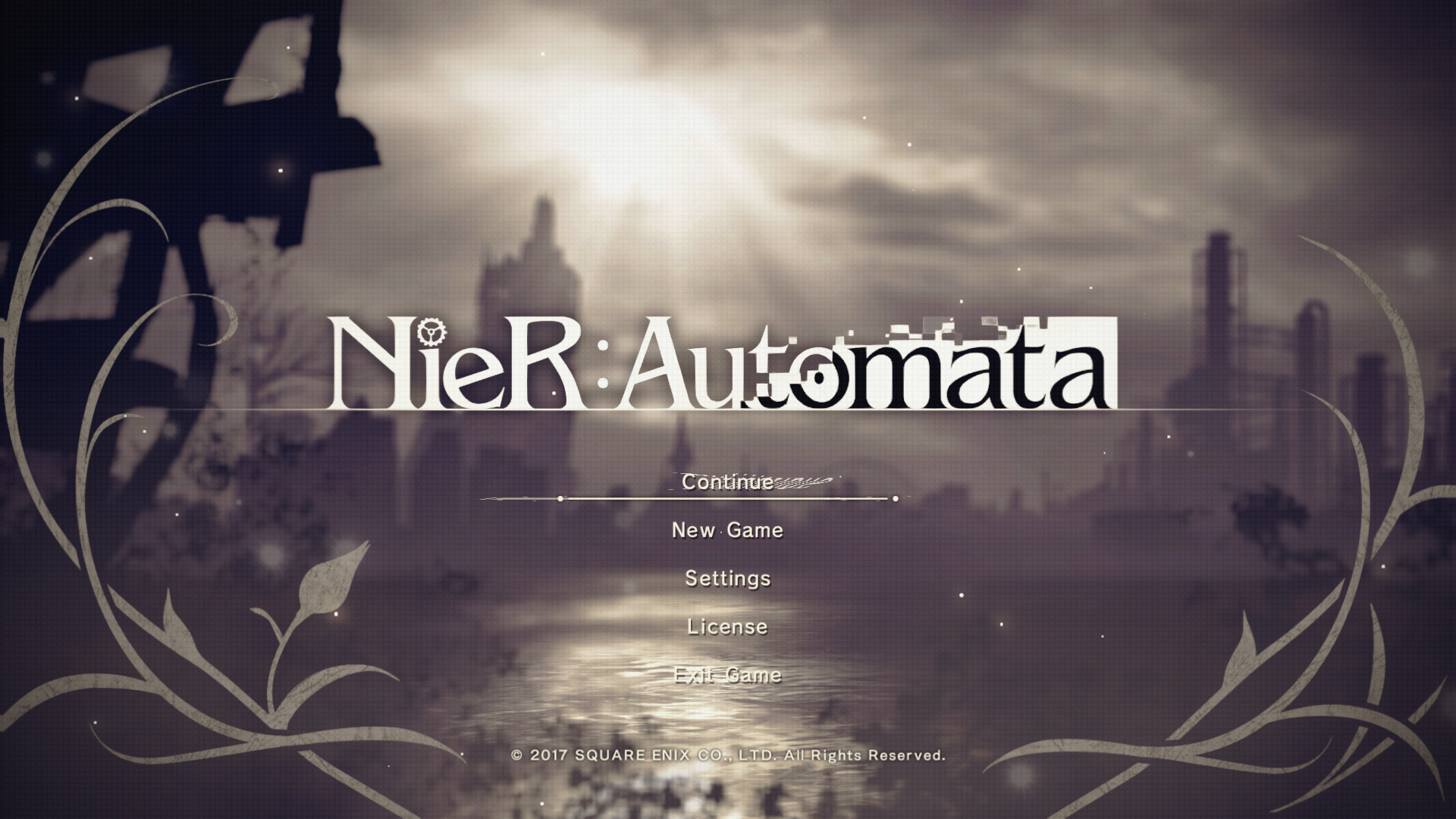 Nier: Automata title screen. The glitch in the logo is intentional and recurring: the game's typography occasionally corrupts during cutscenes and menus, foreshadowing reveals about the nature of the YoRHa androids. Source: Game UI Database.
Snapshot
| Director / studio / publisher | Yoko Taro (director) · PlatinumGames (development) · Square Enix (publisher) |
| Released | 2017 (PS4/Steam) → 2019 (Xbox One) → 2022 (Switch, The End of YoRHa Edition) |
| Genre | Action-RPG; hack-and-slash combat with shmup, twin-stick, and side-scrolling segments |
| Business model | Premium one-time purchase, no MTX |
| Iconic mechanic | Plug-in Chips that include the HUD elements: your minimap is software you choose to install |
| Core dialectic | "Mechanics as commentary, not as content": every system rereads the fiction |
| Hours to credits | ~25–30h to Ending E (the canonical complete experience requires routes A, B, C/D, E in sequence) |
| Sales | 7.5M+ copies as of 2023, far outperforming Square Enix's modest projections |
Macro loop
loop:
  pick route protagonist          # A: 2B → B: 9S replay → C/D: A2/9S → E: meta
  explore open-ish world (City Ruins / Desert / Forest / Amusement Park / Factory / Copied City)
  combat → drop chips + EXP + crafting mats
  loop:
    open menu → tune chip loadout under storage budget (start ~64, max 256)
    decide: more HP? more damage? show the minimap? auto-collect items? auto-fire?
    every chip equipped is a chip not equipped
  pursue main quest → cutscene → next chapter
  optional: side quests, weapon upgrades, unlock weapon-story paragraphs
on death:
  drop body in world (chips equipped at death go with it)
  recover at last save → travel to body → fight your own corpse OR retrieve chips
on credits A (~12h):
  story "ends" → game tells you to start over as 9S
on credits C/D (~25h):
  story "ends" again → unlocks Ending E
on Ending E:
  bullet-hell the credits to a chorus → game asks if you'll delete your save to help others → choose
Mechanic deep-dives
- Plug-in chips: the loadout. Every passive ability (HP+, Auto-Heal, Combo Up) AND every HUD element (minimap, EXP bar, OS itself) is a chip. They share one storage budget. You have to choose what you can see.
- Multi-route ABCDE structure: five "endings" but only E is the ending. A is 2B's run, B is the same content as 9S (different POV + hacking), C/D are A2/9S branching, E is the meta-finale.
- Genre-shifting combat: the camera reframes from third-person hack-and-slash to twin-stick shmup to 2D side-scroller depending on the room. The verbs change with the camera, not with the mode select.
- Ending E + save sacrifice: bullet-hell the credits, accept help from strangers' encouragement messages, then choose whether to delete your own save to help the next player. Ludonarrative as meta-altruism.
- Weapon stories: every weapon has a four-paragraph story, with paragraphs unlocked by upgrading the weapon. Flavor text as the game's most consistent narrative voice.
Through other lenses
- Ludonarrative reading: these mechanics read through the resonance lens. Verdict: structurally affirms. The game's central claims (perception is software, replay is rereading, sacrifice is the verb of empathy) are enacted by the mechanics, not narrated over them.
What this game teaches
- Loadout-as-budget can include the UI. Most games treat HUD elements as a fixed frame; Automata makes them chips. Removing the minimap to free 4 storage for an Auto-Heal chip is a real, frequent decision. The lesson: any element of the game's frame can become a cost.
- "New Game+" is a load-bearing narrative tool, not a checkbox. Route B isn't optional; it's mandatory and a different game. The trick is that Yoko Taro budgets accordingly. Don't promise replay; design for it.
- A meta-altruistic ending is cheap to ship and unforgettable. Ending E uses a tiny network feature (asynchronous co-op encouragement) and one binary save-deletion prompt. Total cost: trivial. Memorability: defining.
- Flavor text can be the dominant narrative channel. The four-paragraph weapon stories add up to more total prose than the cutscenes, and they're the part players quote. If your game has equippable items, the text on them is a free narrative budget.
- Genre-shifting works as commentary. When the camera collapses to 2D for the YoRHa Bunker hallway, the game is saying something about institutional confinement before any character speaks. The verb-set is rhetoric.
See lessons.md for the longer take.
See also
- Design tensions: Yoko Taro's quotes on routes, endings, and budget
- Patterns: full pattern table
- Sources: bibliography