Through the ludonarrative resonance lens
A reading of PoE2's mechanics through the ludonarrative resonance lens, does what the player does affirm what the game says it's about?
Mechanic read: combat philosophy (slowed, soulslike-leaning) + weapons grant skills + one-death maps + the inherited optimisation loop (currency-as-crafting, passive tree, atlas).
Verdict: Split, combat tries for resonance, the meta-loop stays orthogonal. PoE2 is the most interesting case on this site because GGG explicitly went back to a decade-old loop and asked "can we make pressing a button feel weighty again?" They partially landed it. The lens shows where.
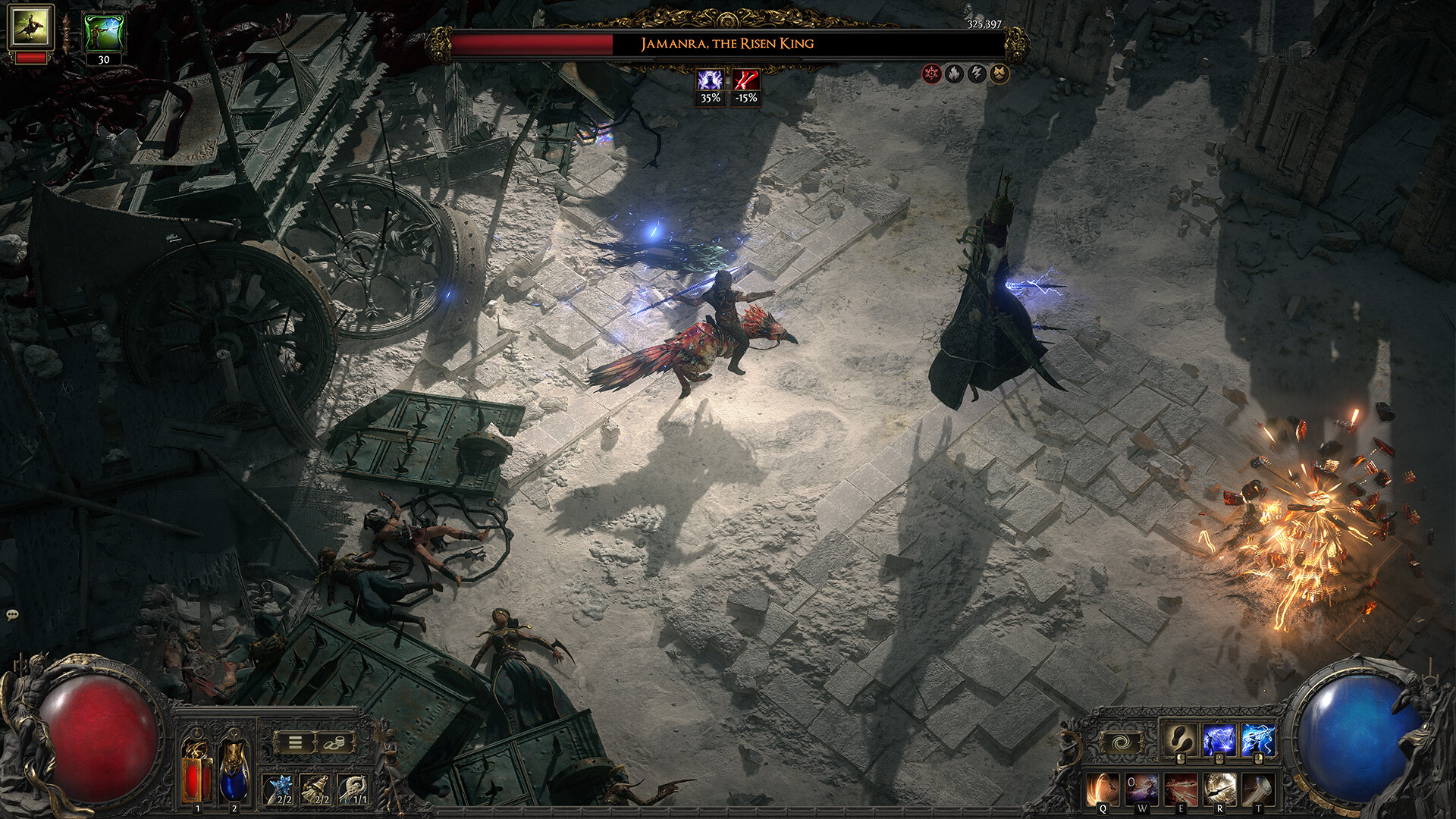 The Jamanra fight is the canonical "PoE2 demands you respect the encounter" moment for early-access players: slowed combat, telegraphed attacks, real consequence for sloppy positioning. Source: Steam.
Two readings, same game
The lens has to be applied at two layers because PoE2 itself made two different design moves:
Layer 1: Combat: tries to affirm
The PoE2 combat brief was "make it feel like Souls." Slower attack animations. Dodge roll with i-frames. Weapon-swap as a real verb. Weapon type grants the skill set (a mace plays differently from a crossbow because the mace's moves are different, not just its damage type).
Fictionally, this matters. PoE's protagonists are exiles, outcasts surviving in a hostile continent. PoE1's combat said: "you are a god of speed-clear; the Atlas blurs past you." PoE2's combat says: "you are a survivor; this enemy will kill you if you don't respect them." The latter affirms the exile premise more honestly. One-death maps in particular make this concrete, fictional permanence in the loop, a stakes-of-the-world that PoE1 long ago abandoned.
This is a partial resonance. Combat-feel does narrative work that PoE1's combat-feel did not.
Layer 2: Meta-loop: still orthogonal, like PoE1
But the rest of the loop, passive tree, currency-as-crafting, Atlas, is structurally the same as PoE1. You roll affixes, you optimise points, you push map tiers. The fiction doesn't tell that story. Wraeclast is still decorative scaffolding around the math.
So the same game is doing two different things: its combat layer reaches for resonance with the exile fiction, and its progression layer runs the same orthogonal optimisation surface PoE1 made famous.
What makes this a useful case
Most games on the lens are clean reads, affirms or orthogonal. PoE2 is the rare split-verdict case, and the split is intentional. GGG didn't want to abandon the optimisation surface (it's why the players are here). They wanted to fix the combat-feel. The result is a loop where the buttons-you-press affirms the fiction more than PoE1 did, while the systems-you-optimise affirms it the same amount (none).
The lens diagnoses a useful design move: you don't have to fix resonance at every layer. Picking which layer to make diegetic, and leaving others honestly orthogonal, is a valid design posture. PoE2 reached for combat-feel because that's where soulslike-pressure makes the moment-to-moment fiction (you are an exile, you might die) felt. The Atlas is an optimisation surface and pretending otherwise would weaken it.
Where it could fall further
The early-access game is still in motion. Two failure modes the lens watches for:
- Combat-feel drift. If meta-progression eventually makes endgame characters back into PoE1's blur-clear meta, the combat-layer resonance evaporates. The one-death-map design is the dam against that drift.
- Cinematic overreach. Adding voice-acted cutscene weight to characters whose loop doesn't deliver on the weight is the trap. PoE1 avoided this by being honest. PoE2's slower combat earned some fictional weight: but not the weight to support a Witcher-3-style narrative ambition. Stay in lane.
What the lens diagnoses
PoE2 is the case-study in partial resonance. You can have a loop whose moment-to-moment verbs affirm the fiction while its meta-progression remains orthogonal, and that mix can be a deliberate design choice, not a failure. The lens names this; PoE1 → PoE2 is the case study where the same studio applied the lens at one layer and left the other alone.
See also
- Mechanic pages: Combat philosophy, Weapons grant skills, Atlas (one-death), Crafting pulled back
- Sibling reading: Path of Exile 1: Ludonarrative reading (clean orthogonal)
- Lens (overview): Ludonarrative resonance
- Adjacent pattern:
vision-driven-iteration: GGG's decision to fix the combat-feel rather than the meta-loop is itself a vision call.