Skells & FrontierNav (XCX)
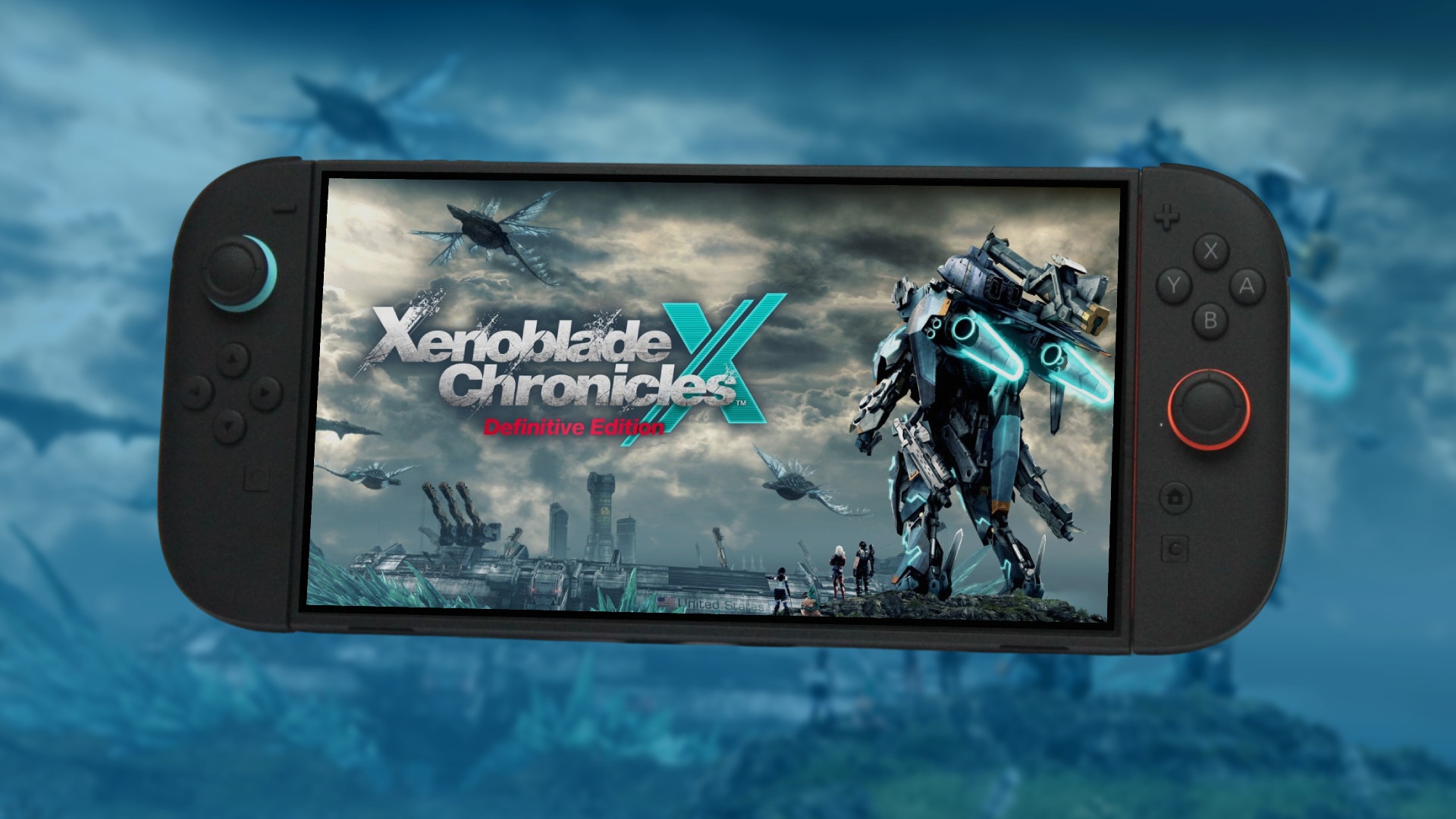
XCX is the odd one in the series, a Wii U launch-window game (2015), Switch DE remaster (2025). It's structured around an alien planet (Mira) the player explores on foot for the first ~30 hours, then earns a Skell license, gets a giant transforming mech, and the game changes shape entirely.
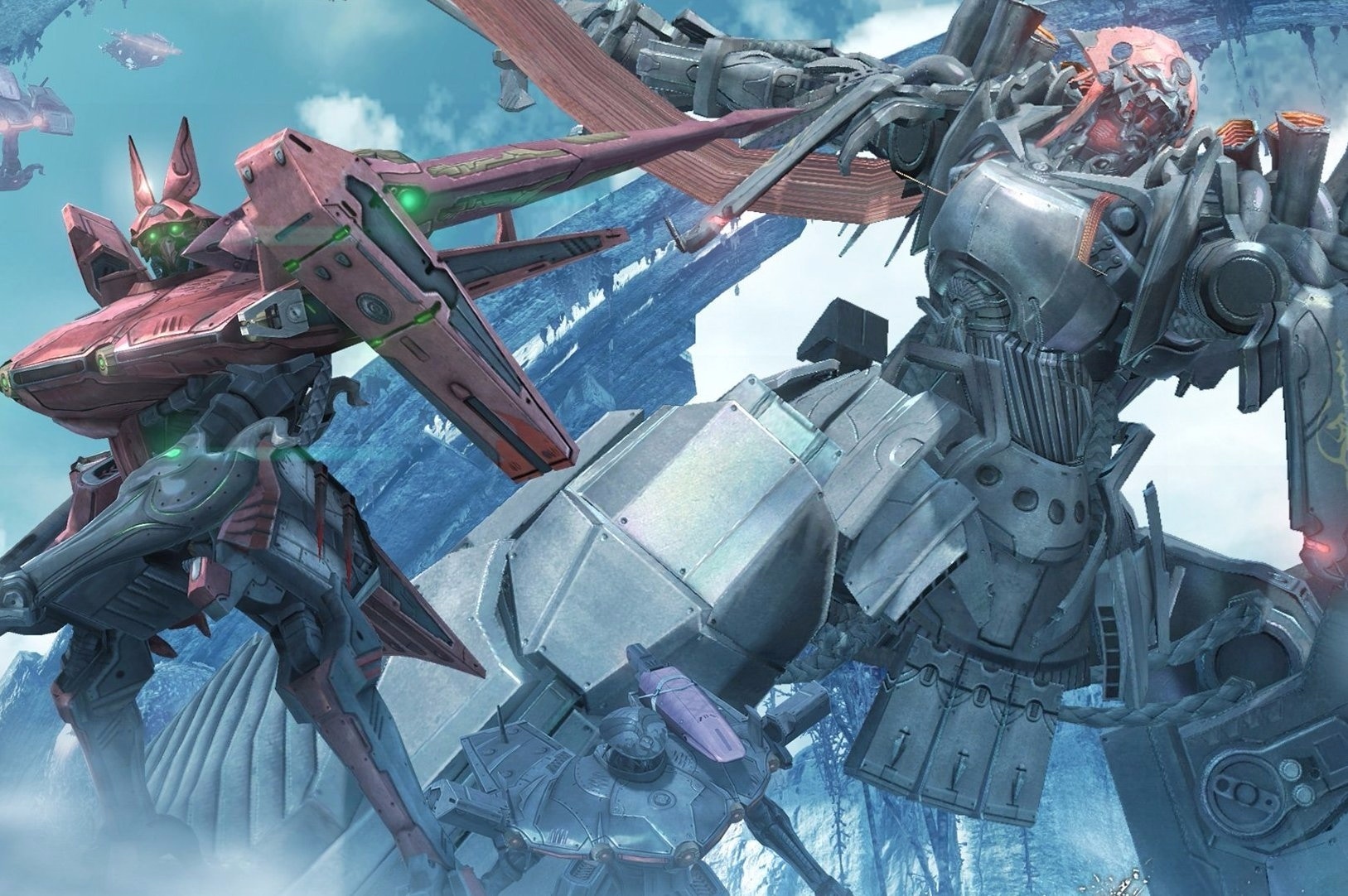 Two Skells facing off: the iconic XCX visual the player doesn't get to see for ~30 hours. Skells are 10-meter transforming mechs the player licenses mid-campaign; combat at this scale is fundamentally different from the on-foot game that preceded it. Source: Eurogamer.
 Elma, XCX's defining NPC and mentor: she onboards the player into BLADE, the colony's military arm, and is the human face of the planet's stranger systems. Source: Eurogamer.
Skells: the late-arriving mech
The campaign starts on foot. Combat is XC-shaped: arts on cooldown, position-aware, status chains. The world is the largest single-map open world Monolith Soft ever shipped, five continents on a single planet, all explorable from hour 1, with no walls.
But you're walking. Some areas have monsters that are level 80+ when you're level 20, and you can sneak past them but not fight them.
Around hour 30 (campaign chapter 6), the player completes a license series and gets their first Skell, a roughly 10-meter-tall transforming mech with:
- Vehicle mode: drives like a car, fast traversal, can mount weapons.
- Combat mode: humanoid form with separate arts palette, weapon slots (heavy / sniper / sword / shield), entirely different cooldown rules.
- Flight mode (later upgrade): once the Flight Module unlocks, the planet becomes navigable in 3D.
Combat in a Skell is bigger, bigger numbers, bigger AoE, longer cooldowns. Playing the same fight on foot vs. in a Skell is two different games.
This is the canonical late-introduced mechanic. The first 30 hours teach combat. The next 30 hours reteach combat in a vehicle that doesn't share most of the on-foot vocabulary. A player who quits before unlocking Skells has experienced about 40% of XCX.
Why it works
The intuition for "we'll lock half the game behind 30 hours of play" sounds wrong. But XCX's bet was:
- Players who reach hour 30 are committed. If they bounced, they bounced earlier.
- A new system at hour 30 is more valuable than a new system at hour 5. The hour-30 player has burned out on novelty in the early-loop systems; introducing a vehicle: different controls, different combat shape, different traversal, is a complete refresh.
- Skells don't replace on-foot combat. Many fights are on-foot-only or favor it. The two modes compose. So Skells expand the game rather than replacing the previous 30 hours.
This is in tension with what general-mass design teaches, front-load to retain players in the first hour. XCX optimizes the opposite end: keep players hooked at hour 50 by still introducing systems.
FrontierNav: the planetary probe network
The other late-system reveal. Around the same time as Skell access, the player unlocks FrontierNav, a planet-spanning network of probe nodes the player places to:
- Mine resources (Miranium for Skell construction; rare metals for upgrades).
- Generate currency over time (Money probes earn passive income).
- Boost research at the BLADE base (Research probes accelerate progression).
- Connect nodes with chains for combo bonuses (a chain of Mining probes amplifies output).
There are ~70 placement spots on Mira. Probes come in tiers and types. Placing them is a planet-scale loadout puzzle: which combination of probes maximizes the resource you most need right now, and how do chains amplify?
The system runs in real-world time when the game is playing, so it's also an idle-game layer underneath the action layer. Many XCX players spent more time on the FrontierNav UI than fighting.
BLADE divisions and class trees
XCX has a separate progression axis: the player joins BLADE (the colony's military arm) and picks a division (Pathfinder / Outfitters / Curators / Reclaimers / Prospectors / Harriers / Mediators / Intervenors). Each division has its own ranking, daily contribution tasks, and rewards.
Layered on top: 17 classes with branching mastery trees. The classes lead into one another (Bastion Warrior → Galactic Knight → Full Metal Jaguar, etc.). Each class master grants permanent skills usable in other classes.
So XCX's progression graph:
| Axis | What it gates |
|---|---|
| Character XP | Base stats, equipment slots |
| Class mastery (17 classes, branching) | Skills that compose across classes |
| BLADE division rank | Storage caps, equipment access, recruitment tasks |
| FrontierNav probe placement | Resource income, research speed, currency |
| Skell licensing → Flight module → G-Buster | Combat scope, traversal scope |
| Heart-to-Heart affinity (each crew member) | Personal sidequests, post-game content |
This is one of the most layered progression structures in the series, and the layers fully unlock only ~50+ hours in.
Soul Voice: the dialogue-driven chain attack
XCX's chain-attack analog is Soul Voice: party members shout combat dialogue ("Strike now, Cross!", "I need backup!") at specific moments. If the player or another AI ally responds correctly (using the prompted art type within the window), it triggers chain bonuses, heals, debuff cleanses, and chain-attack damage.
The result feels less menu-driven, more conversational than XC1/2/3 chain attacks. Combat is noisier and more chaotic; the soul-voice system rewards listening.
What this teaches
- Late-game system reveals are a viable engagement strategy if you can author enough content for the system after the reveal. XCX's post-Skell content is ~60+ hours; that's why it works.
- Open-world JRPGs can carry MMO-shape combat at planetary scale. Mira is bigger than any other Xenoblade map; the combat system holds up.
- Idle-game probe networks layer cleanly under action loops. FrontierNav runs in the background; the player checks in, optimizes, leaves. It composes well with the on-foot/Skell action layer rather than competing for attention.
Patterns this exemplifies
late-introduced-mechanics: the 30-hour Skell unlock is the canonical case study; FrontierNav, classes, and divisions all unfold across 50+ hours.loadout-as-budget: class arts palette, Skell weapon slots, probe placement, and BLADE-rank-gated equipment are all separate budgets.nested-progression-graph: six orthogonal progression axes layered onto each other.