Climbing + the stamina ring
The single design decision that re-shapes Hyrule. Almost every solid surface in the world is climbable, cliffs, trees, walls, monsters, towers, ruins. The constraint is a stamina ring that depletes while you climb (and run, swim, paraglide-glide-extend) and recharges while you're on flat ground.
This one rule re-routes every other system in the game.
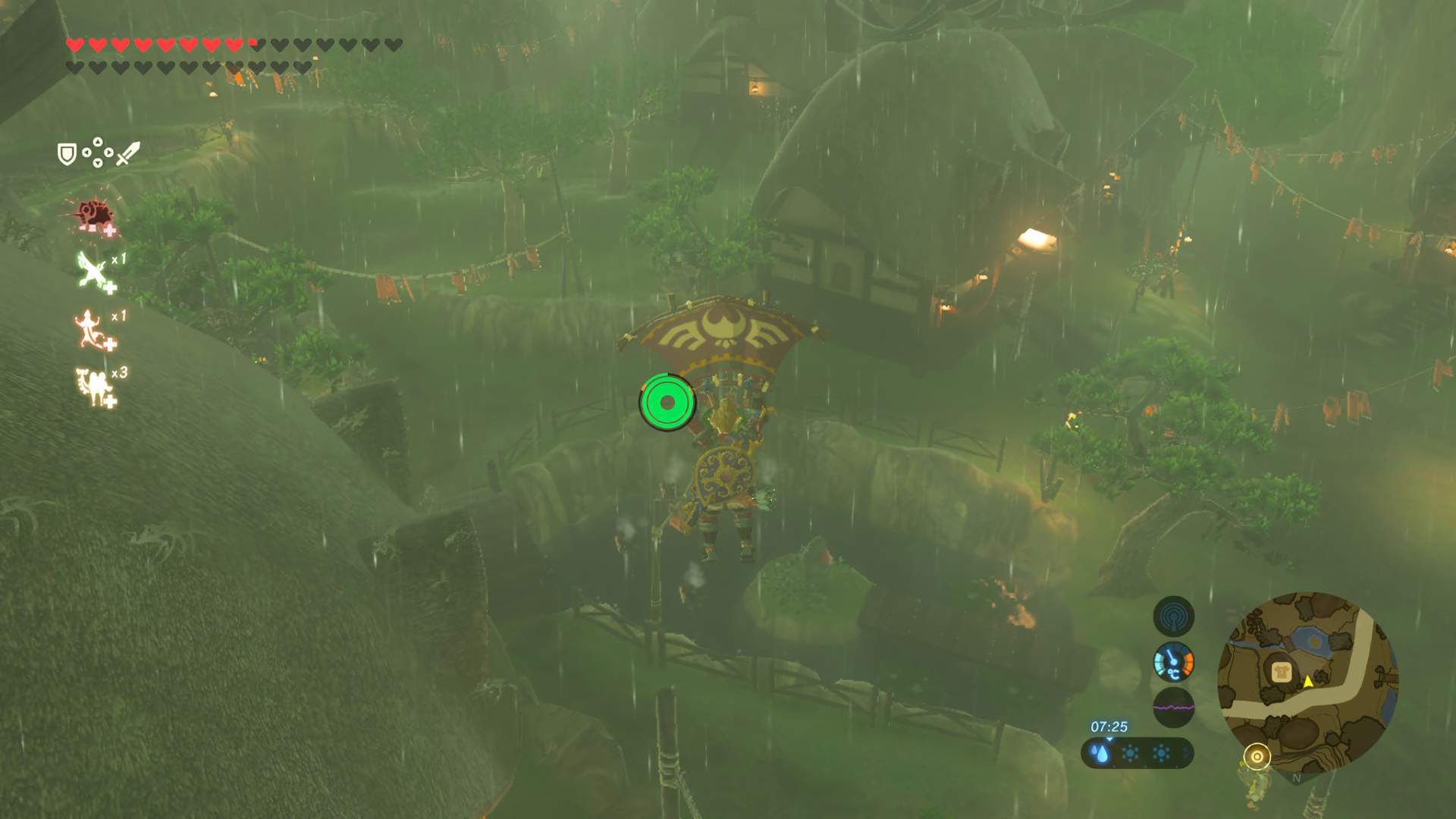 Paragliding consumes stamina just like climbing. The same ring governs sprint, swim, climb, and glide: making vertical movement a single resource economy. Source: Game UI Database.
What the ring governs
The stamina ring is a single circular meter near Link's portrait. It controls:
| Action | Stamina cost | Recovery |
|---|---|---|
| Sprint (run faster than walk) | Drains while held | While walking / standing |
| Climb (any wall) | Drains while moving up; stops draining when stationary on the wall | While stationary on the wall (slow) or on flat ground (fast) |
| Climb-jump | Big single drain (~1/4 ring) | : |
| Glide (paraglider) | Drains while gliding | On landing |
| Swim (fast stroke) | Drains while held | On shore / standing in shallow water |
| Charge attacks | Drains during charge | After release |
The ring starts at one full circle. Stamina Vessels, earned by trading 4 Spirit Orbs from shrines at a Goddess Statue, add segments. Each Vessel adds 1/5 of a circle. Maxed: ~3 full circles (15 Vessels). The player chooses Stamina vs Heart Container at every Goddess Statue trade, a permanent commitment.
Climb is governed by the ring AND by weather
The "almost every surface" rule has one major exception: rain.
When it's raining, Link's hands slip on the wall every ~1 second of climb-up. The stamina cost stays the same; the climb just resets your position. Effectively, climbing in rain is impossible above shallow heights.
This single environmental constraint reshapes the player's planning:
- See the sky → check weather → if rain, postpone the cliff approach.
- Caught in rain mid-climb → either rappel down or bonfire-pass-time (sit at a campfire and skip until morning).
- Storm-cooking ingredients → certain food items reduce slip chance ("Sticky" elixir from Sticky Frogs grants temporary climb-in-rain ability).
So climbing is not just gated by stamina. It's gated by stamina × weather × terrain (wet wood, ice). The ring is the visible cost; the weather is the hidden gate.
Why "climb anywhere" works
The "almost everywhere" rule is what makes Hyrule's verticality matter. In a typical open-world game, traversal is gated by designed paths, doors, bridges, ladders. Players walk along the routes the level designer drew.
In BOTW, climb-anywhere means the player draws their own route. Three consequences:
- Encounter approach is open. Every Bokoblin camp has 20 viable approaches: from above (paraglide bombs), from a cliff side (climb-up + sneakstrike), through grass (fire arrow), via Magnesis (drag a metal box onto them).
- Map gates dissolve. The "you must clear this dungeon to reach this region" pattern of classic Zelda is gone. You can walk to Hyrule Castle in the first hour. You'll die: but you can walk there.
- Stamina becomes the difficulty curve. Tall mountains aren't gated by puzzles; they're gated by stamina capacity. Want to climb Mount Lanayru? Train more Stamina Vessels, or come back with cooked food that grants temporary stamina.
This is climb-anywhere-stamina, a single rule that produces a continuous, navigable, non-gated open world. There is, to my knowledge, no widely-replicated peer to this in commercial games. Genshin Impact's climb borrows the form, but its world has more designed gates.
Stamina food: the temporary stamina sub-economy
The ring has one extension: cooked food that grants temporary stamina (or fully restores it on consumption).
| Effect | Source | Use |
|---|---|---|
| Stamina restore | Stamella Shrooms, Restless Crickets | Standard recharge food. |
| Endura ("temporary extension") | Endura Shrooms, Endura Carrots | Adds 1+ extra rings on top of your max: needed for the longest climbs. |
| Hearty (extra hearts + full HP) | Hearty Durian, Hearty Truffle | Indirect: fully heals so you can re-engage. |
Endura food is the player's tool for breaking the soft cap on stamina. A maxed-stamina + Endura Carrot meal lets you climb a wall the base game wouldn't allow. The ingredient is rare; the meal is expensive; the trip is once-per-rare.
The ring as a designer's lever
The Goddess Statue trade, 4 Spirit Orbs for either +1 Heart Container or +1 Stamina Vessel, is a real choice. The player commits permanently. There are 30 total Goddess Statue trades (120 shrines / 4) plus 4 Champion Memory blessings = 34 total trades. The player gets to fill either the heart bar OR the stamina ring to max, not both, without the DLC trial.
This is bonus-with-drawback at the meta-progression layer: you cannot have both maximum HP and maximum traversal. Combat-focused builds run out of stamina; explorer-focused builds get one-shot by Lynels.
What this teaches
- One constraint can carry the whole verb-set. Sprint + climb + swim + glide + charge-attack all share one meter. The player learns the meter once and applies it everywhere. No new tutorial needed for any new traversal verb.
- A single environmental gate (rain) reshapes player planning. Players check the sky before committing to a climb. Weather becomes a strategy resource rather than ambient texture.
- Climb-anywhere works because the cost is small enough to forgive. A botched climb costs you a few hearts (fall damage) and 30 seconds. So players experiment freely. If the cost were a death and a 5-minute reload, players would stop trying.
- A meta-progression fork forces commitment. Heart vs Stamina at every Goddess Statue is a real, irreversible (without rare amiibo) choice. Players become kinds of players: climbers vs fighters, through their accumulated trades.
Patterns this exemplifies
climb-anywhere-stamina: universal climbability gated by a single regenerating resource. Uncurated; BOTW is the canonical case.bonus-with-drawback: the Heart / Stamina trade at every Goddess Statue is a clean per-decision tradeoff with permanent consequences.
Adjacent patterns
loadout-as-budget: the whole stamina ring is a 1-resource budget across 5 verbs. Loadout-as-budget at the traversal layer instead of the inventory layer.