Cult of the Lamb
A possessed lamb is gifted a Red Crown by an imprisoned god, then has to fund the deicide by running a cute woodland cult on the surface. The hub is a colony sim; the dungeons are a Binding-of-Isaac-flavoured roguelite. Worth dissecting because almost every loot category in the dungeon resolves to a hub bottleneck, and almost every hub building enables a longer or richer dungeon run, the cleanest dual-life loop in the genre, paired with one of the most aggressive post-launch update cadences in indie.
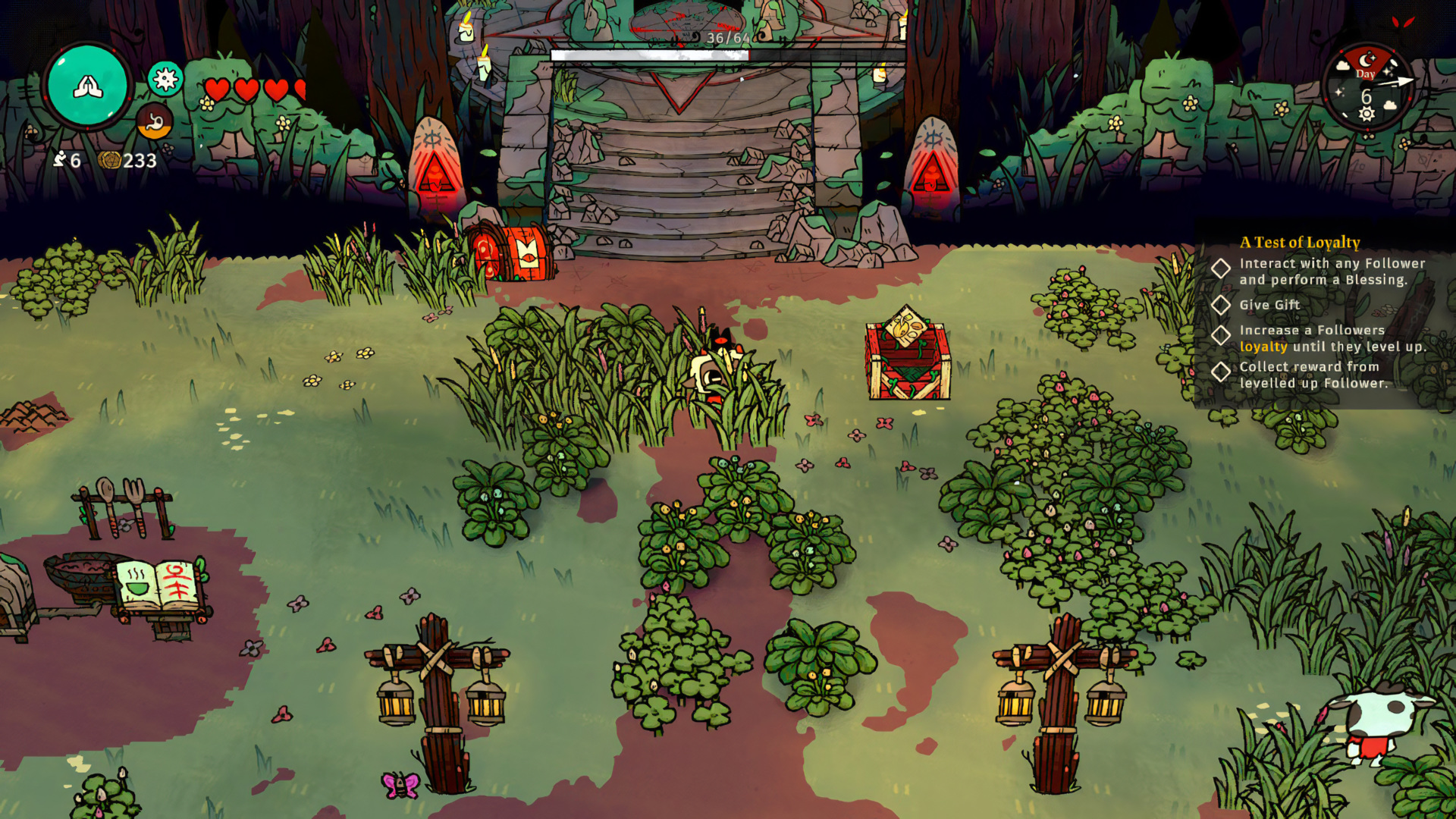 The hub midday. The objective tracker on the right ("Interact with any Follower and perform a Blessing → Give Gift → Increase a Follower's loyalty until they level up → Collect reward from levelled-up Follower") is a 4-step Sims-style nudge wrapped around the cult's autonomous activity. Source: Game UI Database.
Snapshot
| Studio | Massive Monster (Melbourne, AU) |
| Publisher | Devolver Digital |
| Released | August 11, 2022 (PC, Switch, PS4/5, Xbox One / Series, later Apple Arcade) |
| Run length | ~15 min per Crusade (deliberately matched to one in-hub day) |
| Iconic mechanic | Indoctrination loop: crusade for resources, run a cult with the spoils |
| Core dialectic | Cute aesthetic vs. cult horror; dungeon time vs. hub time |
| Inspirations | The Binding of Isaac (room-to-room dungeon), Stardew Valley (hub sim), Moonlighter (dual-life loop), Don't Starve (cult-as-attrition feel) |
| Sales | 1M in week one; ~7M by 2025; one of Devolver's biggest releases |
| Live arc | Eight free major updates 2022–2024 → first paid expansion (Woolhaven, Jan 2026) |
Macro loop
Hub: the Cult (real-time, day/night)
  ├─ Sermon at the Temple   → Faith → Doctrines (cult-wide perma-effects)
  ├─ Rituals (Bone-fuelled) → Wedding, Funeral, Sacrifice, Brainwashing, Resurrection
  ├─ Build (Divine Inspiration tree)
  │    Shelter → Food → Decoration → Refining → Faith → Health
  ├─ Tend to followers, feed / bless / clean poop / heal / put out dissent
  └─ Walk to a Crusade portal
       │
       ▼
Crusade: 4 Lands of the Old Faith
  ├─ Land = Darkwood (Leshy) | Anura (Heket) | Anchordeep (Kallamar) | Silk Cradle (Shamura)
  ├─ Entry room → pick weapon + curse offer
  ├─ Mid-run map (DAG)
  │    Combat | Tarot | Lore | Recruitment | Shop | Sacrifice door
  │    Resource node | Heart room | Mini-boss | Bishop | Event | Prayer
  ├─ Per-room: kill, loot, sometimes choose (tarot, fork, sacrifice door)
  ├─ End: mini-boss → recruit a follower
  │       OR Bishop → release their followers + Doctrine Stone + Crown power
  └─ Return  (or die, "Martyred!", lose 25% of new items, still keep most)
       │
       ▼
Hub absorbs the haul:
  Lumber/Stone → buildings · Bones → rituals · Gold → shops/Tarot
  Recruited followers → indoctrinate → assign jobs
  Doctrine Stones → unlock a Doctrine choice (binary fork, permanent)
  Divine Inspiration → next tech-tree node
The hook: time passes in the hub while you're in the dungeon. A Crusade is ~15 minutes and so is a hub day; if you leave for two Crusades back-to-back, you come back to a hungry, sick, possibly dead cult. The two halves are not just connected, they are competing for the same minutes.
Mechanic deep-dives
The Crusade layer and the hub layer are roughly equal in mechanical depth, and the bridge between them is the most interesting design surface. Sub-pages, in reading order:
- Crusades: dungeon generation & structure, how a run is composed: lands, biomes, room library, weapon/curse roll, what carries vs. resets.
- Crusades: technical implementation, for devs building their own dungeon-crawler: room prefab schema, stitcher algorithm, seam-hiding tricks, evidence from patch notes + modding API, lessons for a Godot project. Every claim tagged by confidence level.
- Dungeon map: DAG node types, the mid-run choice layer: every node icon, what it costs, what it pays.
- Hub & followers: Faith/Hunger/Sickness, the follower lifecycle (recruit → indoctrinate → loyalty → die / sacrifice).
- Doctrines & rituals: the four launch Doctrine trees + the bone-fuelled Ritual menu; how Sermons drive both.
- Divine Inspiration tree: the building tech tree and how it gates run quality.
- Combat & loadout: weapons (6 + flail), curses, Tarot Cards (reset per run), Fleeces (persistent), Relics.
- Bishops & progression: the wire-up, how each Bishop fight is a triple-payoff event (story beat + hub unlock + Crown power).
- Post-launch evolution: eight free major updates → first paid expansion. The arc as a case study.
Through other lenses
- Ludonarrative reading: the cute/cult axis through the resonance lens. Verdict: split, affirms at the aesthetic/system layer, undercut at the narrative-consequence layer (the Lamb is never made to confront what they've done).
What this game teaches
- A 15-minute dungeon and a 15-minute hub day are not a coincidence. When both halves of a dual-life loop tick on the same clock, the player has to actually choose which half to spend a minute on, not just toggle between them at will.
- Wire every dungeon resource to a specific hub bottleneck. Lumber/Stone → buildings, Bones → rituals, Gold → tarot, Doctrine Stones → permanent forks, followers → labour pool. No "general XP": every drop opens a named downstream lever.
- Triple-payoff bosses. Each Bishop drops a story beat and releases a wave of followers and unlocks a permanent Crown power. The act-clear feels three times bigger than the time it took.
- Live-service-without-monetisation is a real shape. Two years of free updates kept Steam reviews trending up before the first paid expansion. The trade-off (the eventual pivot) is its own design lesson.
- The cute/cult dialectic is load-bearing aesthetically, optional narratively. Most of the horror is in the systems (sacrificing followers for buffs), not the cutscenes. That's a deliberate restraint: and a place where some players will land "all aesthetic, no consequence."
See lessons for the longer take.