Bishops & progression: the wire-up
This page is about the bridge between the two halves. The Bishop fights are where the dungeon side and the hub side are most explicitly stapled together, each Bishop kill pays out across three layers simultaneously, which is most of why the game's act-clears feel disproportionately rewarding.
The arc
Four Bishops in fixed order, plus a final confrontation:
Lamb is rescued by The One Who Waits
    ↓
Build first cult (Lonely Shack)
    ↓
Leshy in Darkwood ───────── First Crown ability
    ↓
Heket in Anura ──────────── Second Crown ability
    ↓
Kallamar in Anchordeep ──── Third Crown ability
    ↓
Shamura in Silk Cradle ──── Fourth Crown ability
    ↓
The One Who Waits (final)  ─ Story climax (post-launch added a longer epilogue)
Gating is by recruited-follower count, not item collection or skill tree. Each Land's entry portal opens when your cult passes a population threshold, so the cult side directly throttles when you can advance the story.
The triple-payoff structure
A regular boss in most action-roguelites pays one of: a new biome, an XP burst, a permanent unlock. A Bishop in Cult of the Lamb pays all three at once, plus a hub population jump. The payouts:
1. Story beat (narrative layer)
Each Bishop is a phase of the central revenge plot. Defeating one triggers a cutscene with The One Who Waits, advances the prophecy, and unlocks new narrator commentary. Story is literally on a four-stop track.
2. Crown ability + Talisman fragment (combat layer)
Each Bishop drops a piece of the Red Crown, a permanent dungeon ability the Lamb can use on subsequent Crusades. Mechanics vary (one is a charge attack, one is a damage burst, etc.). They are pure power additions that stack.
Each Bishop also drops a Holy Talisman fragment. Four fragments combine into the full Talisman, which unlocks Fleece slots / Crown perks / Sermon-tree depth. This is a delayed payoff, the Talisman doesn't matter much until the fourth piece.
3. Hub unlocks (cult layer)
On Bishop kill:
- The Bishop's surviving followers join your cult: typically 10–20 NPCs at once. This is a sudden population jump that flips you past the next Land's gate, often immediately.
- A Doctrine Stone drops (from Bishop and mini-bosses): unlocking the next Doctrine fork.
- New buildings are unlocked in the Divine Inspiration tree (the Bishop's faction brings their architectural style).
- New decorations and follower forms enter the cosmetic pool.
The notification feed captures the moment:
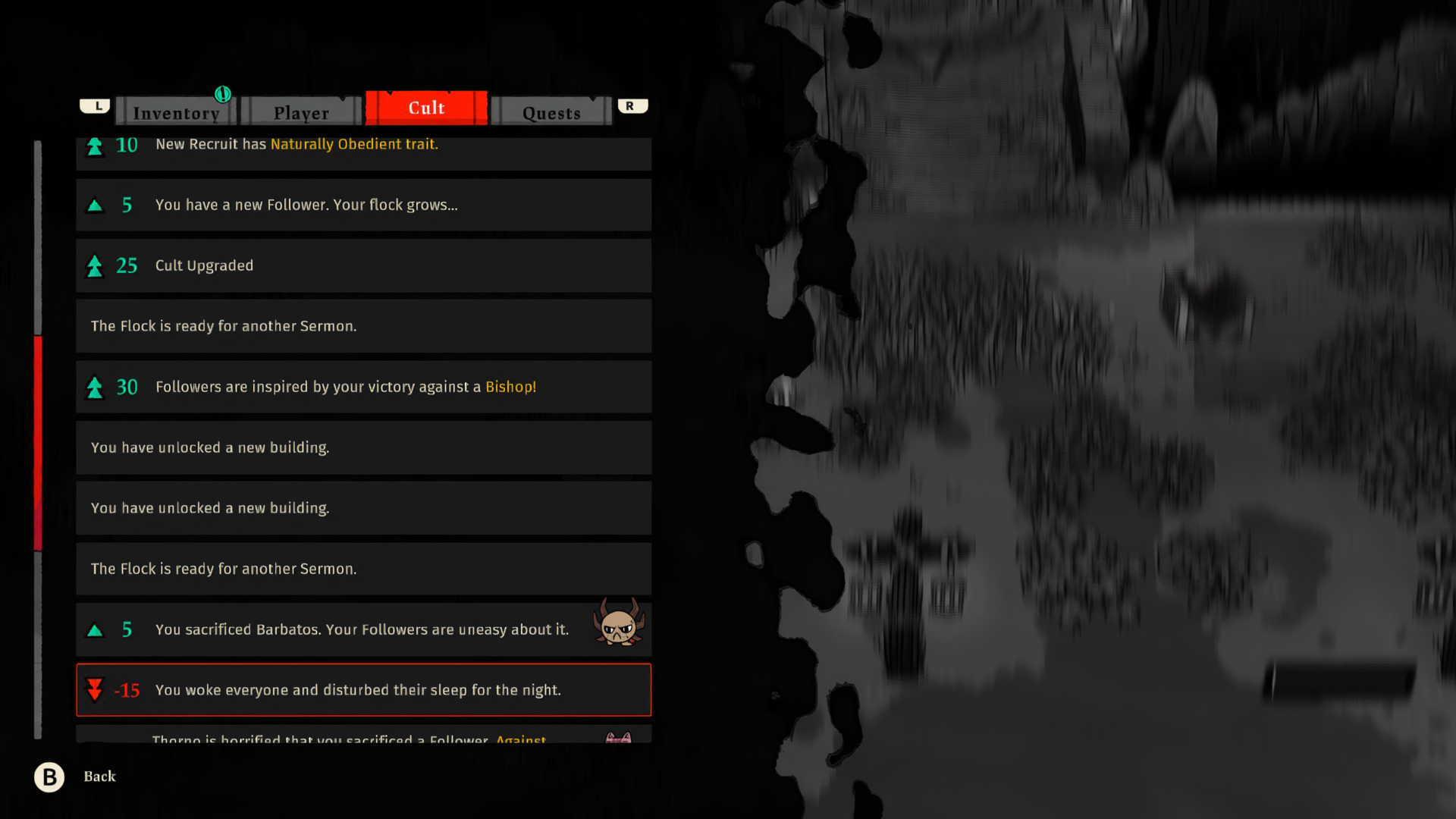 The Bishop-kill notification cascade. +30 Faith for the victory. Two "You have unlocked a new building" entries. A bishop kill literally fires multiple cascading state changes: and they all stamp the same notification feed, making the moment visually heavy. Source: Game UI Database.
Why triple-payoff matters as a design choice
In single-payoff bosses, the player asks "was the fight worth it?" with a single yes/no answer. In a triple-payoff structure, some axis always feels rewarding even if the run was rough. The pacing implication:
- The act-clear feels three times bigger than the fight. A ~5-minute Bishop fight delivers narrative + permanent-power + cult-state changes that take 20+ minutes of hub play to fully integrate.
- Recovery from a bad run is faster. Even if you barely scrape the Bishop with 1 HP, the consequences of the kill are the same. The reward is decoupled from how clean the win was.
- The next Land opens "for free" via the population jump. The player doesn't have to grind followers: the Bishop kill gives them.
This is the structural reason CotL's progression feels so propulsive despite an only-modest dungeon-generator. The bosses are not the test; they are the delivery vehicle for everything else.
How each Land changes the meta
| Land | What unlocks |
|---|---|
| Darkwood (Leshy) | First Crown ability, Faith-tree Doctrines, Refining buildings, ~10 new followers |
| Anura (Heket) | Second Crown ability, Sustenance buildings (mushroom/farm), seasonal events, ~12 new followers |
| Anchordeep (Kallamar) | Third Crown ability, Fishing rework, Crystal-decoration tier, deeper Doctrine slots, ~15 new followers |
| Silk Cradle (Shamura) | Fourth Crown ability, Silk Cradle decorations, all Holy Talisman fragments completed, ~20 new followers, end-game story access |
By the time the credits roll the cult has roughly quintupled in size, the Lamb has four Crown abilities, the Talisman is complete, all four launch Doctrine trees have a couple of slots open, and the Divine Inspiration tree has unlocked at least two tiers in every category.
The non-Bishop progression layer
Bishops are the punctuation. Between them, three quieter progression axes run continuously:
1. Sermon-tree
Each Sermon ticks a small skill-tree progress bar. Unlocks include:
- Weapon reroll at Clauneck's tent
- +½ Heart Container ("Hearts of the Faithful," twice)
- Extra Tarot slot on the Crown
- Tarot-card draw rerolls
- Bonus Faith from sermons This is the per-run-modifier layer; it makes future Crusades better without changing what they are.
2. Quest system
A standing list of side and main quests:
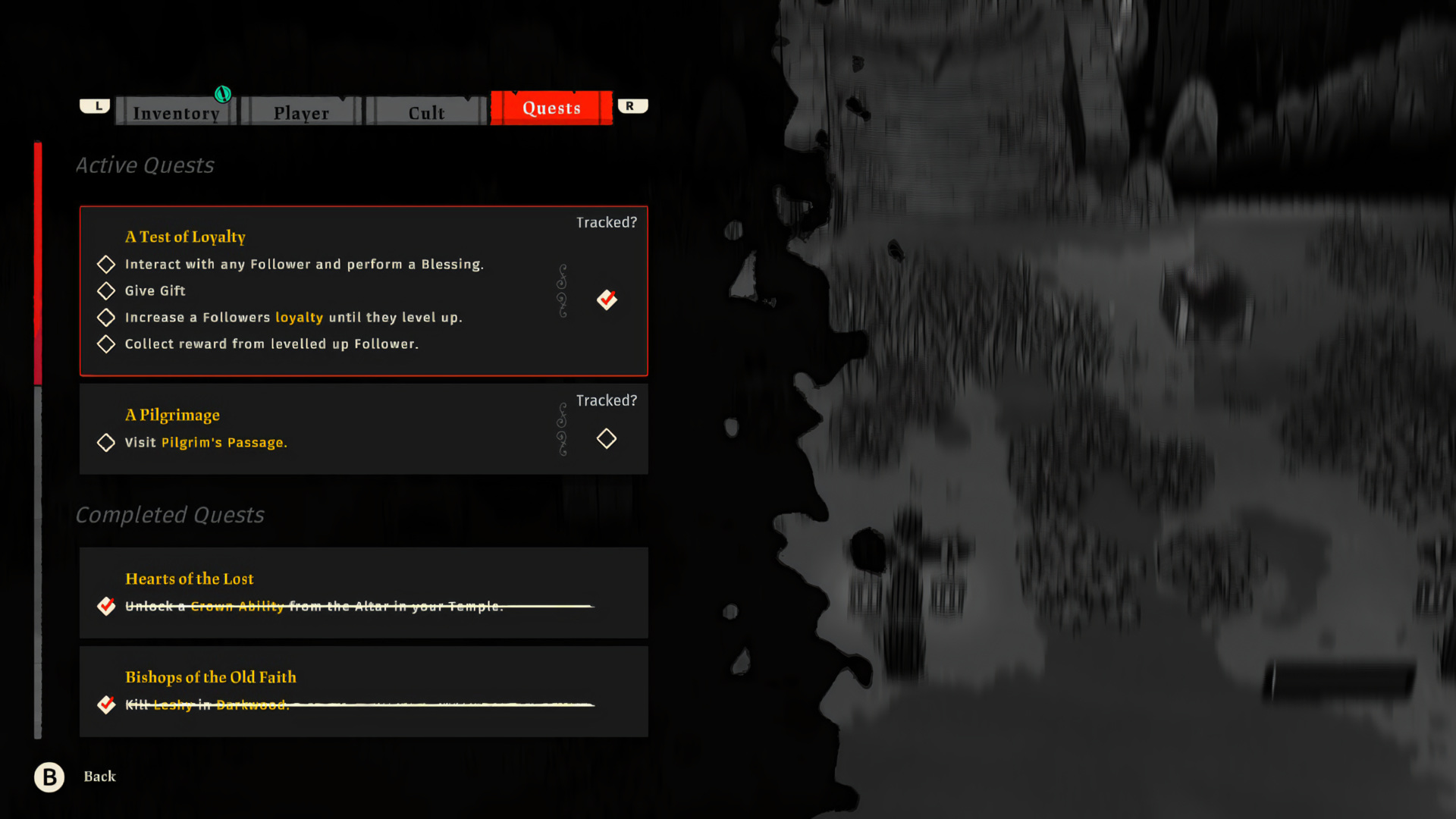 Active and completed quests. Main quests are tagged with the next Bishop's name ("Bishops of the Old Faith: Kill Leshy in Darkwood"); side quests come from follower interactions ("Test of Loyalty") and from the overworld map ("A Pilgrimage"). The completed list is itself the campaign's narrative log. Source: Game UI Database.
Quests unlock Tarot slots on the Crown, Tarot Cards for the codex, NPC vendors (Clauneck, Chemach), and special followers.
3. Side locations on the overworld
Off the four Bishop paths, the overworld has Pilgrim's Passage, Spore Grotto, the Crimson Keep, the Lighthouse, fishing minigames, Knucklebones tournaments, special vendors. Each is a quiet third income/unlock stream that doesn't gate the main path but enriches it.
What the wire-up teaches
The thing CotL gets right that most genre-fusion games trip on is that the dungeon and the hub are not connected, they are bound together at every loot line. A Hades-style dungeon with a Stardew-style farm strapped to it would feel like two games sharing a launcher. CotL's version feels like one game because:
- Every dungeon drop has a named hub use (no generic XP).
- Every hub building either feeds future Crusades or buys time to be on a Crusade.
- Every Bishop kill pays out across both halves simultaneously.
- The clock runs in both halves at once (time passes in the hub during runs): so the player feels the cost of investing more in one half.
- Doctrines turn dungeon-acquired Stones into hub-shaping policy.
If you removed any one of these, the loop would still function but it would feel categorically less unified.
Patterns this exemplifies
bounded-roguelite: credits roll after Shamura; post-game added later via Relics of the Old Faith. The shape of the campaign is a complete narrative arc, not a procedural treadmill.