NaviCust (Navi Customizer)
Introduced in BN3 (2002) as a replacement for the linear stat-upgrade system. The single most-original meta-progression mechanic the series produced, and a textbook grid-inventory implementation that pre-dates Sparklite by 17 years and Moonlighter 2 by 23.
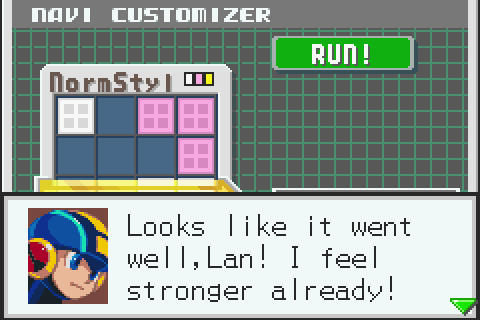 The NaviCust customization screen in BN3. Pink program (UnderSht: keeps you at 1 HP on otherwise-lethal hits), white programs (Atk+1, Speed+1), grey buster mods. The third row is the Command Line, solid programs must touch it; striped programs must not. Source: image captured during a community Let's Play of MMBN3 (CC) on the LP Archive; underlying game © Capcom.
Structure
A small grid (4×4 in BN3, expandable to 5×5; effectively doubled in BN6 via off-grid overflow). The player drops Tetromino-shaped programs onto the grid: HP+50, Charge+1, Shield, AirShoes, FloatShoes, Custom+1, Buster+1, etc. Each program is a 1–4 cell shape, same Tetris-style geometry as Sparklite's patches.
There's a Command Line running through the middle of the grid horizontally, the load-bearing constraint:
| Program type | Rule |
|---|---|
| Solid / "ON" parts (one-color blocks) | Must touch the Command Line |
| Plus / "OFF" parts (textured/striped, often pink/white/yellow) | Must NOT touch the Command Line |
| Same-color edge adjacency | Forbidden (corners are fine) |
Violating any rule doesn't reject the placement, it boots the program bugged.
Bugs as an opt-in cost
Bugs are persistent debuffs that follow MegaMan into combat:
- Random panel cracks (under your own feet)
- Reduced HP regen
- Button input corruption
- Accidental chip use
- Aggro behavior that pulls enemies toward you
This is the cleverest part of the design. You can ship a sub-optimal solution to fit one more program in. "I want HP+50 but it doesn't fit in a legal placement → ship it bugged → take the bug → still get the +50." A BugStop program neutralizes one bug, but BugStop costs valuable space too.
The whole NaviCust meta-puzzle is: how much chaos can I tolerate to fit one more buff? Pure-clean solutions are achievable but constrained. Strong, bug-tolerant solutions are tighter.
This is textbook bonus-with-drawback at the loadout layer.
Compression Codes (BN6)
BN6 added a depth layer: secret button-input codes that compress a program by one cell. Hold Up + B + Select on the Customizer screen with a specific program selected, and its footprint shrinks. The codes are released in magazines, in-game hints, and (now) community wikis, same "hidden knowledge depth" pattern as Program Advance recipes.
Compressed programs let you fit more into the same grid. Players who memorize the codes can ship 50%+ more programs than players who don't.
Why this is a textbook grid-inventory
NaviCust matches the grid-inventory pattern as cleanly as any game in this knowledge base:
| Element | NaviCust |
|---|---|
| Grid | 4×4 → 5×5 (BN3); larger in BN6 |
| Item shape | Tetris-shaped programs |
| Adjacency rules | Command-Line constraint + same-color non-adjacency |
| Footprint vs. value | Bigger / better programs eat more cells |
| Constraint violation cost | Bugs (debuffs): opt-in, not failure |
| Pressure-release valve | BugStop, Compression Codes (BN6) |
BN3 shipped this in 2002. It pre-dates Sparklite (2019), Moonlighter 2 (2025), and most Tetris-inventory games of the modern era. The game does not get cited as much as it should for the genre's lineage.
Evolution across the series
| Game | NaviCust shape | Notes |
|---|---|---|
| BN3 (2002) | 4×4 → 5×5 grid; Style-Color overlay | Style locks you to a preferred program color; Error Codes unlocked via subquests |
| BN4 (2003) | Same as BN3, cleaner ruleset | Soul Unison decouples forms from color-locking |
| BN5 (2004) | Dark Programs added | Bug consequences scaled; Liberation Mission programs unlock new effects |
| BN6 (2005) | Effective area roughly doubled (off-grid overflow); Compression Codes | The series' final, most expansive form |
What this teaches
- Adjacency-based constraint puzzles produce more design space than slot-counting. Same buff library, totally different meta-puzzle.
- Opt-in chaos is more interesting than fail-state chaos. Bugs aren't "you broke the rule, now this doesn't work": they're "you bent the rule, here's what it costs you."
- A 4×4 grid is enough. You don't need a sprawling Sparklite-scale grid; the constraints carry the design.
- Hidden depth (Compression Codes) extends the system's lifespan. Codes shipped in magazines in 2005 are still being shared in retrospectives.
Patterns this exemplifies
grid-inventory: the canonical example, predating most modern instances.block-puzzle-stat-upgrades: Tetris-shaped stat blocks; passive upgrades through spatial packing.bonus-with-drawback: Bugs as opt-in costs for fitting more.opportunity-cost-loadout: every cell taken by HP+ is a cell not available for Charge+, FloatShoes, etc.