Genre-shifting combat
Nier: Automata's combat sells itself in trailers as a PlatinumGames hack-and-slash (fast melee, light/heavy weapon swaps, dodges, juggles). That's the default mode. The full inventory of combat verbs is wider:
| Mode | Camera | Verbs | When |
|---|---|---|---|
| Third-person hack-and-slash | Free 3D camera, behind 2B/A2 | Light, heavy, ranged (Pod), dodge, perfect-dodge counter, jump | Default open-world combat |
| Twin-stick shmup | Top-down, 2B/9S piloting flight unit | Move + shoot | Vertical "flight" sections (intro, certain bosses) |
| 2D side-scroller | Side-view, locked plane | Move + jump + attack | Hallways in the Bunker, Copied City sequence, several boss approaches |
| Top-down 3D | Locked overhead, character at centre | Same as default but constrained | Specific corridor encounters, Amusement Park introduction |
| Bullet-hell | Top-down, character is a small ship-icon | Move + shoot, bullet curtain | The hacking minigame (9S only) AND the Ending E credits |
| Idle / dialogue | Static camera, sometimes 2D | Talk, no combat | Bunker, Resistance Camp |
The shift is camera-driven, not menu-driven. The player doesn't pick a mode. They walk through a doorway and the camera reframes; on the other side of the doorway, the verbs available have changed.
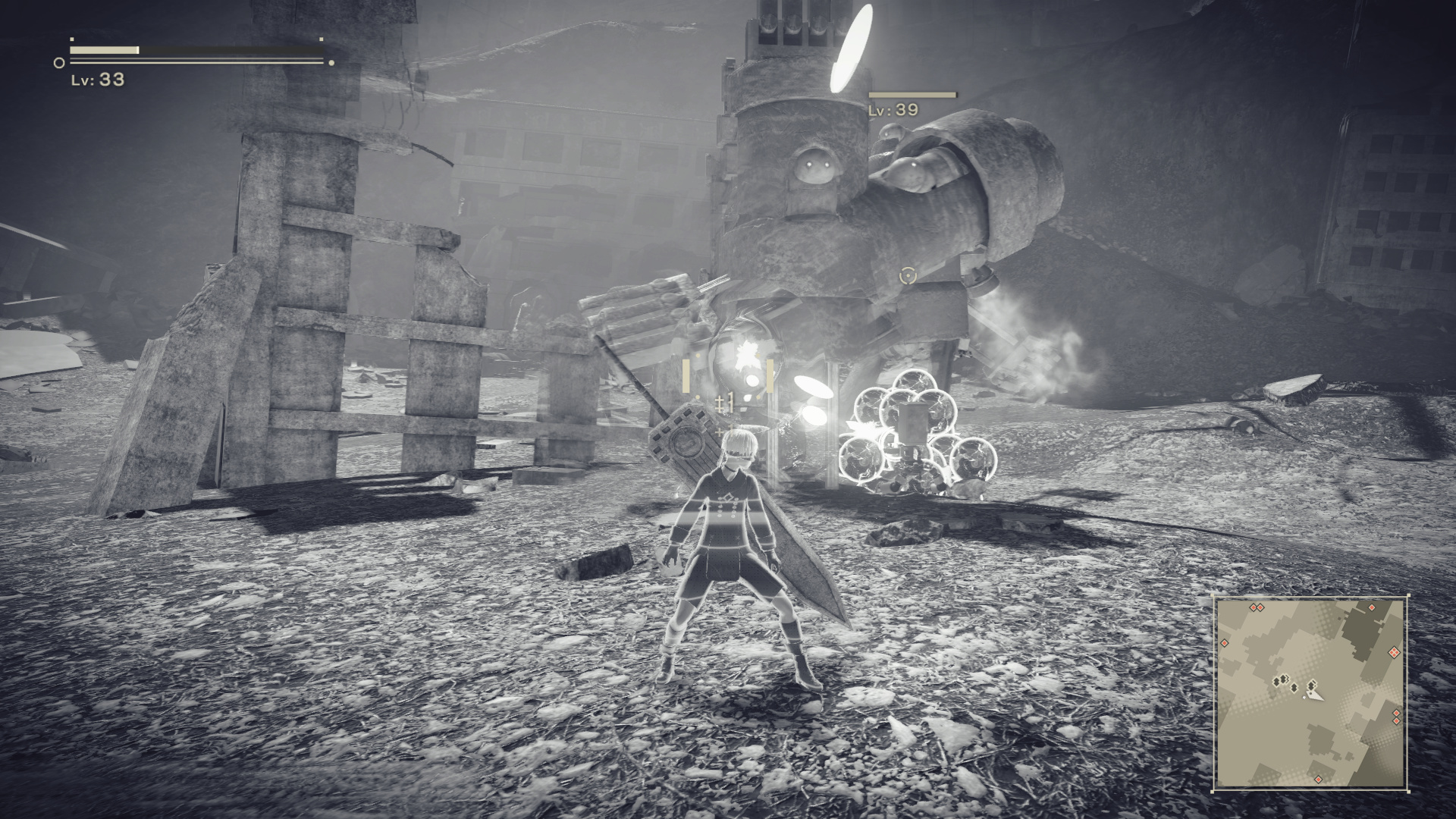 The default combat camera (hack-and-slash). Note the minimap bottom-right, the HP bar top-left, the enemy HP bar top-centre: every one of these elements is a Plug-in Chip the player has chosen to install. Source: Game UI Database.
Why this is more interesting than "set-piece variety"
Plenty of games include genre-shift segments: Uncharted has a stealth bit, Yakuza has karaoke. Those segments are typically marked: a clear loading screen, a clear minigame frame, a clear return. Automata does not mark its shifts.
A short walk in the Resistance Camp is in side-scrolling 2D. You exit through a door, the camera lifts to top-down 3D for the courtyard. You jog through a tunnel and the camera swings behind you for an open-world encounter. Then you mount the flight unit and you're in a top-down shmup.
The implicit rule: the room shapes the verb-set. A tight corridor wants 2D. A circular plaza wants top-down. A bossfight in open ground wants behind-the-character 3D. Camera angle becomes a hint for what the player is allowed to do.
This is rhetorical: the Bunker (YoRHa's institutional home) is shot in 2D side-scroller, like a Game Boy Advance. The Earth surface is shot in open 3D. Without a single line of dialogue, the camera tells you which is the cage and which is the world.
The hacking minigame: the most committed genre-shift
When 9S hacks an enemy or terminal, the screen cuts to a bullet-hell twin-stick shmup. 9S becomes a small triangular ship in an arena; the target is a black core. Hack the core under the time limit; survive the bullet curtain; unlock the system / damage the enemy / read the data.
The minigame:
- Has its own progression: chips affect it (Hack Defense, Hijack Boost, RAM-related chips).
- Has its own difficulty curve: late-game hacks are denser bullet patterns than early ones.
- Replaces certain encounters entirely. Some 9S boss "fights" are the hack.
- Is later promoted to an Arcade Mode at Access Points, a standalone shmum with score tables.
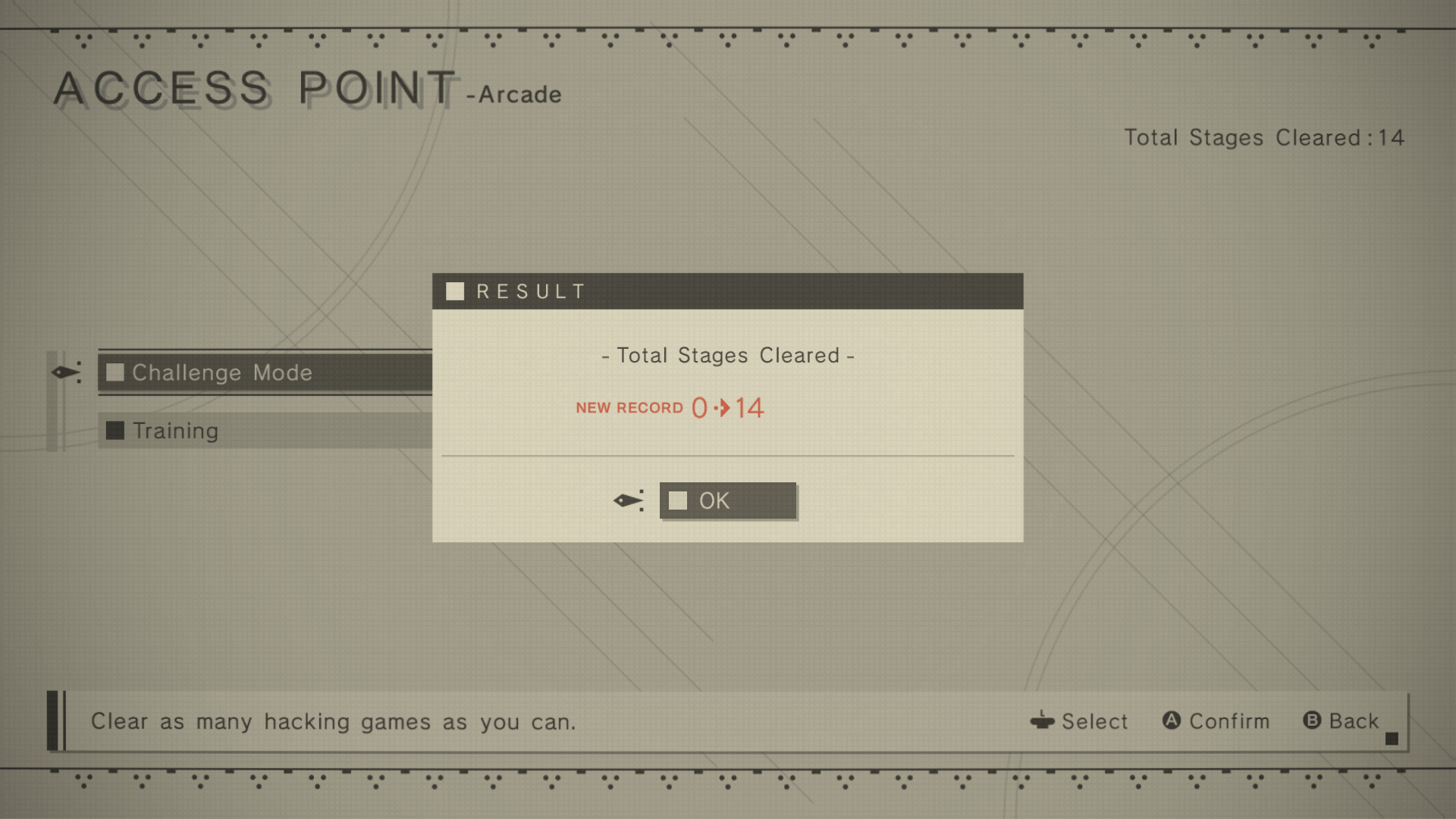 The hacking minigame, promoted to a standalone Arcade Mode at Access Points. The scoreboard format ("NEW RECORD 0 → 14") signals: this is a real game, not a transition device. Source: Game UI Database.
The Ending E credits use the same hacking shmum engine, but now the bullets are letters of the credits, fired at the player at increasing density. You shoot the credits to advance them.
This is one of the highest-leverage decisions in the game's design: build one good shmum, reuse it for hacking, for Arcade Mode, and for the final-final climax. Three uses for one system.
The Pod: a shooter inside the hack-and-slash
Even within standard combat, the Pod (a flying companion drone with a chain-gun, missile pod, or laser) gives 2B a permanent ranged attack. So default combat is already dual-genre: melee with the right hand, twin-stick shooter with the left.
This shows up as the Pod programs subsystem, separate from chips, with its own progression menu. Pod programs include long-cooldown specials (gravity well, decoy, 360° barrier) that function more like a MOBA ult than a shooter weapon.
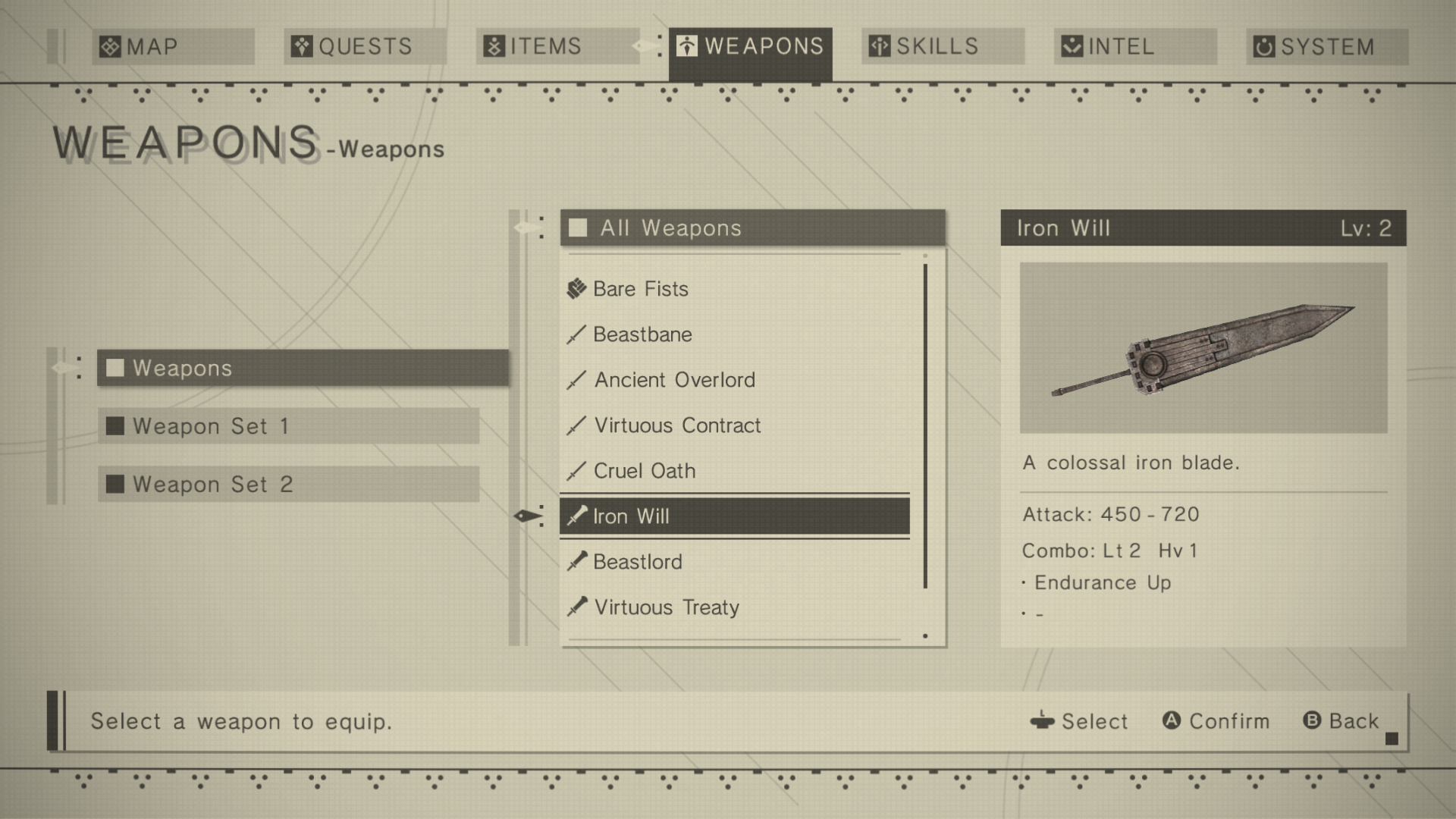 The whole skill system is two things: chips (the loadout) and Pod programs (the cooldown abilities). Two systems doing different jobs (passives vs actives) explicitly separated at the menu's top level. Source: Game UI Database.
What this teaches
- Camera angle is a verb-set hint. Before any tutorial pop-up, the camera tells the player what the controls do now. This is much faster than text.
- Genre-shift only works if the underlying input language stays consistent. 2B's controls in 2D are just the 3D controls projected onto a plane. The player doesn't relearn buttons; the camera relearns them for them.
- Build a transition device once, reuse it three ways. Automata's hacking minigame is mechanic, transition, and credits sequence. The shmum engine has higher ROI than any other PlatinumGames system.
- Rhetorical camera framing is essentially free. The 2D Bunker is the same 3D environment with a fixed camera. No new assets. Massive narrative payload.
Patterns this exemplifies
genre-shifting-camera: verbs change with camera framing, not menu select. Uncurated; Automata is the only entry currently using this.
Adjacent
- Mega Man Battle Network also blends two genres (action + card game), but in a fixed 6×3 grid: the inverse approach.