Class & Ouroboros (XC3)
XC3's signature systems. Every party member can master every class, and any two party members can interlink into a fusion form called an Ouroboros. The result is a combat system with more loadout permutations than any prior Xenoblade entry.
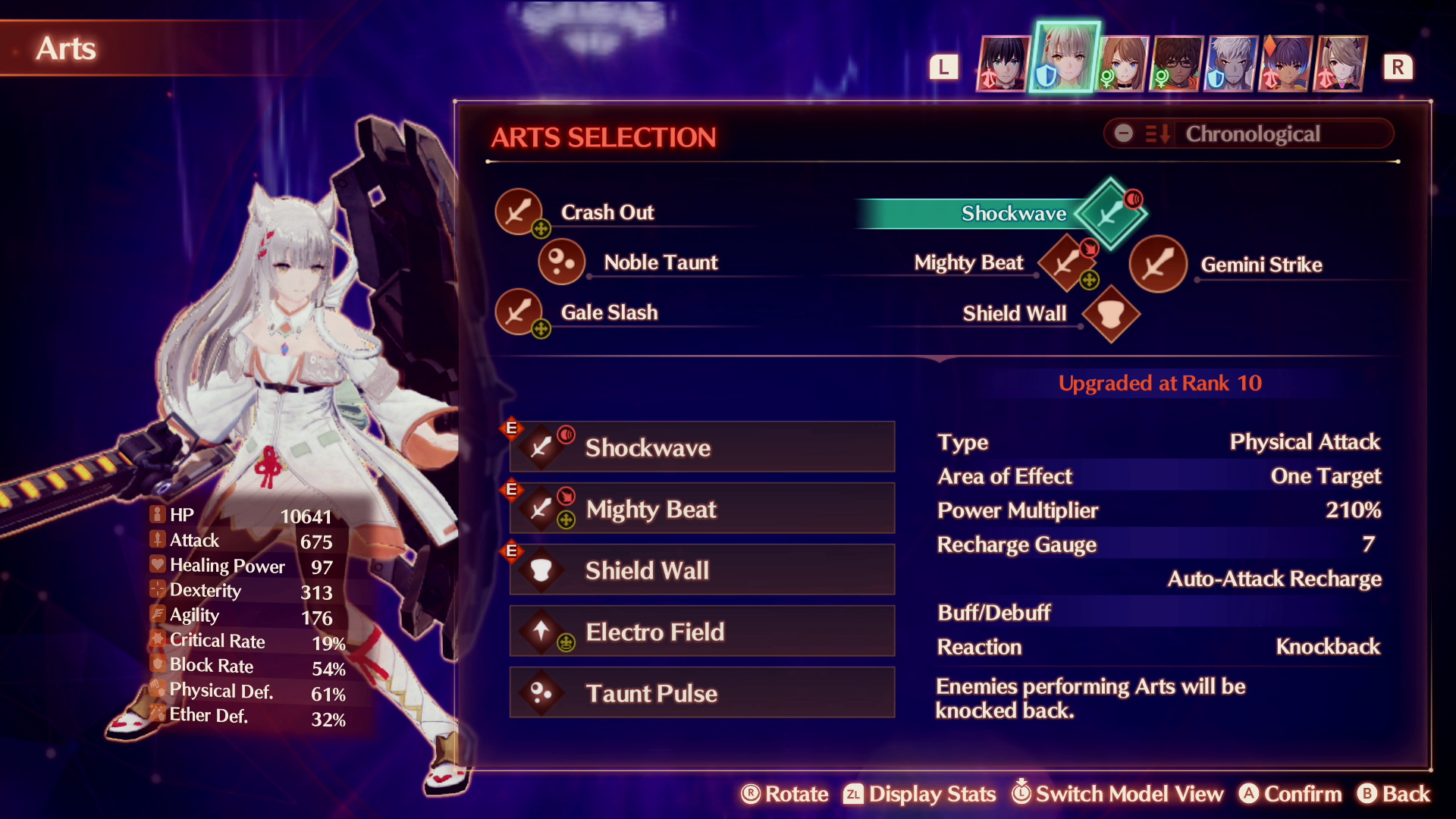 Noah's character screen: XC3's loadout in one view. Class: Swordfighter (Attacker, Rank 16). Arts: the 8-slot palette is what you actually pick from this class's pool. Skills, Gems, Accessories, Clothing are separate equipment axes. The left tabs (Class / Arts / Skills / Gems / Accessories / Clothing / Interlink) are the seven layers a player tunes per character, and any character can be any class once mastery unlocks via Hero Quests. Source: Game UI Database.
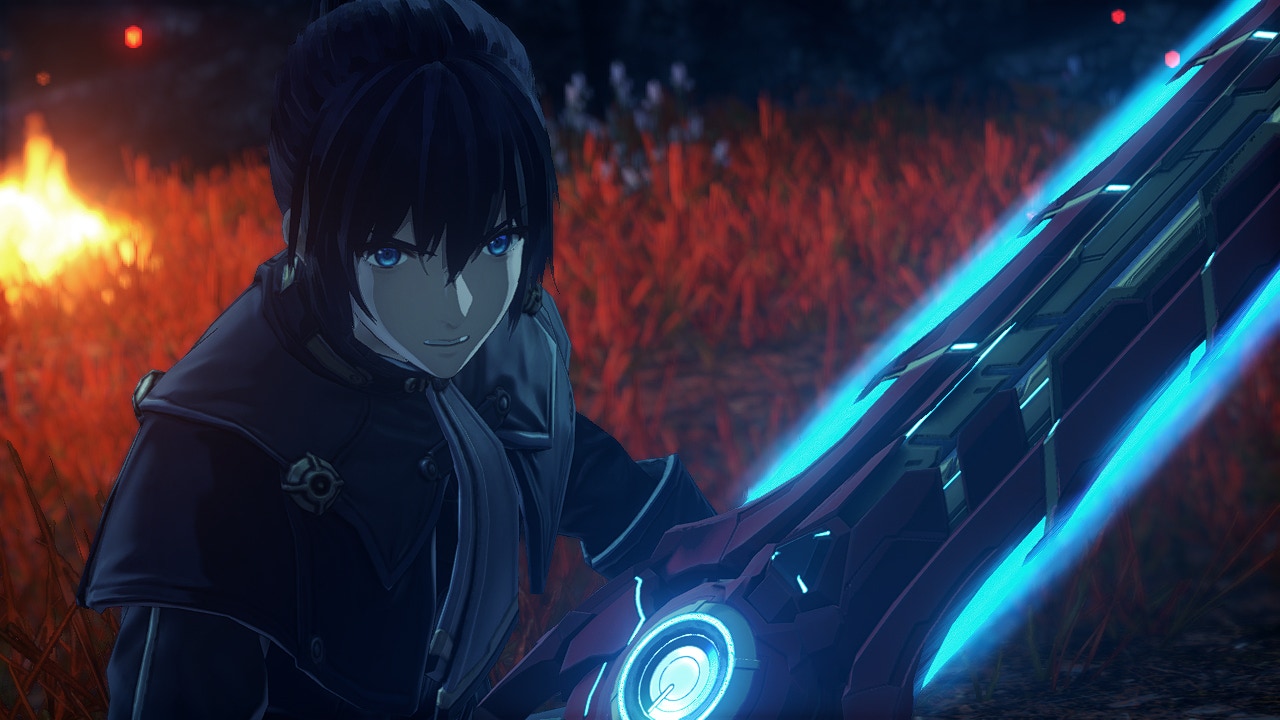 Noah, XC3's protagonist, with the Lucky Seven: the sword whose form changes in Ouroboros mode. Source: Eurogamer.
The class system
Six base party members. Each starts with a base class locked in (Noah is a Swordfighter, Mio a Zephyr, etc.). But over the course of the campaign, the party meets Heroes, NPC seventh members who join temporarily, and each Hero unlocks their class as a swappable option for the entire main party.
By endgame:
- ~20 classes available across the party.
- Any party member can equip any class they've inherited from a Hero quest.
- A class brings: arts palette, skills, role (Attacker / Tank / Healer), stat curve, fashion (the visual armor changes).
- Mastering a class on one character unlocks the option to equip its arts on a different class.
So the loadout decision is: pick a class for each character, pick which 3 arts of that class are active, and pick which arts from other mastered classes are slotted as the alt set. Combinatorially huge.
This is the most XC3-original system, XC1 and XC2 had fixed character roles; XC3 explodes them.
Ouroboros: the interlink
XC3 has six main party members (vs. 3 in XC1, 3 in XC2). They're paired into three duos. Each duo can interlink mid-combat into an Ouroboros:
- Two characters merge into one giant mech-form humanoid.
- The Ouroboros has its own dedicated arts palette (built from the duo's combined arts).
- It has a heat gauge: Ouroboros mode is time-limited.
- Triggering Ouroboros at the right moment is an offensive burst; using it defensively is a survival tool.
There are three Ouroboros pairings (Noah+Mio, Lanz+Sena, Eunie+Taion), each with a distinct mech-form and combat identity. Each pairing has its own Ouroboros tree of upgradeable abilities and a relationship-driven story arc.
Chain attacks: the heavy XC3 version
XC3 chain attacks are a multi-stage menu sequence:
- Pick which character starts (each has a different bonus).
- Pick a Tactic card from that character's deck (each tactic has a target multiplier and a hit count).
- Score points by clearing tactic targets: extending the chain or finishing it.
- The longer the chain extends, the more damage the final hit does.
The chain attack is the centerpiece of XC3's late-game combat. Bosses have ~5× more HP than they would in XC1. The intended encounter rhythm is survive 3–5 minutes of normal combat, then chain-attack for 60–90 seconds and delete a third of the boss's HP, then survive another 3 minutes.
This is also where XC3 reveals systems late: the chain-attack scoring rules, multi-character bonuses, hero-card interactions, and chain-extension multipliers are introduced over ~30 hours of campaign. A player at hour 10 sees chain attacks; a player at hour 40 has a different game.
Heroes and Hero Quests
The other layer XC3 layers on top of class. Throughout the campaign, the party meets 20+ Hero NPCs, each of which:
- Joins as a temporary 7th party member.
- Has a unique class.
- Has a personal Hero Quest revealing their backstory.
- Once their quest completes, their class unlocks for the main 6 to learn.
Heroes are how XC3 paces class introduction. You can't dump 20 classes on a player at hour 5; you drip them across 80 hours of campaign through encounter-driven hero arcs. Each new class is narratively earned before being mechanically equipped.
This is one of the cleanest examples of late-introduced-mechanics, using the campaign structure as a system-reveal pacing tool.
What XC3 borrows and adds
| System | Predecessor | XC3 evolution |
|---|---|---|
| Auto-attack + arts | XC1, XC2, XCX | Same shape, with class-swappable palettes |
| Break → Topple → Launch → Smash → Burst | XC2's | Inherited; combined with class-driven arts that own different chain steps |
| Chain attacks | All prior entries | Most elaborate version: full menu game inside combat |
| 6-character party | New | Doubles XC1/XC2's party-of-3 |
| Class system | New | The defining XC3 system; no direct precedent in series |
| Ouroboros (pair interlink) | New | Distantly related to XCX Skell mode (vehicle form), but mechanically distinct |
Patterns this exemplifies
loadout-as-budget: pick class (1 of ~20), pick 3 arts from that class, pick alt arts from another mastered class. Permutations explode.nested-progression-graph: main character XP + class mastery + Hero affinity + Ouroboros tree are 4 orthogonal axes.late-introduced-mechanics: Heroes as a 30+ hour drip of class options; chain attack rules unfold across the campaign.