Random perfect-roll economy
Lemma: Item identity is shaped by multiple independently-rolled stats. Most rolls are average; the joint distribution of "all stats are great" is astronomically rare. The rare instances become traded market commodities, per-item unique, expensive, identity-defining for the buyer's build.
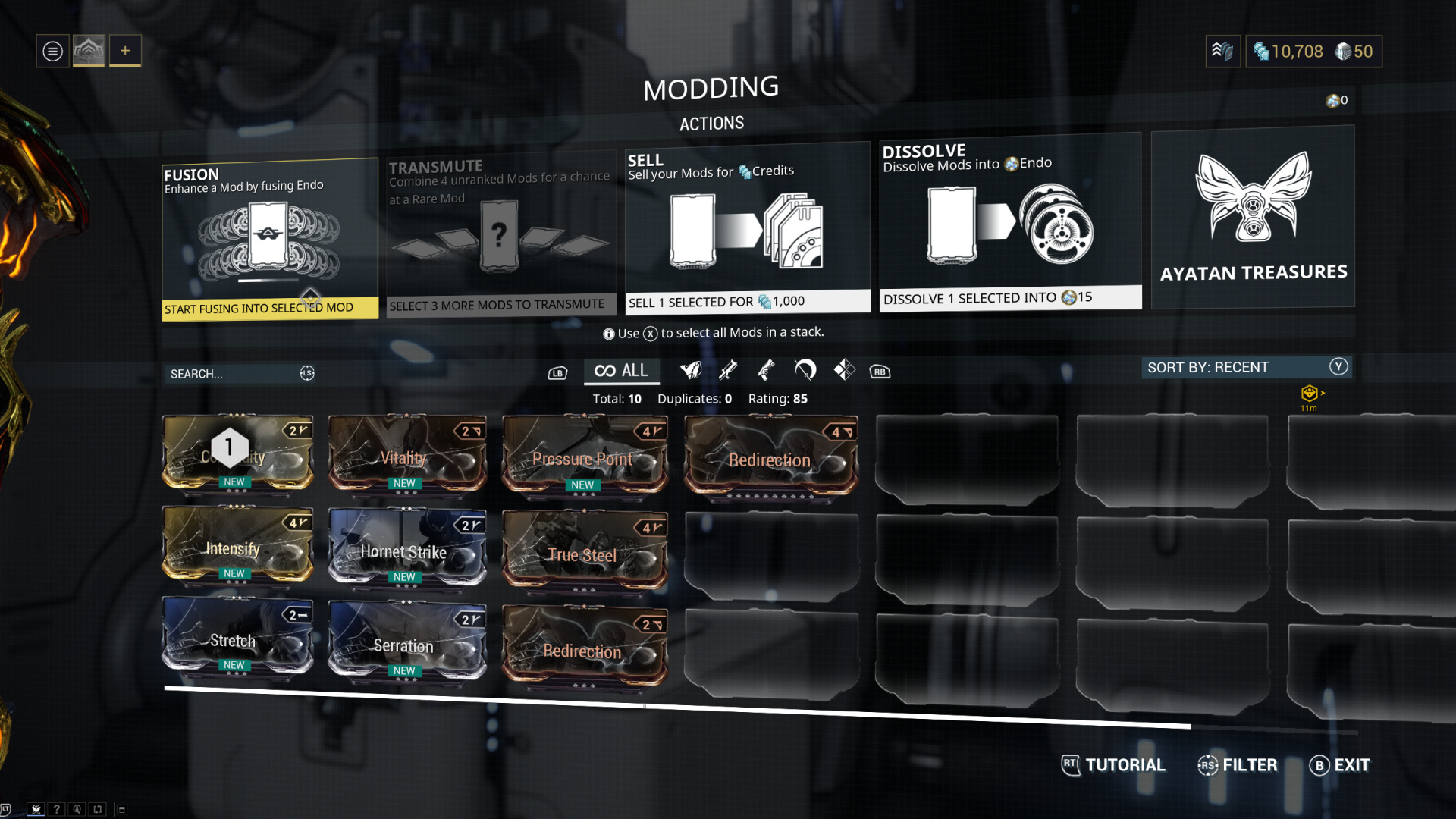 Warframe's mod detail screen: the Riven slot is one of these. Each Riven mod rolls 2–3 random positive stats and sometimes a random negative; perfect rolls become tradable market commodities denominated in Platinum. Source: Game UI Database.
What it solves
A flat "best item" design has nothing to chase past acquisition. You found the legendary; the legendary is the same as everyone else's; done.
Random perfect-roll economies break this by decoupling the item type from the item instance. Two players can both have a "Riven for Soma Prime" or a "rare amulet", but the joint roll on their stats means one is worthless and the other trades for thousands of dollars in market currency. The chase isn't the item, it's the roll.
This produces:
- Per-item uniqueness as economic depth. Every drop is potentially a small lottery ticket.
- Trade-economy texture. Players who don't farm can buy specific rolls; players who don't buy can chase specific rolls. The two sides need each other.
- Long-tail engagement. A player who already has a "fine" version of the item still has reason to look at every new drop, because the roll might be better than what they have.
Variants across games
| Game | The roll surface | Re-roll mechanic | Market position |
|---|---|---|---|
| Path of Exile (rare items) | Up to 6 affixes (3 prefix + 3 suffix), each rolled independently from a pool weighted by item base + level + tags. Each affix has a tier (T1–T7); T1 is intentionally rare. | Currency orbs (Chaos = re-roll all, Divine = re-roll values, Annulment = remove one, Exalted = add one). Each re-roll is a sink. | Mirror-tier items as the asymptote. Top-1% items trade for thousands of currency or get mirror-copied (one-shot duplication). |
| Path of Exile (skill-gem 6-link) | Sockets, colours, and links are all separately rolled on the gear. A 6-link is ~1/1500 attempts via Orb of Fusing. | Jeweller / Chromatic / Fusing orbs; Bench recipe caps the cost deterministically. | The 6-link is one of the cleanest "asymptote" rewards in F2P design: binary, expensive, identity-defining. |
| Warframe (Riven mods) | Riven attaches to a specific weapon class; carries 2–3 random positive stats and sometimes a random negative. Disposition multiplier shifts the magnitude per-quarter based on weapon usage. | Re-roll with Kuva (per-account farmable). Trade Rivens with other players for Platinum. | A "god-roll" Riven for a popular weapon trades for thousands of Platinum. Off-meta weapon Rivens float upward as Disposition rebalances quarterly. |
The shape is the same across all three: a base item type + a multi-axis roll + a market that prices the joint outcome. The variants differ in the re-roll cost (currency, Kuva, fusings) and in whether the rolls are tradable as the unit (Rivens are tradable; PoE rares are tradable; 6-links are gear-bound until you use a divine to manipulate the values).
When to use this pattern
- Long-running ARPGs / looters with active player-to-player trade.
- Games where item drops are the engine: every drop should be looked at, evaluated, and either kept, sold, or scrapped. The rolls are what make this evaluation non-trivial.
- Trade-economy games where currency-as-crafting + perfect-roll lottery compose: spend currency to re-roll, the rolled item has market value, the market value is denominated in the same currency.
Avoid when:
- Single-player closed-form games. The asymptote is wasted on a player who'll quit at the credits.
- Player base is too small to support trade. Without a market, perfect rolls are vanity for the lucky and frustration for everyone else. Warframe has hundreds of thousands of concurrent players; PoE has tens to hundreds of thousands. Below ~10k DAU the trade engine probably stalls.
Pitfalls
- Power gap between rolled and unrolled items. A god-roll Riven can be 5–10× the power of a base mod; this widens the gap between "no Riven" players and "good Riven" players in a way that affects co-op and competitive content.
- Trade dependency. If perfect rolls are the chase but trade is the only way to get them, players who don't trade are locked out of the top of the curve. Warframe and PoE both make trade technically possible but frictioned; the friction concentrates trade expertise in a subset of players.
- Re-roll cost calibration is brittle. Too cheap and everyone has perfect rolls (the asymptote collapses); too expensive and only whales reach the top. PoE's Kuva (Warframe re-roll currency) and Chaos (PoE re-roll currency) are explicitly tuned to keep the perfect-roll the work of weeks/months.
- Random-perfect-roll requires a second loop to absorb non-perfect rolls. Otherwise every non-god-roll drop is junk. PoE has currency-shard recipes; Warframe has endo-as-mod-currency. Without the absorber, the player drowns in chaff.
Adjacent patterns
aspirational-crafting: the upstream philosophy. Random perfect-roll only works if the asymptote is held in place; otherwise crafting collapses determinism into "everyone gets a god roll."currency-as-crafting: the natural pair. Re-rolls cost currency that has other uses; this is what makes each re-roll feel like a real opportunity cost.community-driven-balance: Warframe's Riven Disposition is the unique twist: the magnitude of the perfect roll floats based on weapon usage stats. Direct nerfs become disposition shifts; the market self-adjusts. PoE doesn't have an analog.
Why this matters as a design lesson
The economic depth of random-perfect-roll is multiplicative, not additive. A flat item has 1 dimension of value (rarity); a 6-affix random-roll item has up to 6+ independently rolled dimensions, and the joint distribution of "all great" is what's rare. That's exponentially more design space for free, in the sense that no new authoring is required to produce the variation.
The cost is a market that has to be designed around, an absorber loop for the chaff, and a re-roll cost calibrated within a narrow band. Cheap-to-author content; expensive-to-author systems.