Branching DAG map
Lemma: A directed acyclic graph of node types between start and end. The player picks a path from a partially visible graph at the start of a run and commits to a sequence of risks. Replaces "string of random encounters" with "chosen route through encounter types."
What it solves
The default roguelite shape is "random encounters in sequence." Hades' early prototypes worked that way; so did the original Moonlighter. The problem: each encounter feels like an independent dice roll, and the run feels like things happening to the player.
A branching DAG makes the run feel like the player chose its shape. Every node-choice is a small risk/reward call: take the elite for a relic, skip a rest to hit a shop, detour for the perk you need before the boss. The map turns "what's next?" into "what's my path?"
This is one of the most-imitated patterns in modern roguelites. Slay the Spire popularized it; Monster Train, Inscryption, Across the Obelisk, Wildfrost, Hades (in its softer way), Moonlighter 2 all use variants.
Variants across games
| Game | Map shape | Node types | What's revealed |
|---|---|---|---|
| Slay the Spire | Vertical DAG, 15 floors per act | Monster, Elite, Event, Shop, Rest, Treasure, Boss | Whole act visible from floor 1 |
| Moonlighter 2 | Horizontal DAG per biome | Chest, Event, Potion, Blacksmith, Recipe, Elite, Miniboss, Boss, Ice/Thunder Perk | Full biome path visible at start |
| Hades | Per-biome chamber DAG, one chamber visible ahead | Boon (per god), Hammer, Gold, Healing, Charon shop, Nectar, biome-specific currencies | Just the next chamber's reward (no whole-biome view); the player commits chamber-by-chamber |
| Cult of the Lamb | 2–4 fork DAG per mini-dungeon, ~12 node types | Combat, Mini-boss, Bishop, Tarot, Lore, Recruitment, Shop, Event, Prayer, Graveyard, Resource, Heart, Sacrifice door | 1–3 layers visible, between Spire's full-map and Hades' one-ahead view. Unique: a node type that takes a named follower from the other loop |
Visual contrast
Spire's map (DAG node graph) isn't yet captured locally; see the wiki.
| Moonlighter 2: Zephyr Fields biome map | Cult of the Lamb: mid-Crusade DAG |
|---|---|
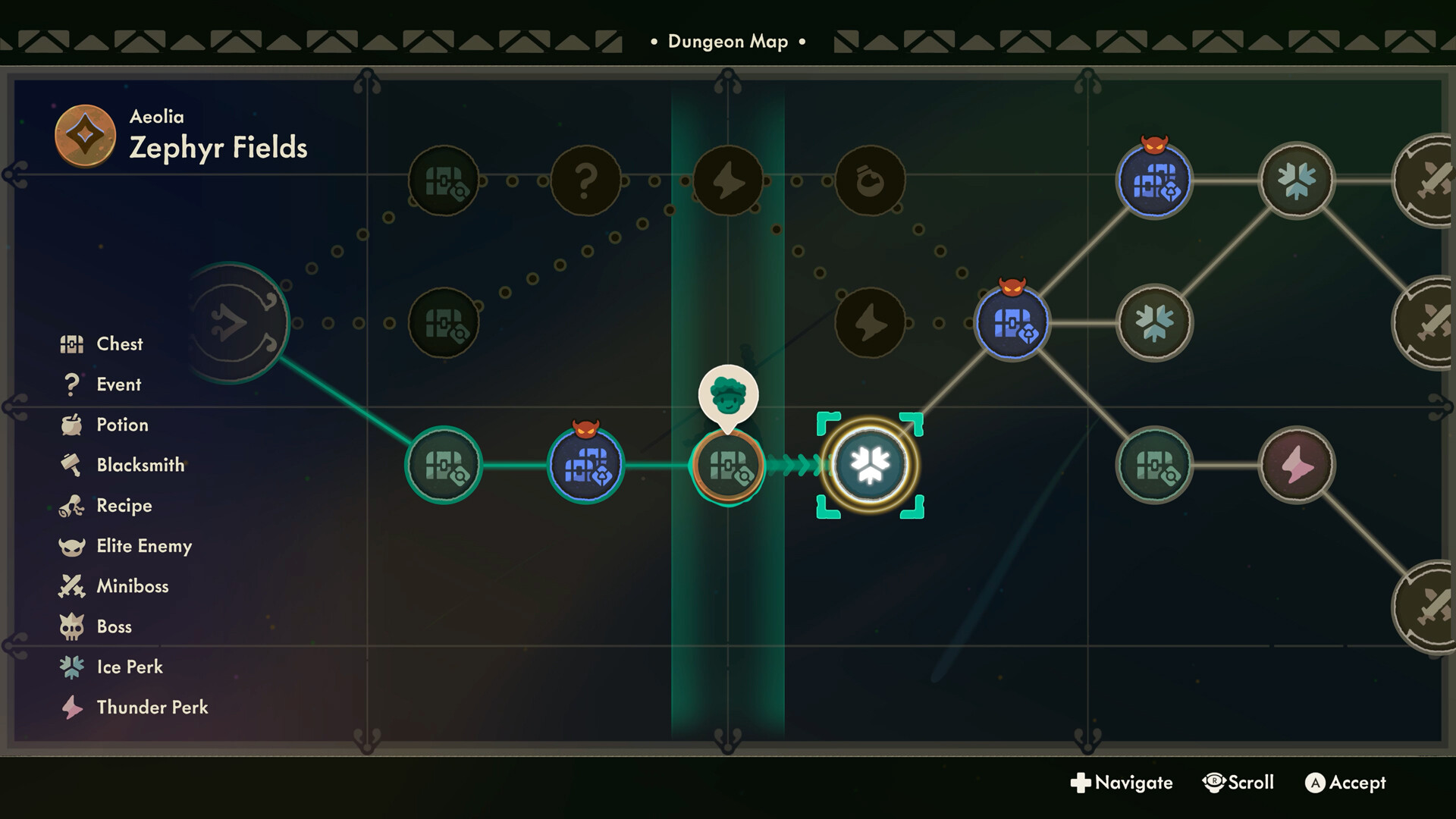 | 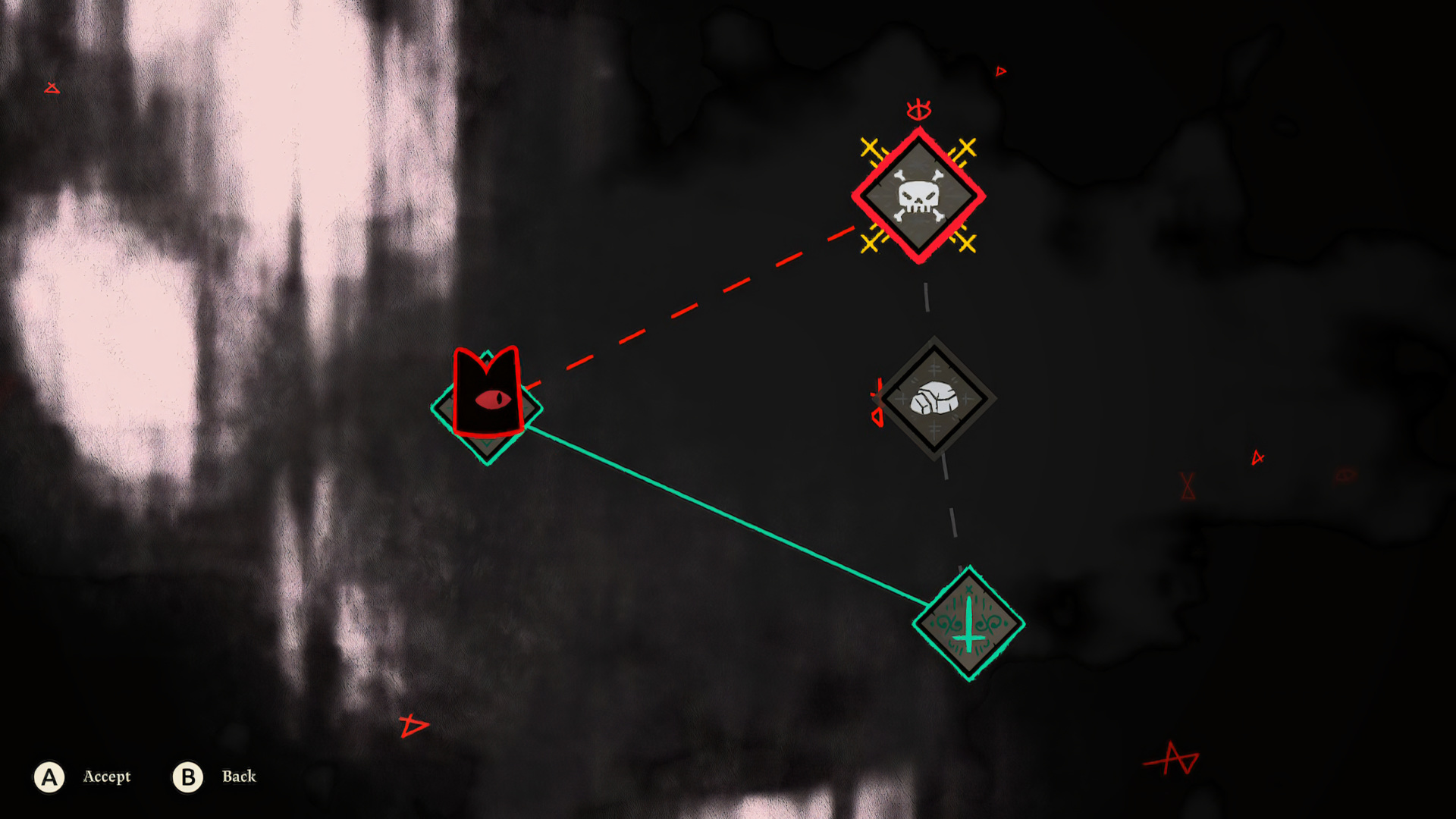 |
| Full DAG visible at the start of the descent. Legend (left) shows the node-type vocabulary. | Just the next 2–3 layers visible: between Hades' one-ahead and Spire's whole-act. Dashed-red = previewed branch, teal-solid = committed path, plain grey = available. |
Both games make the map a single screen, with all node types in a legend. The player plans the run shape before the first encounter.
When to use this pattern
- Any game with sequential encounters: turn-based, action, deckbuilder, even narrative.
- When you want player agency over the run shape without committing to per-encounter procedural generation.
- Genre-fusion games that need to give players a hook into the structure (Moonlighter 2 used the Hades-style map specifically to make the dungeon half feel "chosen" again).
Avoid when:
- The game is open-world or non-linear by design.
- Run length is short enough that route-planning doesn't pay off (~5 minutes or less).
Pitfalls
- All paths are equivalent: if the optimal route is "always take the rightmost path," the choice is illusory. Spire and Moonlighter 2 both use procedural variation in node placement to keep this from happening.
- One node type strictly dominates: if Elites are always worth taking, the DAG collapses to "find Elites." Cost-balance Elites with HP cost or relic-quality variance.
- Map too readable: if every run's optimal path is computable in 10 seconds, the puzzle is shallow. Random small variations (which Elite, which event resolves to what) reintroduce uncertainty.
- Map too noisy: if there's no signal, players just rush forward. Some node types should be obvious wins, some should be obvious traps, and the rest should be interesting trades.
- Forced backtracking: DAGs should mostly enforce forward motion. Allowing backtracking complicates UX and undermines the "this is your path" framing.
Adjacent patterns
handcrafted-pcg-hybrid: DAG maps are the canonical example of "hand-author the units, randomize the layout."bonus-with-drawback: node choices that lock in a build direction (Moonlighter 2's Ice vs. Thunder perk nodes; Spire's act bosses with their relic choices).