Psychonauts 2
A 3D platformer where the levels are people. Each mental world is one character's psychological condition built as playable space: a hospital that becomes a casino when you plant an idea in its owner, a cooking show that is really performance anxiety, a library that is really hoarding, a sensory-deprived brain that gets its senses back all at once and hands you a post-processing stack to prove it. Almost none of the level verbs repeat. It's in the knowledge base as the strongest argument on this site that theme can be the level-design brief, and that a game can spend its entire budget on non-reusable content and still be worth studying, because the process that produced it is documented on video, hour by hour, for 22 hours.
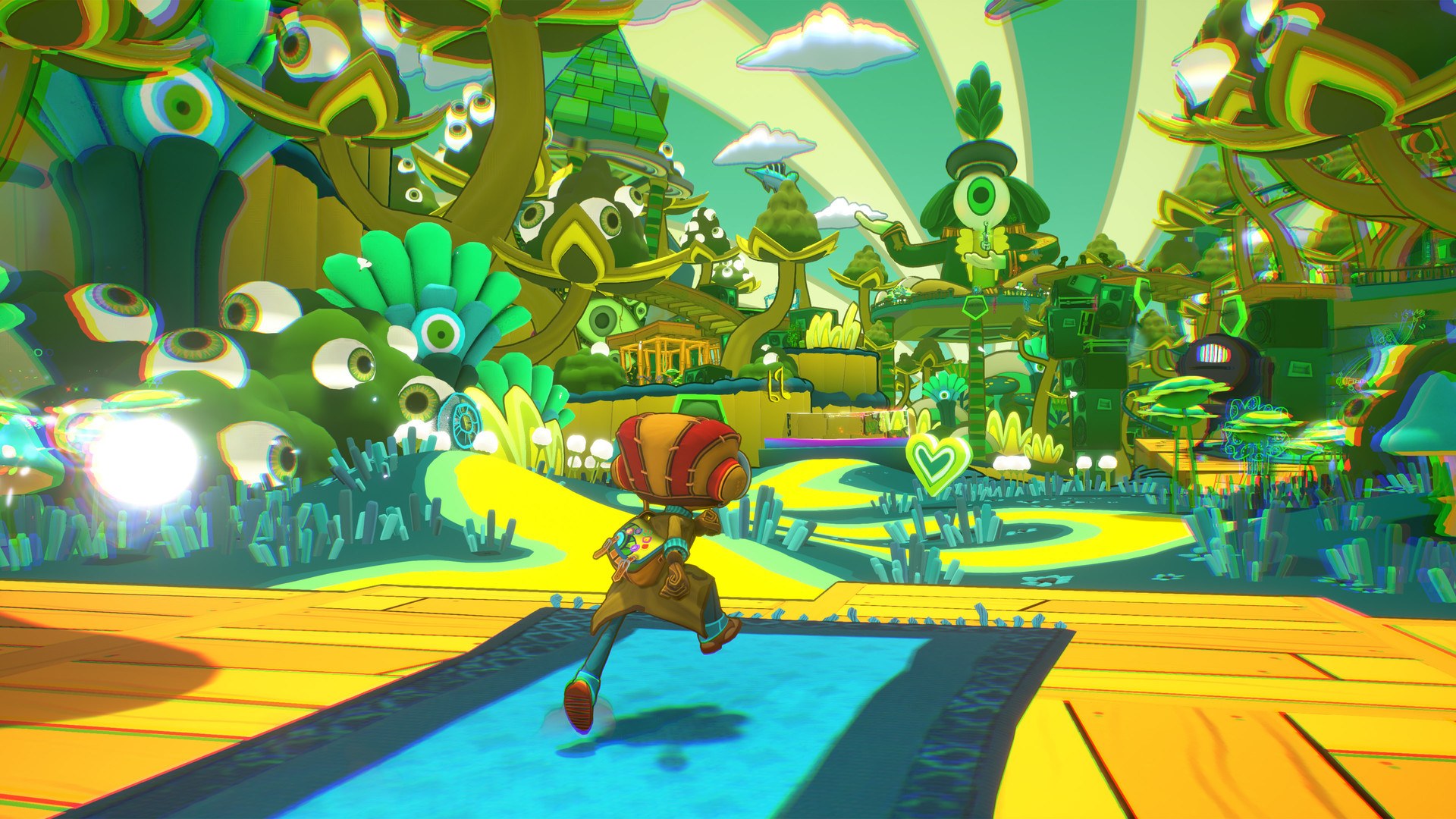 The PSI King's Sensorium. A brain that has been in a jar too long is given senses back all at once, and the level renders that as a full-screen chromatic-aberration split, eyeball flora, and a green-on-green palette that the team had to fight to keep readable. The visual effect is not decoration; it is the character's condition.
Snapshot
| Studio | Double Fine Productions (San Francisco) |
| Publisher | Xbox Game Studios |
| Released | August 25, 2021 (PC, PS4, Xbox One, Xbox Series, day-one Game Pass); Linux/macOS May 2022 |
| Engine | Unreal Engine 4, adopted to avoid the cost of custom engine development |
| Funding | Fig crowdfunding, $3,829,024 in Jan 2016; total budget est. $10–13.5M; Microsoft acquired Double Fine in June 2019 mid-development |
| Run length | ~15 h main story, ~25–30 h for rank 102 |
| Iconic mechanic | Mental worlds: one person's psychology as an entire level's art style, geometry, and mechanic |
| Core dialectic | Heal the level, don't clear it |
| Lineage | Psychonauts (2005), Psychonauts in the Rhombus of Ruin (2017, VR); picks up minutes after both |
| Reception | Metacritic 87–91 by platform (PC 89, Xbox One 91), GDC Best Narrative 2022, TGA 2021 GOTY nominee, 1.7M+ sold by April 2022 (Double Fine's best-seller) |
| Unusual asset | PsychOdyssey: 32 episodes, ~22 hours, of the entire development filmed by 2 Player Productions |
Macro loop
Real world hub (Motherlobe / Questionable Area / Green Needle Gulch)
  → talk to a Psychonaut who has a problem
    → enter their head (Collective Unconscious door, or a direct dive)
      → MENTAL WORLD = that person's condition as a place
        ├─ bespoke art style + shader stack (unique to this level)
        ├─ bespoke mechanic used here and mostly nowhere else
        │    (cooking timer / betting odds / sense-restoration / bottled memories)
        ├─ enemies that are named emotions (Censor, Doubt, Regret, Panic Attack, Enabler)
        └─ collectibles that are the person's psyche as objects
             Figments      = loose thoughts            → 100 = +1 Rank
             Emotional Baggage = a crying bag + its tag → 5 reunions = +1 Rank
             Memory Vault  = a repressed memory reel    → +1 Rank
             Half-A-Mind   = two halves = +1 health pip
             Nugget of Wisdom = an NPC's advice         → +1 Rank
      → resolve the person's issue: LEAVE THE LEVEL BETTER THAN YOU FOUND IT
    → back to hub, +1 Rank tier, +1 Intern Credit
  → spend: Intern Credits on power ranks (I → IV), Psitanium on Pins / health / capacity
  → equip: 4 of ~9 PSI powers at a time + 3 Pins
  → new power unlocks change what old levels are reachable in
The shape is Mario 64 (hub, doors, collectibles, ranks) with the collectible layer rewritten so that every pickup is a piece of a specific person's mind rather than a generic star.
Mechanic deep-dives
- Mental worlds as level design: the headline system. How a psychological condition becomes a brief, and why almost no verb repeats between levels.
- Visual language & shaders: per-level render identity. Painterly UE4, hand-drawn 2D VFX, and the levels where the post-process stack is the mechanic.
- PSI powers & the four-slot radial: ~9 powers, 4 equipped, 4 upgrade ranks each. The loadout budget, and the friction it caused.
- Traversal & movement feel: levitation ball, glide, Mental Connection grapple, and the forgiveness layer that makes the platforming land.
- Combat & enemies as emotions: Censors, Doubts, Regrets, Enablers, Panic Attacks. The weakest system, and why it still teaches something.
- Collectibles & the rank economy: Figments, Emotional Baggage, Memory Vaults, Half-A-Minds, Nuggets, Psitanium, Pins, rank 102.
- World structure & hubs: the Motherlobe, the Questionable Area, the Quarry, and the Collective Unconscious as a menu made of brain.
- Accessibility as a design surface: invincibility, no-fall-damage, Narrative Combat, and the decision not to touch achievements.
Through other lenses
- Ludonarrative reading: read through the resonance lens. Verdict: affirms, with one loud seam. The level is the person, the goal is repair rather than clearance, and the collectibles are the psyche. The seam is that a game about compulsion asks you to hoover up 1,300 figments.
What this game teaches
- Theme is a level-design brief, not a coat of paint. "Performance anxiety" produced a cooking-show timer, a multitask arena, and a panel of judges. The metaphor generated the mechanic; the mechanic wasn't dressed in the metaphor afterwards.
- Combine two nouns that don't belong together. Hospital + casino. Dentist + labyrinth. Nationalist rally + puppet theatre. Schafer's stated technique is collision, and it's cheap to run in a design meeting.
- A shader stack can be a character trait. Chromatic aberration, palette, and lighting per level do narrative work here that no dialogue line does. See visual language.
- Give the player a restorative goal. "Leave the level in better condition than you found it" is the opposite of the shooter default and it changes the meaning of every verb in the game.
- Assist toggles cost you nothing and buy you everyone. Invincibility, fall damage off, and Narrative Combat ship in the options menu with achievements fully intact. See accessibility.
- Non-reusable content is expensive and it shows in the schedule. This is also the cautionary half: see design tensions and lessons.
See lessons for the longer, more opinionated take.