World structure & hubs
Psychonauts 2 is a hub-and-spoke game in the Mario 64 lineage, with one twist that carries real weight: the hub is a workplace, and the level select is an organ.
The three real-world spaces
| Space | What it is | Function |
|---|---|---|
| The Motherlobe | Psychonauts HQ. A 1960s-modernist government facility built into a mountain | Main hub. Quests, NPCs, shops, the Collective Unconscious access point in Sasha's lab |
| The Quarry | The industrial Psitanium mine below the campus | Connective platforming space, secrets, side objectives |
| Green Needle Gulch / Questionable Area | A hippie commune and a roadside-attraction tourist trap | Second-half hub, and the game's densest optional-platforming playground |
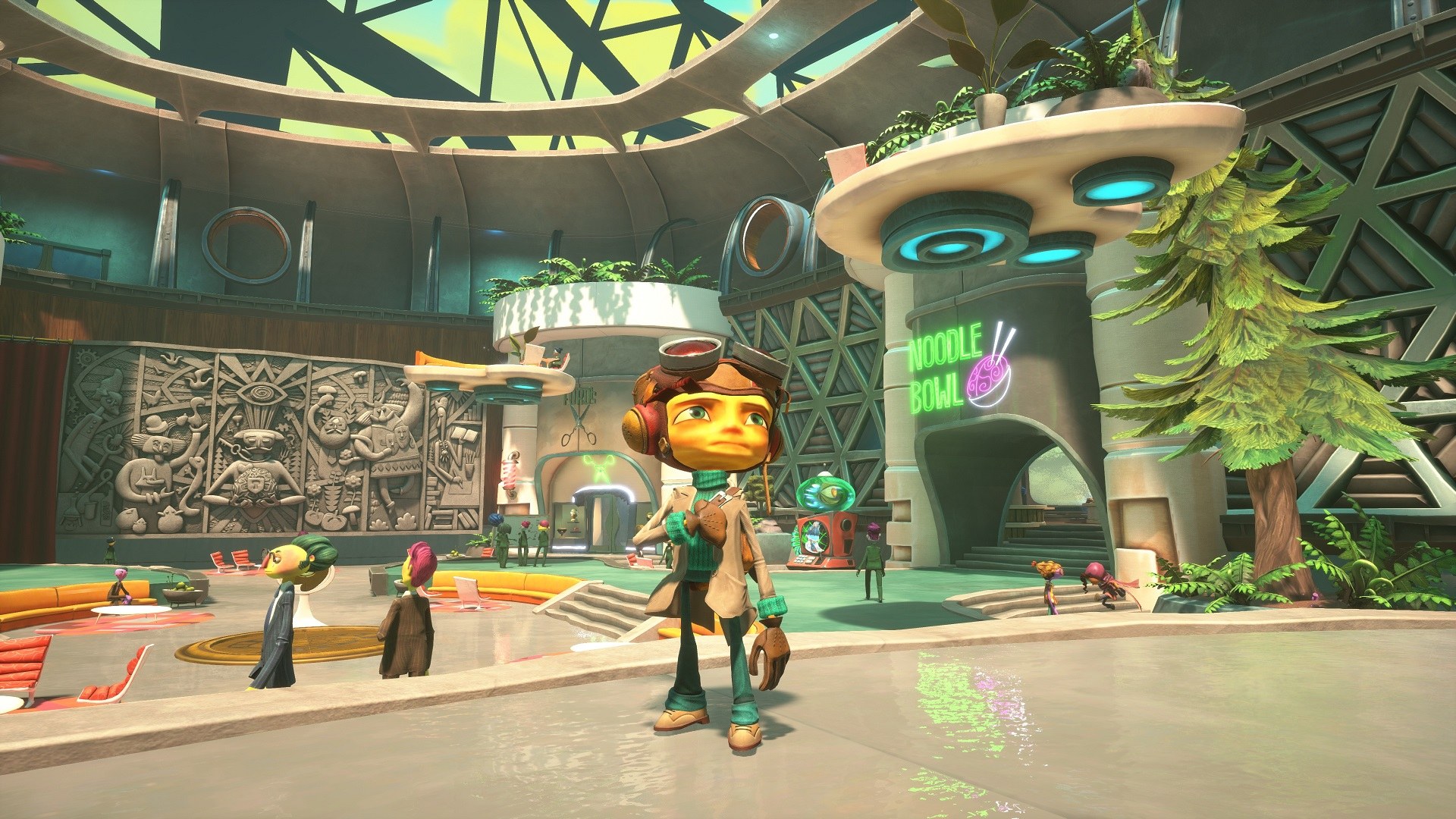 The Motherlobe lobby. It reads as an office building: reception, signage, a food counter, people at work with places to be. The carved relief on the left wall is the agency's own mythologised history, which the plot later takes apart.
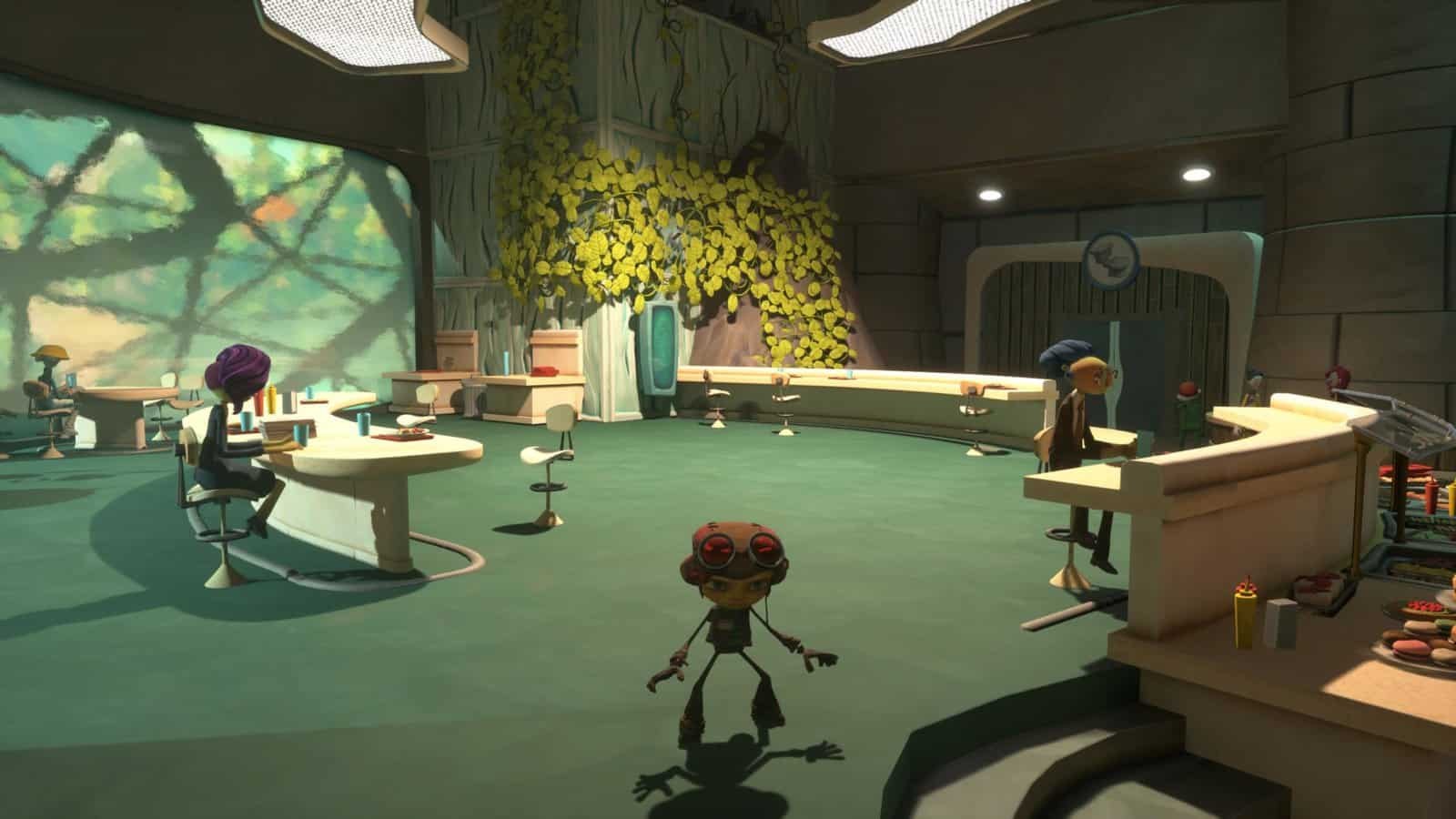 The commissary. Hub spaces here are functional rather than ornamental: a canteen with staff in it, a barber, a mail room. The world-building is done by giving the organisation the mundane infrastructure a real one would have.
The design point: the hub is a place people work, not a lobby with doors in it. Nearly every NPC has a job title, a grievance, and a side objective attached. Compare the Whispering Rock summer camp of the first game, which was a camp with campers. The Motherlobe is the same design idea aged up, and it does the narrative work of the sequel's premise (Raz has arrived at the institution he idolised, and it is a dysfunctional office) purely through level dressing.
The Questionable Area
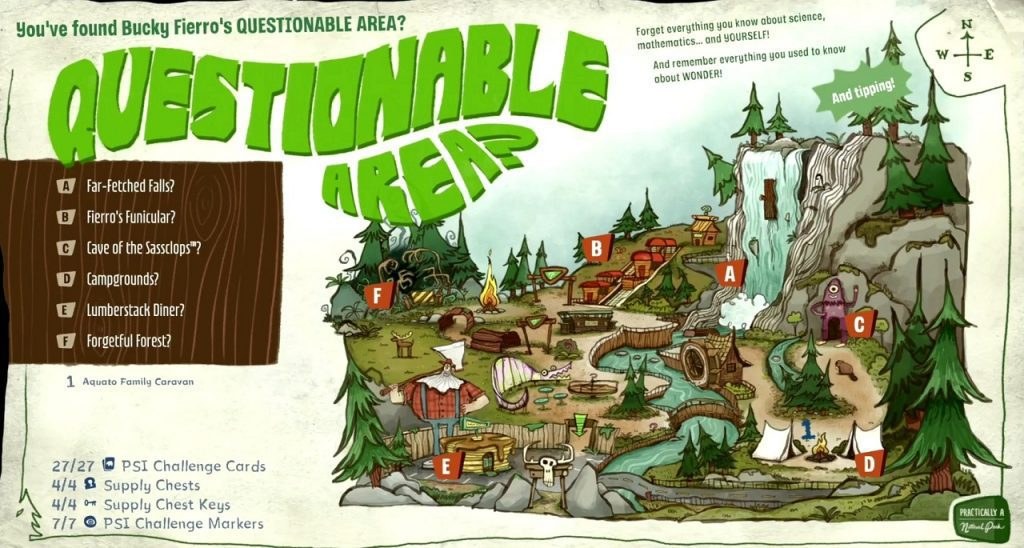 The area map is a roadside-attraction pamphlet, complete with sales copy: "Forget everything you know about science, mathematics... and YOURSELF! And remember everything you used to know about WONDER! (And tipping!)" The counters at the bottom left track PSI Challenge Cards, Supply Chests, Keys, and Markers.
The Questionable Area is the game's best-shaped optional space: a tightly bounded tourist trap of funiculars, caves, and campgrounds that reads as far larger than it is because it is dense with interactive gimmicks and vertical routing. It is the model for small-footprint optional content: rather than a large sparse zone, build a small area with more things stacked per square metre than anywhere else in the game.
The Collective Unconscious: a level select made of brain
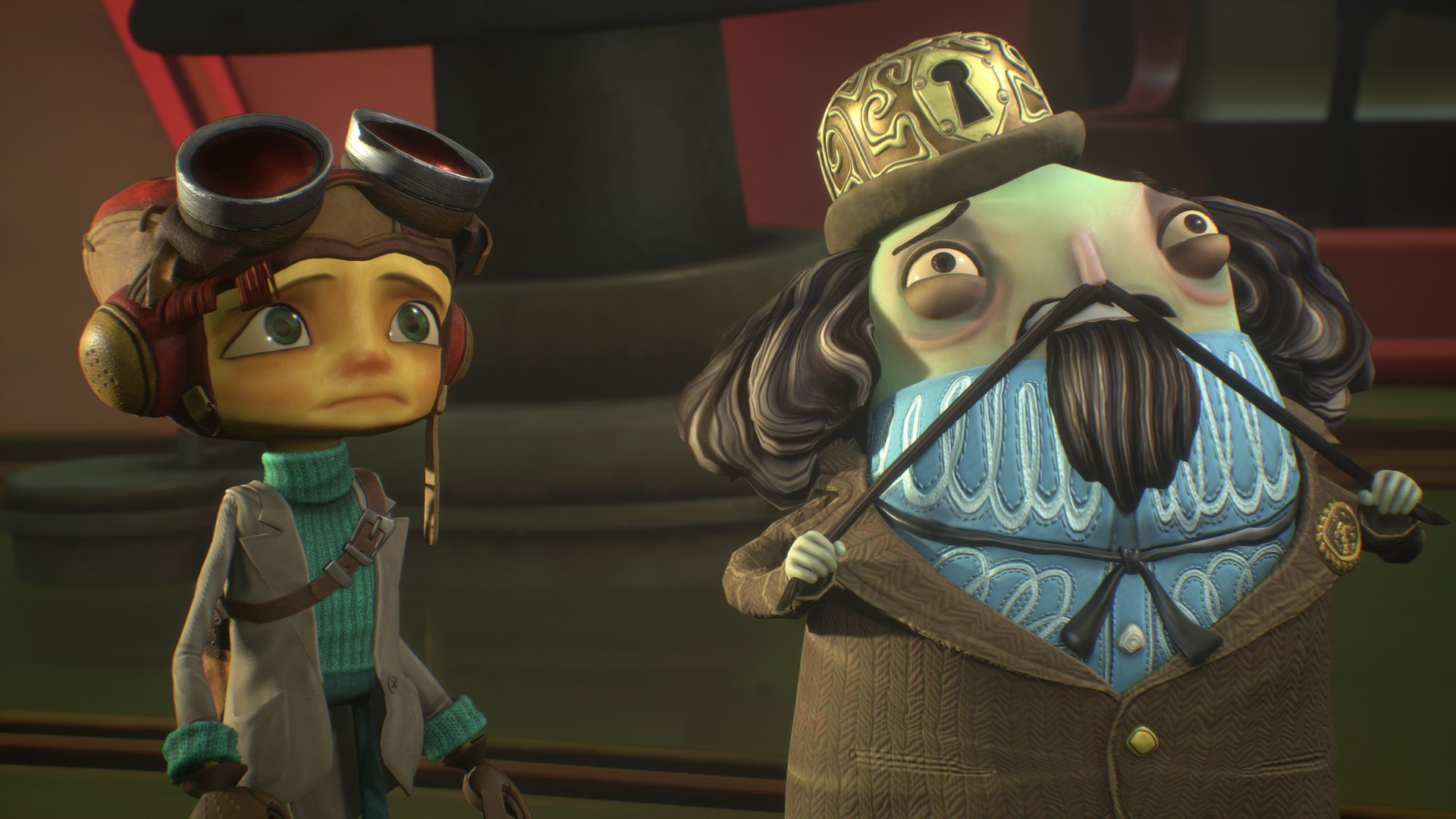 Access to a mind is a fictional act, not a menu action. Characters have to consent, be tricked, or be broken into, and the game stages each entry as a scene.
Mental worlds are entered in two ways:
- Directly, by Raz jumping into a person's head in a story moment.
- Through the Collective Unconscious, a hub-inside-the-hub reached from Sasha's lab: a giant floating brain with the doors to every visited mind orbiting it, reachable only by chaining Mental Connection grapples.
That second one is the neat piece. The level-select screen is:
- Diegetic (it's a place, not a menu),
- A traversal challenge (getting to a door is a small platforming problem),
- A callback (it is the giant floating brain from the first game's main menu, promoted from a background image to a playable space),
- And a thematic statement (all these minds are connected, and moving between them is a chain of associations).
For a small project the transferable version is: if you have a hub with doors, ask whether the act of reaching a door can be a small expression of the game's central verb.
Structural notes worth knowing
- A point of no return exists, and it is signposted. After it, the Motherlobe, Quarry, and Questionable Area close until the post-game, though the shop and all previously-visited mental worlds remain reachable through the Collective Unconscious. Free-roam returns after the credits, so 100% completion is never lost.
- New powers retroactively open old levels. Standard metroidvania-lite backtracking. Because most collectible types are per-level and tracked in the journal, the game tells you exactly which levels still owe you something.
- The real world is a mental world too, thematically. Raz's family arrive mid-game and the last act moves to the site of a historical disaster. The hub is not neutral ground by the end.
The narrative frame, briefly
Worth recording because the structure supports it. Raz joins the Psychonauts as an intern, uncovers a mole, and unravels why the founding generation of psychics fell apart. The reveal reframes the whole cast: Nona, the grandmother of Raz's family, is Lucrecia Mux, the missing seventh member of the Psychic Six, whose dissociated alter-ego Maligula drowned a country. Ford Cruller buried her identity using a machine called the Astralathe, altered the Aquato family's memories to accept her, hypnotised them into a fear of water, and then shattered his own mind on purpose so he could never reveal what he had done.
That last detail is why the structure works: Ford's Fractured Mind is a level made of four unrelated genre fragments because the character deliberately broke himself. The game's most formally unusual level exists because the plot required a mind in pieces. Story and level architecture were designed to need each other.
See the resonance reading for the full analysis.