Ludonarrative reading
Applying the resonance lens: describe the loop without the fiction; does it still read as a story about these characters?
Verdict: affirms, with one loud seam. Psychonauts 2 is one of the few games on this site where the level is the resonant unit rather than a mechanic. You cannot describe a Psychonauts 2 level fictionlessly, because the fiction is the level's geometry. The seam is the collectible economy, which is inherited from a different game and says something the rest of the design argues against.
The place is the person
Describe the structure without the fiction: you enter a discrete space whose layout, art style, enemy mix, and central mechanic all derive from a single named individual, resolve a problem inside it, and leave it in a better state than you found it.
That description is already a story about people. There is no translation step. Most games have to spend a cutscene establishing what a level means; here the meaning is the level's construction spec:
- Compton's Cookoff is performance anxiety, so it is a timed multitask arena with judges, and the pressure of the mechanic is the character's pressure.
- Hollis' Hot Streak is a hospital that becomes a casino because you planted the suggestion. Your action changed the level's rules and appearance, so the transformation is your consequence, not a set-piece.
- Ford's Fractured Mind is four sub-levels in four unrelated genres because the character deliberately shattered his own mind. The most formally strange level in the game exists because the plot needed a mind in pieces.
- Fatherland Follies is a propaganda puppet show, so the level literally narrates a lie while you play through it, and playing it means walking through someone's self-mythology.
Compare Nier: Automata, which makes the same "form mirrors theme" bet at the level of structure (routes, endings, the save file). Psychonauts 2 makes it at the level of place. It is the same design conviction working at a different scale.
The verb is repair, not clearance
The stated design rule: Raz should leave every level in better condition than he found it, framed by Schafer as the "complete opposite" of a shooter.
Fictionlessly: the win state of each space is that the space is improved. Bob's garden regrows. The PSI King gets a body. A crying suitcase stops crying. This inverts the default action-game grammar, where the player is an agent of entropy and a cleared level is an emptied one.
It also decides what you are allowed to fight. You never attack the person whose mind you are in. The enemies are named mental processes: Doubts, Regrets, Censors, Enablers. Punching a Regret is the game's model of confronting a regret, which is crude but not dishonest, and the roster is careful about where crudeness would be a problem. Bad Moods cannot be attacked at all; you have to find their cause. That single enemy rule does more thematic work than most games' entire scripts.
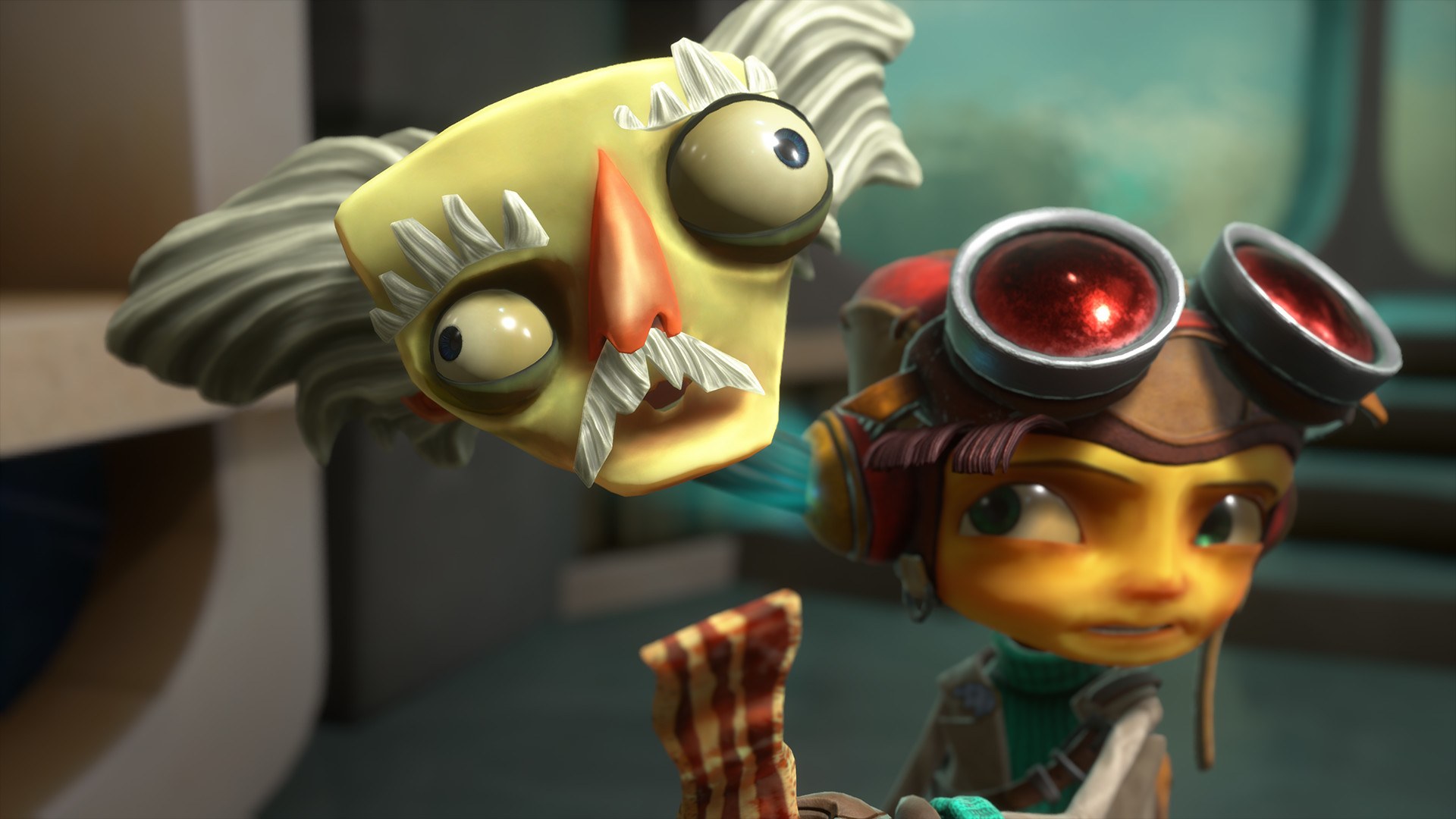 Ford Cruller: mentor, legend, and the man who broke his own mind on purpose to keep a secret. The game's structure and its central act of harm are the same object.
The collectible is the psyche
Six collectible types, six different things about a person:
- Figments are loose thoughts, drawn as flat 2D scribbles in 3D space, and they take the shape of whatever matters to whose head you're in.
- Memory Vaults are repressed memories, locked and spinning, that you break open to watch.
- Emotional Baggage is a crying bag whose lost tag is somewhere else in the level, and reuniting them stops the crying.
That last one is the strongest single instance of the lens on this page. The English idiom "emotional baggage" is rendered as an object that is literally heavy, that literally follows the person around, that literally cries, and that literally becomes bearable once you have identified what it belongs to. The player's verb, finding the tag that names the bag, is a serviceable model of a real therapeutic act. See collectibles & rank.
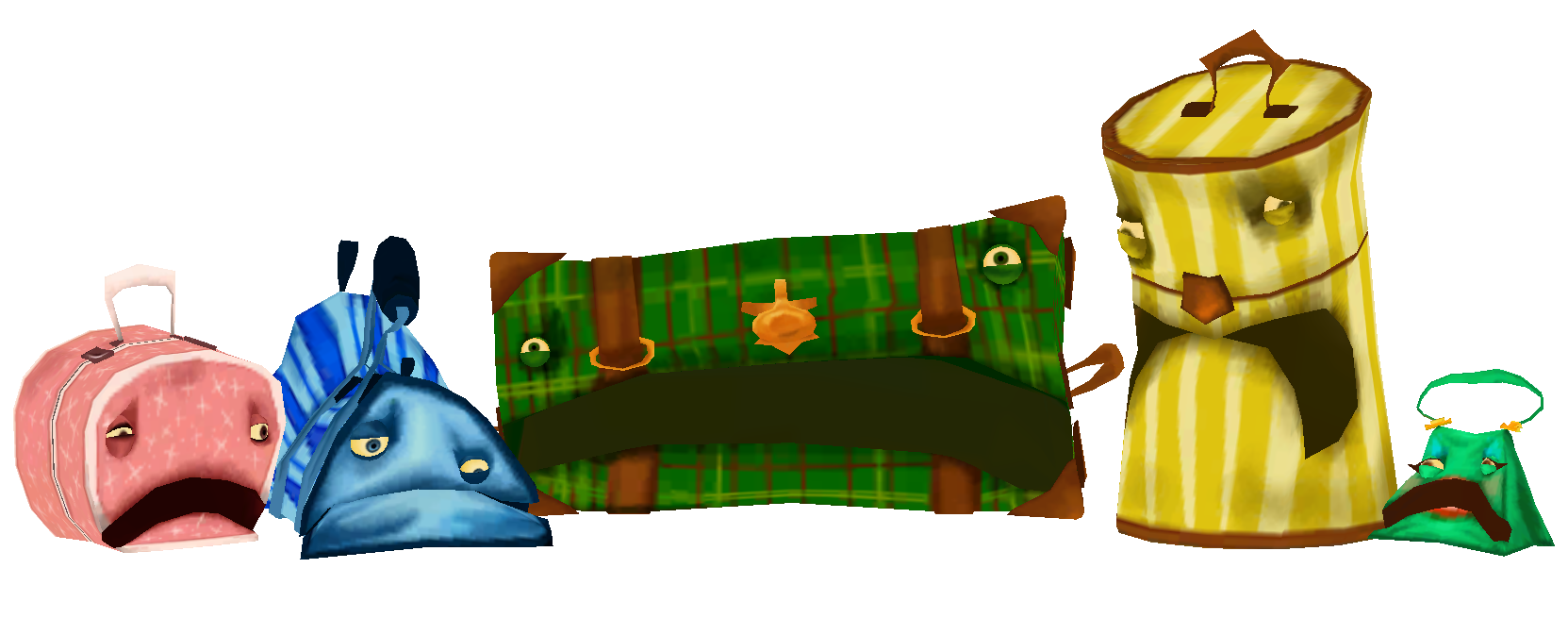 Five per world, nine worlds. Each is miserable until you find the tag that says whose it is.
The plot's central act is a mechanic the game already taught you
The reveal: Nona, the grandmother of Raz's family, is Lucrecia Mux, whose dissociated alter-ego drowned a country. Ford Cruller used a machine to bury her identity, rewrote the Aquato family's memories to accept her as one of their own, hypnotised them into a fear of water, and then shattered his own mind so he could never tell.
 Two people, one mind. The reveal is that the game's central act of villainy was performed by its mentor figure, using the exact verb the player has spent fifteen hours performing.
Note what that is, mechanically. Entering a mind and altering it is Raz's core verb. He does it in the tutorial. He does it to Hollis, on purpose, to make her more fun, and the level visibly rewrites itself as a result. Then the plot reveals that the same verb, applied by an adult with more power and better intentions, produced the game's foundational harm.
The game teaches you a power, lets you use it casually, and then shows you what it costs. That is resonance done as structure rather than as flavour, and it is why the twist lands as more than a soap-opera reveal.
The seam: a game about compulsion that asks you to compulsively collect
The honest failure. There are roughly 1,300 figments. Rank 102 requires 100% of everything. Cassie's Collection is a level about hoarding, and it sits inside a game whose completion loop is exhaustive accumulation of a person's every stray thought.
Reviewers caught it: "the omnipresence of collectibles is nonetheless questionable in a game that has a whole mission dedicated to the problems that can result from compulsive behaviour."
This is a genre inheritance problem, which is the most common source of dissonance in otherwise-resonant games. The collect-a-thon economy comes from the 2005 original and from the Mario 64 lineage before it. The subject matter comes from a 2021 conversation about mental health. At one point the two contradict, and the game does not notice.
The generalisable warning, and the reason this page exists: dissonance rarely comes from a bad decision. It comes from a decision that was correct in the genre you inherited and is no longer correct in the game you are actually making. Audit inherited systems against your theme, not just new ones.
Verdict
One line for the concept index: the level is the person, the win state is repair rather than clearance, and the plot's central crime is the player's own core verb turned on someone; the seam is a hoarding level inside a 1,300-collectible game.